


Welcome International Students & Scholars!
Congratulations! You have embarked on the exciting and challenging endeavor of coming to live in the United States while pursuing your education. Our offices are here to support you as you get used to life at UAlbany.
Learn more about UAlbany and about the Capital Region. You may also wish to review campus maps and directions.
Click a link below to skip to that section of the webpage:
- Traveling to UAlbany
- Housing
- Campus Resources
- Conduct & Safety
- Cultural & Community Resources
- U.S. Income Tax
- Additional Guidance (Emails, bank accounts, driving, mass transit)
Questions? Please contact the office you work with on campus for clarification:
Traveling to UAlbany
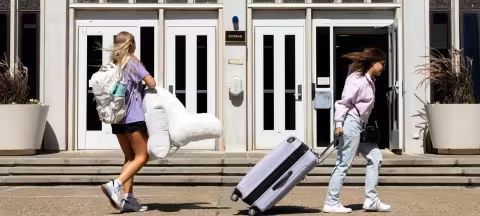
Students and scholars must arrange their own transportation to the University. UAlbany does not endorse any transportation provider and simply provides these resources for your convenience.
The address for UAlbany’s main campus, the Uptown Campus, is 1400 Washington Avenue, Albany, NY 12222. Download a campus map.
Students should visit the Obtain & Maintain Student Status page and New Student Checklist page, and scholars should visit the Visiting Scholar Program page, for detailed instructions on how to enter the U.S. once their visa is granted and what to expect at the port of entry.
traveling-to-UAlbany
Travel tips
- Before you leave, photocopy all your important documents, such as your passport, visa, I-20 or DS-2019, etc. Put copies in a different place such as your carry-on and checked luggage.
- For your safety and convenience, do not book a flight into the U.S. that arrives late at night.
- Never leave bags unattended or carry anything given to you by a stranger.
- While in an airport, train or bus terminal, ignore non-uniformed people offering to assist with baggage or transportation.
- Go to ground transportation information counters, bus stops and taxi dispatchers for safe and legitimate transportation.
- Always trust your instincts. If something doesn’t feel right, avoid it. Be aware of your surroundings at all times. Remain alert and focused.
- Have a valid payment method, such as a personal credit card, with you when you arrive.
- Before you leave, research whether eSim is available for your phone.
Air transportation to the U.S.
Many students choose to fly from their home country into a New York City airport and then take another flight to Albany International Airport (ALB) or another transportation option to Albany.
New York City has three major airports: John F. Kennedy International Airport (JFK), LaGuardia International Airport (LGA) and Newark Liberty International Airport (EWR) in New Jersey.
LaGuardia and Newark have non-stop connecting flights directly to Albany International Airport (ALB). JFK does not.
Chicago-O’Hare (ORD), Detroit Metropolitan (DTT), Atlanta (ATL) and other major international airports also have non-stop connecting flights to Albany.
Ground transportation from New York City airports to Albany
UAlbany does not endorse any specific transportation providers or routes and simply provides this information for your convenience.
By Shuttle
Premier Transportation Group’s Airport Shuttles offers shuttles from John F. Kennedy International Airport (JFK) and LaGuardia International Airport (LGA) to Albany International Airport (ALB).
Once you arrive at Albany International Airport, you can take a taxi or rideshare service (such as Uber or Lyft) to the University.
By Train
The JFK AirTrain and Newark AirTrain take passengers from those airports to New York Penn Station (NYP) in New York City.
Once you’re at Penn Station, you can take an Amtrak train to Albany-Rensselaer Station (ALB). From there, you can take a taxi or rideshare service (such as Uber or Lyft) to the University.
By Bus
Several bus companies offer direct connections between New York’s major airports and the Port Authority Bus Terminal in New York City.
Once you arrive at the Port Authority Bus Terminal, you can take a Greyhound bus, a MegaBus bus or a Trailways bus to Albany. Some buses stop at the downtown Albany bus terminal and some stop on UAlbany’s Uptown Campus.
Note: Some MegaBus buses depart from Hudson Yards, which is in a different part of Manhattan than the Port Authority Bus Terminal. Be sure which you are booking.
By Car
If you or a relative will be driving to Albany, we recommend:
- Ensuring the driver has a valid U.S. driver license or an eligible foreign driver license
- Reviewing these driving directions to UAlbany
- Plugging this address into Google Maps: 1400 Washington Avenue, Albany, NY 12222
Rideshare services in Albany
Once you arrive in Albany — whether at the airport, bus terminal or train station — you’ll need to take a taxi or a rideshare service to your temporary or Academic Year housing. Be sure to have that address handy.
Rideshare services include Uber and Lyft, which are both apps you can download on your phone. Once you create your account and add a payment method, you can request a ride to your preferred destination.
The Albany airport, bus terminal and train station are all about 15 minutes away from UAlbany’s Uptown Campus.
Access additional transportation options from the Albany International Airport. Note: To rent a car, you must have a valid U.S. driver license or an eligible foreign driver license.
Reimbursement for students
Undergraduate and graduate students may be eligible to receive a one-time, one-way reimbursement for transportation from the Albany airport, bus terminal or train station, or select hotels, to their Academic Year housing (whether on or off campus).
You must save the receipt from your taxi and/or rideshare service to be reimbursed, and you must sign up to receive reimbursement in advance.
Housing
Students and scholars are responsible for making their own housing arrangements, which includes applying for housing well in advance of their arrival date. Meal plans are available to students who live on or off campus.
If you need temporary housing while you are arriving in or leaving the United States, you may need to book a hotel. Explore hotels near the Uptown Campus. We recommend calling hotels before booking to see if they offer a discounted rate to UAlbany students.
Note: International students and scholars must notify ISSS of address changes within 10 days of moving to a new physical residence. Students should visit the Obtain & Maintain Student Status page and scholars should visit the Visiting Scholar Program page for more information.
housing
On-campus Housing
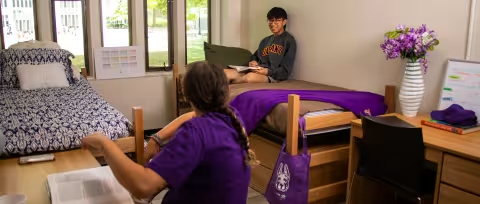
UAlbany offers on-campus housing every year you study at the University, with options ranging from traditional residence hall rooms to suites and apartments.
On-campus housing is fully furnished, comes with free laundry, internet and fitness facilities, and includes 24/7 access to Residential Life staff.
Visit the Residential Life website to explore housing options, room rates and sign-up information.
Note: On-campus housing is not available for J-1 visiting scholars.
Off-campus Housing
Note: Undergraduate students must have junior or senior class standing to live off campus. Learn more about UAlbany’s on-campus housing requirements.
ISSS and IELP do not make housing arrangements for students, but we offer this information to help you find the right fit for your needs.
General Guidance
Exercise caution before signing any lease agreement, which is legally binding. Read the lease in its entirety and make sure the housing is appropriate for your needs before signing.
Undergraduate students with questions or concerns about a lease can contact the Student Association’s Student Legal Services for assistance.
We recommend walking through a potential apartment or house and its neighborhood before signing a lease. Some international students opt for a short-term housing arrangement at first, so they can look for a more permanent off-campus rental once they have arrived in Albany.
UAlbany’s Off-campus Student Resources provides resources to students living off campus, including important advice for renting an apartment in Albany.
Students looking for a roommate or short-term housing can check out the Off-campus Housing Marketplace and/or the UAlbany International Students Facebook Group. Graduate students can also join the Graduate Student Association (GSA) Listserv.
Considerations to keep in mind
Location
Consider first where your classes are located. If you don’t have a car, choose a neighborhood that is close to bus lines or within walking distance. Use your UAlbany student ID to gain free access to mass transit.
For example, many students live in Albany’s Pine Hills neighborhood, which is centrally located next to the downtown campus and is heavily populated with landlords who rent to students. The area is also serviced by several CDTA bus lines that run directly to and from the UAlbany campus.
Lease Length
Leases are generally for one year, which can be convenient if you decide to go home for the summer yet still want somewhere to store your belongings.
If you don’t plan to stay for the summer and don’t want to pay rent during those months, you may consider subletting your place while you’re away. Not all landlords allow their tenants to sublet though, so take this into account when signing contacts.
Security Deposit
Most rentals require a deposit, which cannot exceed one month’s rent. When your lease ends, you’ll typically get this deposit back, minus any fees for damages. Be sure to get this agreement in writing.
The landlord must return the refundable part of the deposit within two weeks of the time you vacate an apartment. Deductions from the deposit must be itemized in writing.
Background Checks
Some rental applications might require a background check, which requires a social security number. If you do not have a social security number, ask your landlord/leasing company to see what other options you have. If you encounter problems, please contact ISSS or IELP.
Renters’ Insurance
The landlord’s property insurance policy usually does not cover your personal possessions inside your rental, so you should consider purchasing renters’ insurance to cover your personal belongings.
Renters’ insurance is usually inexpensive, ranging from $10 to $20 per month. You can get quotes online from different insurance companies for comparison.
Move-in Documentation
When you move in, always take photos of the rental’s condition and notify your landlord or leasing office in writing of any existing problem or damages. This can help protect you from being charged for any existing issues when you move out.
Repairs
If damage to the property occurs during the rental period, it is the landlord’s responsibility to fix/repair the damage.
If you request a repair but the issue goes unresolved, you can contact the City of Albany’s Division of Buildings & Regulatory Compliance for help ensuring the repairs are made in a prompt manner. Note: If you do not live in the city of Albany, please contact your local municipality instead.
Roommates and/or Housemates
Be mindful when selecting your roommates/housemates. Choose roommates who will fulfill their share of the rent. Establish a mutual agreement about quiet hours, guests, groceries, cleaning, etc.
What to Ask
You may want to ask the landlord or leasing office about the following items before signing a lease:
- Residential Occupancy Permit (ROP): Every property in the City of Albany that is being rented must have a valid ROP. An ROP certifies that the property has been inspected and is up to code. If the landlord is unaware when the last time the property was inspected you can call the Division of Building & Regulatory Compliance to check to see if the apartment has a valid ROP. If the apartment does not have a valid Residential Occupancy Permit we would strongly suggest not renting from this landlord.
- Utilities: Ask if the utilities are included in the rental price. If not, ask your landlords or other tenants in the building about the average monthly cost of utilities. Utilities include water, electricity, internet/Wi-Fi, TV cable and heating, etc. Below are some links for utility companies in the area:
- Electric & Gas: National Grid, PSEG, NYSEG
- Internet & TV: Spectrum, DISH, DIRECTV, Verizon FIOS
- Major Appliances: Most apartments include a stove, oven and refrigerator, but always confirm this with the landlord/leasing office. Ask if a microwave is provided.
- Furnished/unfurnished: Most off-campus housing is rented without furniture, but furnished housing is also available.
- Parking: If you plan to share the rental with other people, ask about the number of parking spaces available. Rentals often only offer street parking, which means that you are not guaranteed parking in front of your rental. Apartments that offer a parking lot will sometimes be more expensive or charge an extra parking fee.
- Laundry: If a washing machine and dryer are not included in the unit, ask about the nearby laundromat options.
- Pets: If you plan to have a pet, check the policy with the landlord/leasing company in advance. Note: Tenants with disabilities are allowed to have service animals and tenants with a chronic mental illness are permitted to have emotional assistance animals, regardless of a no-pet clause in their lease.
Other Tips
- Plan ahead and start early. Apartments rent can quickly as the academic year start date approaches.
- Talk to other students who are currently living off campus. You may be not familiar with the local area, so talk to American peers who might know the area better to find out their neighborhoods and their experiences.
- View the apartment in person before signing the lease. A lease is a binding contract and once you sign it can be very hard to get out of, so you want to be 100% sure that this is the right place for you.
- If you can’t view the apartment yourself, ask someone you trust to view the apartment and take a video, so you can see the entire property, not just what’s pictured online.
- If you don’t know anyone in the area, ask the landlord for as many updated pictures as possible so you can make an informed decision.
- Figure out the mass transit. Take the time to ride the bus to campus from the bus stop to figure out the exact time you need to get to the campus.
- Talk to other tenants in the building to find out more information about the neighborhood.
Additional Resources
Homestay
Live off campus with a local family, experiencing American home life and culture. Visit the OvECS Ltd. homestay company website to learn more about homestays and how to sign up.

Campus Resources
A wide range of campus offices exist to provide the support you need to succeed at UAlbany. For more information, review UAbany Guidebook — your guide to campus departments and units.
campus-resources
Academic Support
Campus Technology: Review Information Technology Services’ Student Guide to Technology at UAlbany to activate your UAlbany account, connect to campus WiFi, access email, Brightspace and other important platforms, and more.
Tutoring: Access free peer and online tutoring options in a variety of subjects.
Faculty Office Hours: Instructors are required to have weekly office hours, which are typically listed in your course syllabus. Office hours are a great time to meet with your instructor to ask any questions you have about the course material.
University Libraries: The University Libraries offer study spaces, workshops on research, writing and citation, course materials, databases, and more. Subject librarians can provide research help for your field of study.
GPA Calculator: This tool from Academic Advising allows undergraduate students to calculate their grade point average (GPA).
Disability Access & Inclusion Student Services (DAISS): Students with disabilities can request academic, housing, parking and other accommodations from DAISS.
Career & Professional Development: Meet with a career counselor to explore career options, internships and jobs, work on your resume and/or practice your interviewing skills.
Minerva Center for High-Impact Practices: The Minerva Center manages experiential learning opportunities for undergraduate students, including for-credit internships and research.
Community and Public Service Program: Volunteer for your new community and earn credit at the same time as an undergraduate student.
English Proficiency & Language Help
International students must provide proof of their English language proficiency before being admitted to an academic degree program at UAlbany. However, it’s common for students to face challenges as they adjust to English-speaking classrooms and culture.
Use these resources for additional support with writing, speaking and reading in English.
UAlbany Resources
- Tutoring: Access free peer and online tutoring options in a variety of subjects.
- University Libraries: The University Libraries offer study spaces, workshops on research, writing and citation, course materials, databases, and more. Subject librarians can provide research help for your field of study.
- Courses: UAlbany offers several courses that help undergraduate and graduate international students succeed academically. Visit the Schedule of Classes to find current offerings. Register for classes.
- Graduate Students: ETAP 500: Academic Writing for English as a Second Language
- Undergraduate Students:
- UUNI 100: The Freshman Year Experience (Note: Look for sections of this course that are intended for international students only.)
- UUNI 110: Writing and Critical Inquiry (Note: Look for sections of this course that are intended for international students only.)
- There are Two Languages in my Head webinar: Watch this video, made by a UAlbany PhD student, to learn how to write and communicate well as someone who speaks two or more languages.
- Basics of Writing in an American Classroom webinar: Watch this video to learn about academic writing expectations in the United States.
Additional Resources
- Purdue University Online Writing Lab (OWL): The Purdue OWL website offers a diverse range of resources and tips for student writers.
- Grammarly: This online tool functions like a spell checker but will also check your writing for grammatical mistakes, word choice and plagiarism. The basic service is available for free.
- BibMe: This online writing resource can help you check your grammar, create citations and avoid plagiarism.
- How to read a book: This article by a University of Michigan professor provides tips on how to read books, articles and other documents for class.
Health & Well-being
Medical Resources: Student Health Services (SHS) provides compassionate and inclusive healthcare to all registered UAlbany students. Most services are covered by tuition and fees.
Mental Health Resources: In the United States, visiting a counselor, therapist, psychologist or psychiatrist is widely accepted if a person is dealing with a mental health issue. Explore the free mental health services and resources available to UAlbany students.
Health Promotion Resources: The Office of Health Promotion offers wellness coaching, sexual violence survivor support and advocacy, and more.
Virtual Resources: TimelyCare is a virtual platform that provides 24/7 access to medical and mental health services to currently enrolled UAlbany students.
Basic Needs: Supplemental Support Services responds to reports of concern for UAlbany students, administers the campus food pantry and professional clothing closet, and manages emergency grant funds.
Disability Resources: Students with disabilities can request academic, housing, parking and other accommodations from Disability Access & Inclusion Student Services (DAISS).
Fitness: Recreation & Wellness offers a variety of facilities and programs, including club/intramural sports, group exercise classes and fitness centers.
Insurance: UAlbany provides an international health insurance plan that offers comprehensive medical insurance for accidents and illness, plus medical/security evacuation and repatriation coverage. The plan is required for all international students and scholars, with few exceptions.
Student Life
Student Organizations: Joining a student organization is a great way to get involved, meet new people and understand both yourself and your campus better.
Recreation: Join a club/intramural sports team, take group exercise classes and use the University’s fitness centers.
Athletics: UAlbany has a Division 1 (D1) athletics program, which is the highest level of college sports. Only certain sports require a ticket to attend, and undergraduate students can attend all regular season sporting events for free — just be sure to claim your ticket before each event!
Events: Explore upcoming campus events to learn more about campus and connect with other students.
Resource Centers: Access support, resources and community through the Women's Resource Center, Multicultural Resource Center, Interfaith Center and Gender & Sexuality Resource Center.
Student Finances
Cost of Attendance
International students pursuing a degree at UAlbany should review the tuition and fees for international students. Please also be aware of your financial liability for dropping courses or withdrawing.
IELP students should review IELP’s rates.
Paying your bill
Visit the Billing & Accounts webpage on the Cost & Aid website for information on:
- Using E-Pay and other official payment methods to pay your bill
- Enrolling in a payment plan that spreads your payments into installments
- Allowing your parent, guardian or another trusted person to view and pay your student account balance, as well as access tax documents
Scholarships for degree-seeking students
Consider applying for scholarships from the University at Albany Foundation and Alumni Association, as well as outside scholarships. Visit the Office of Financial Aid’s Scholarships webpage for more information.
Graduate students should also review the Graduate School’s Funding Graduate Studies page for information on graduate scholarships, assistantships and fellowships.
Harvard University’s Graduate School of Education also publishes a list of external funding sources for international students.
On-campus employment
Undergraduate students can apply for student assistantships on campus, while graduate students can apply for graduate assistantships and/or teaching assistantships on campus.
Visit the International Student Employment page for detailed information about working or interning while studying on a student visa.
Private student loans
F-1 and J-1 students are not eligible to complete a Free Application for Federal Student Aid (FAFSA) or receive federal student loans, but they can apply for private student loans if they choose.
Loans through private companies often require a U.S. citizen or permanent resident co-signer. These loans typically are subject to higher interest rates.
Learn more about private student loans from the Office of Financial Aid.
You can also use these sources to understand and find private international student loans (Note: The following source are not endorsed by the University and are listed simply for your convenience.):
- International Student Loans, InternationalStudent.com
- International Student Loans, NerdWallet
- Education Loans for International Students, MPower
- Student Loans, Sallie Mae
Your local bank or credit union in the U.S. may also offer educational loans.
However, before taking out a private loan, please carefully consider these important factors:
- Loan Repayment Terms: Depending on the interest rates and the repayment period of your loan, your monthly loan payments may be relatively high in your estimation. Additionally, payments could begin immediately upon disbursement, which may place financial strain on your budget. Please review the terms of your loan carefully to ensure you’re prepared for the financial commitment.
- Loan Disbursement Delays and Individual Need Adjustments for Private Loans requiring University certification: In accordance with federal loan regulations and the UAlbany Office of Financial Aid’s procedures, the disbursement of private loans, including coverage for living expenses, may be subject to a required waiting period of up to several weeks. Additionally, the amount of the loan disbursed may vary based on your individual cost of attendance and demonstrated financial need as ultimately determined by the Office of Financial Aid. Please be aware that your disbursement amount may differ from other international students’ amount, depending on your unique financial circumstances.
If you eventually decide to accept a private loan offer, you should be prepared to have one to three months of liquid funds (cash) for personal/living expenses until you receive your loan disbursement.
Additionally, if the cost of attendance and demonstrated financial need calculations differ between the UAlbany Office of Financial Aid and your private lender, you may need to adjust your monthly budget of living expenses accordingly. You are strongly encouraged to consult with a financial advisor and the Office of Financial Aid before committing to any private loan to ensure that you fully understand the terms and financial obligations involved.
Additional information
Conduct & Safety
The University wants to ensure that all students have a positive, productive and safe experience while at UAlbany. For this reason, we hold all members of our community to a high level of conduct and responsibility.
Please review and familiarize yourself with the information about your rights, student conduct expectations and student safety guidance.
You may find some of these terms unfamiliar. If you don't understand something, you should ask ISSS, IELP or other campus offices for clarity.
conduct-safety
Community Rights & Responsibilities (Student code of conduct)
Community Standards administers the student code of conduct, called the Community Rights & Responsibilities, and ensures students understand how to uphold those principles.
All students are responsible for reading and understanding the Community Rights & Responsibilities. If you have questions about University policies and procedures, you should ask Community Standards for clarification.
If a student is charged with violating the student code of conduct, they will meet with a student conduct administrator.
Students found to have violated the code of conduct may face a variety of sanctions, depending on the severity or frequency of the offense, including and up to expulsion (permanent suspension) from the University.
Title IX (Discrimination based on sex and/or gender)
Title IX refers to a federal civil rights law in the United States intended to prevent discrimination based on sex and/or gender.
On university campuses, a Title IX violation may refer to any offense related to discrimination based on sex and/or gender, including but not limited to sexual harassment, stalking, retaliation, sexual or domestic violence, sexual abuse or assault, and rape. Violations of the Title IX policies are very serious and can result in criminal charges.
Additionally, the University and New York State have rules and laws requiring affirmative consent for any sexual activity. Consent cannot be given when a person is incapacitated, including incapacitation due to consumption of drugs or alcohol.
The University is strongly committed to maintaining a healthy and safe community for all.
- The Office of the Title IX Coordinator oversees University-wide compliance with UAlbany policies, state laws and federal laws that prohibit discrimination and sexual misconduct. This office investigates Title IX complaints.
- The University also offers confidential support and advocacy to survivors/victims of sexual violence.
Any student or scholar with questions about how sexual misconduct, consent or discrimination are defined in the United States are encouraged to speak with a staff member from ISSS, the Office of the Title IX Coordinator or Community Standards.
All reporting is done discretely and with the intent of keeping information as private as possible.
Alcohol, marijuana and other drugs
In the United States, individuals must be at least 21 years of age to purchase or consume alcohol.
Students under 21 who purchase or consume alcohol may face conduct charges from the University and criminal charges from law enforcement. Individuals over 21 who purchase and/or provide alcohol to individuals under 21 may also be held responsible for these actions.
Even though marijuana has been legalized by New York State, possessing and/or consuming marijuana is still illegal at the federal level in the United States and prohibited on UAlbany campuses.
As an international student or scholar, you are expected to abide by all federal laws and regulations, including those pertaining to drug use. Failure to do so can result in a violation of status. Please consult with an immigration attorney if necessary.
Academic integrity
Academic integrity is a cornerstone of the American classroom, and UAlbany’s definitions may differ from what you are accustomed to.
Students should carefully review the UAlbany’s Standards of Academic Integrity, which includes definitions of common violations, the consequences for violations, resources for avoiding violations and other important information.
It is important that you understand the policy and seek guidance if you do not understand any of the rules or regulations. Academic integrity violations can have very serious consequences, up to and including expulsion (permanent suspension) from the University.
Your legal rights
While in the United States, it is important to be aware of your rights while dealing with law enforcement agencies. Always stay calm and respectful, and keep these resources accessible if you need them:
- American Immigration Lawyers Association (AILA) Resources
- New York Civil Liberties Union (NYCLU)
If you find yourself in legal trouble, undergraduate students may use the free Student Associations’ Student Legal Services. ISSS or IELP can also provide a list of immigration attorneys upon request.
As an international student, it is important to consult with not only a criminal attorney but also an immigration attorney, as any legal case could affect your immigration status, including while travelling, applying for benefits or renewing a visa.
Emergencies
If you are experiencing an emergency (a life-threatening situation such as a fire, medical emergency, crime or another similarly immediate need), you can call 911 anytime, anywhere in the United States, to reach help. Dispatchers can send firefighters, police officers and/or emergency medical teams to your location.
If you are on campus, call the University Police Department (UPD) directly by dialing 911 on a campus landline or dialing 518-442-3131 on a cell phone any time of day or night for immediate assistance. (We strongly recommend you save that number in your cell phone, in case of emergency.) You can also contact UPD by using a campus emergency phone.
UPD can dispatch Five Quad Volunteer Ambulance Service or another local emergency medical services squad, as well as local fire crews. UPD officers are also trained in CPR administration, Narcan/Naloxone usage and crisis response.
Students who call 911 in an emergency where alcohol and/or drugs are involved are not subject to disciplinary sanctions, per the UAlbany’s Good Samaritan Policy. To learn more about the Good Samaritan Policy, please access the Community Rights & Responsibilities, which is UAlbany's student code of conduct.
In case of an emergency on campus, the University will issue an Emergency Alert. Your UAlbany email address will automatically receive these alerts. You can choose to sign your personal phone number and/or email address up too.
Review the following resources for additional safety guidance:
Campus resources also exist for serious situations that are not life-threatening:
- 24/7 mental health and medical assistance for urgent concerns
- Sexual violence support and advocacy services, including a 24/7 hotline
- Report concern for a student (for early intervention, not emergencies)
Scams & fraud
Criminals often use fake phone calls, texts and emails to trick people into giving them money or sensitive personal information. Please be vigilant against potential scams.
Common Scams
Law Enforcement & Immigration Scams
Often, the individual reaching out to you will pose as a law enforcement officer from a local or federal agency, such as the Albany Police Department, Albany County Sheriff’s Office, U.S. Department of Homeland Security, U.S. Immigration and Customs Enforcement (ICE), U.S. Customs & Border Patrol (CBP) or the U.S. Internal Revenue Service (IRS).
The scammer will threaten you with arrest, imprisonment or deportation and demand money (often in the form of gift cards) and/or your personal information.
However, legitimate police officers or federal agents will never demand payment over the phone, via text or by email. It is also very unusual for law enforcement to reach out via phone, text or email. Instead, they will typically contact you in person or by postal mail.
You can report immigration-related scams to the ICE Tip Line at 1-866-347-2423. For more information about immigration scams, please review these resources
- Common Immigration Scams
- Students: Protect Yourself From Immigration Scams
- Chinese Police Imposters Incorporate Aggressive Tactics to Target U.S.-Based Chinese Community
Job & Internship Scams
Job and internship scams offering unsolicited job offers and/or money are also common. Review these resources from Career & Professional Development to learn how to spot and avoid these scams:
Tuition Payment Scams
E-Pay is the official University system for tuition payments. Visit the Cost & Aid website for detailed information on all official payment methods.
If someone contacts you offering you an alternative payment method, such as paying through a "consultant" or "contractor" first, before having your bill paid, this is likely a scam. Please contact ISSS or IELP, as well as Student Accounts, immediately for assistance.
Other Types of Scams
Other scammers may pose as tech support or someone from your bank to gain access to your personal information and/or funds.
How scammers try to trick you
Fraudsters can mask their real phone number to appear as if the call is coming from a legitimate source.
If your phone’s caller ID shows the call is coming from a law enforcement agency, bank, campus office or other official entity, you should call the agency’s real phone number back immediately to confirm and report the scam.
Scam emails may even appear to come from UAlbany email addresses, which have been spoofed or hacked. You can report scam emails to Information Technology Services (ITS).
Scammers may even know personal information about you (such as your name, address and/or school), but they likely gathered those details online. Simply knowing this information does not make the call legitimate.
What to do if you suspect a scam
- Hang up the phone, do not respond to the email or text, and do not click any links included in the message. Call ISSS or IELP for assistance.
- Do not make any payments or provide any personal information, such as your address, degree information, contact information, Social Security Number, credit/debit card number, bank account information, birth date, etc.
- Do not meet anyone at any location to make a payment, unless you have initiated the process and are meeting at a verified business address.
You may also wish to file a police report, especially if the person calling has your personal information.
Cultural & Community Resources
cultural-community-resources
Life in the United States
Leaving the everyday familiarity of your home to come to live and study in a new country and culture is an exciting challenge. Learning how to participate in your new community will help you meet people, succeed in your studies and plan for your future.
You don’t need to give up your own cultural identity and practices, but you will need to expand your skills to be able to interact with people from different cultural backgrounds. Use this guide to help jump start that process.
The Culture Shock & Adjustment Cycle
People often arrive in a new country with high spirits and energy. But it’s equally common for people to feel overwhelmed at first by how different everything is from their home country — especially when even the simplest tasks, such as walking down the street or asking for directions, are difficult due to language and cultural differences.
Adjusting to a new culture can take time, and it often involves several ups and downs. However, with patience and practice, your skills and spirits will improve.
On tough days, please remember these tips:
- Feeling frustrated, overwhelmed or discouraged as you adjust to a new culture is very normal. Everyone experiences these emotions when their life changes dramatically. Don’t lose hope though; things will get easier.
- Taking care of yourself will help: Get plenty of rest and exercise. Talk with other international students who are going through similar experiences. Stay in touch with people from home. Maintain some perspective and try to laugh at your mistakes whenever you can.
- If you’re struggling, connect with ISSS or IELP — our staff is here to support you. You can also explore the free mental health services and resources available to UAlbany students. In the United States, visiting a counselor, therapist, psychologist or psychiatrist is widely accepted if a person is dealing with a mental health issue.
- Learning more about the culture in Albany and interacting with people from the United States will help you better understand the social and cultural context behind people’s words and actions. Learning about cultural generalizations in the United States and analyzing your interactions with others will help you develop your skills.
Using Cultural Generalizations to Aid in Understanding
Generalizations about the values and practices of cultural groups are just that: group average generalizations. They provide broad-brush characterizations of values, assumptions and social conduct of culture members as a whole.
These kinds of characterizations are often used to compare and contrast one culture with another. They do not pertain to everyone in the culture, nor do they pertain to every context or situation in a culture. There is always variation in a cultural group; people don’t all act the same way. Nonetheless, these generalizations have proved useful to people adjusting to a new culture.
As you read each one, think about how your home culture handles each of these concepts, and how that differs from the norm in the United States. Consider what someone from the U.S. would need to learn to understand your culture. How would this information be useful to you living in the U.S.?
- Individualism: In the United States, individuals have the right to make decisions about many issues for themselves, without consulting others for their views and wishes. People are often encouraged to be autonomous and even unique.
- Informality: People from the U.S. tend to employ more informal modes of speaking across many situations, including when talking with supervisors and teachers.
- Time: The clock governs many, if not most, activities. This means events should begin and end on time (as scheduled), people should arrive on time for appointments and classes, and work should be completed by the stated deadline. The pacing of events in the United States is sometimes viewed as fast by people from other cultures.
- Achievement Orientation: In the U.S., people want to be successful and seen as having accomplished or achieved some goal. Being successful is how people gain recognition.
- Interpersonal Communication: People in the U.S. often speak in a straightforward, direct manner. They are able to speak their minds and state their opinions in an open manner.
- Friendship: People from the United States are pleasant and friendly when first meeting others. They show an interest in people, even if those people are just acquaintances. Friendship requires getting to know each other better, which can happen fairly quickly in the US.
Using Observation and Analysis of Interactions to Aid in Understanding
Living in a culture and interacting with members of that culture are some of the best ways to improve your skills. It will also allow you to notice patterns in how different people behave in different contexts within the culture.
By observing and analyzing your interactions, you’ll be able to determine how social conduct in a new culture is similar to and different from social conduct in your own culture. You can also ask people about their actions, when you feel comfortable doing so, to learn more about their intentions and meaning.
You would likely do the same thing if you entered a new situation in your own culture. Imagine going to a new school, job or community in your home culture — you likely would find yourself tentatively participating in and observing how things are done in the new setting.
Consider the following scenarios, which describe hypothetical interactions between you (an international student who grew up in another country) and campus community members from the U.S. imagine yourself in the situation and consider them from the perspective of your home culture and U.S. culture.
For each scenario, ask yourself:
- What thoughts come to mind as you read the scenario?
- In what ways might this situation be understood in your home culture?
- In what ways might people from the U.S. understand the situation? How could you find this out?
- What would you do next?
Scenario 1
While walking across campus, you see Sam — a student from your history class, who grew up in the United States — walking toward you.
Sam says, “Hi, how’s it going?” And you respond, “Hi. Well, pretty well. I went with some friends to see a movie last night and that was fun. My math class this morning was pretty interesting. And I got an email from a friend from home; that was great.”
As you are talking, you notice Sam seems to be moving away along the path and not really listening to you. Sam says, “That’s good. See you later,” as he smiles, waves and walks away.
Notes on Scenario 1:
In the United States, people often greet others by saying “Hello,” “Hi” or “Hey.” They also greet others by saying “How are you?” or “How’s it going?” Sometimes people will use a combination of these items.
When “How’s it going?” is used as a greeting, it is being used like “Hi” or “Hello.” It is not expected that the recipient will give a detailed answer on how they are doing at that time.
In many countries and cultures around the world, the question “How’s it going?” is only asked when someone is making a sincere inquiry about another’s state of being. In those cases, it is not used as a greeting.
What could be the interactional consequences of these two cultural forms coming together in an interaction?
Scenario 2
It is September and your first semester in the U.S. You get to your communication class a little early, enter the room and sit down next to Chris, a student from the U.S. who smiled and said “Hi” to you at the last class meeting.
You would like to get to know Chris better and hope this may be an opportunity to do so, so you say “Hello.” Chris replies, “Hi,” and you ask, “How are you doing?”
Chris says, “OK, you?” You say, “OK,” and pull your textbook out of your backpack to get ready for class. Chris shakes his head and says, “It is really hot in here today.” You look up and reply, “It sure is. I thought the fall season was supposed to be cooler.”
Chris says, “It is, but sometimes the summer heat extends into the fall. I really wish the school would turn the air conditioners back on. It’s hard to think when it is so warm in the room.” You laugh and say, “Yeah. It’s more comfortable outside."
After a short pause, you ask, “Did you get the homework done for today?” Chris says, “Yeah, but it took forever. I hardly got any sleep last night.” You reply, “I know! It took a long time to answer the questions.”
Chris asks, “What did you write about for question 2? The one about learning to do something new.” You say, “I wrote about going kayaking last weekend,” and Chris says, “Yeah? I talked about learning to sky dive.”
You nod and there is another brief pause. Chris asks, “Doing anything this weekend?” and you reply, “Probably just studying.” Chris nods and says, “Right. I should do that too.” The professor then enters the room and class begins.
Notes on Scenario 2:
International students sometimes ask how they can get to know students from the U.S. better, because they can easily have “small talk” chats like the one in Scenario 2 but don’t know how to get past small talk to develop a friendship.
One suggestion is to ask the other student to meet for coffee or lunch, where it will be easier to talk at greater length. In the context of Scenario 2, is there a place in the conversation where you could have asked question that would get things past small talk and what would you have asked?
Students from the U.S. also sometimes ask how they can get to know international students better. In the context of Scenario 2, how could Chris have gotten to know you better?
Scenario 3
You’re in a small, discussion-based class. You, 12 other students and your professor have arranged your desks in a circle to discuss the three short papers you were assigned to read as homework.
About a half an hour into class, the topic shifts to the second paper and the professor asks, “Who wants to start us off discussing this paper?” Everyone looks around to see who might volunteer. Two students, who always have something to say, put their hands up immediately. But the professor is looking at the rest of the class instead.
“Let’s see if we can’t have someone new start us off today,” the professor says and her eyes land on you.
Notes on Scenario 3:
Professors in the U.S. and at UAlbany put an emphasis on student participation in class. In Scenario 3, the professor is trying to get students who don’t normally volunteer to speak in class to talk about the second paper you were assigned to read.
Depending on the educational formats in their home countries, international students sometimes find student participation in class discussions unfamiliar and somewhat difficult. It’s important to remember that some students from the U.S. also find speaking in class difficult.
What could students from the U.S. and international students do to become more comfortable joining class discussions?
Scenario 4
You’re standing in the hallway outside the room where your next class meets. There are several students — some from the U.S. and some from other countries — from the class gathered in a cluster, which you join. They are chatting about the course.
A student who grew up in the U.S. makes a remark about the professor. All the students from the U.S. and some of the international students burst out laughing, but you weren’t able to clearly hear or understand what was said. But your peers are looking around to see how everyone else will react to the remark.
Notes on Scenario 4:
Humor and figurative language are often difficult to understand in a new cultural context. Someone can have a very nuanced command of the language — yet still find humor and figurative language puzzling. For example, even native English speakers from the United States can be confused about humor in England.
It can sometimes feel discouraging or even embarrassing not to understand. But the good news is that people are often happy to explain humor and figurative language to newcomers. Spending time living in the culture can help too — the more familiar with a culture you become, the better you will understand its sense of humor.
Cultural Guides & Resources
UAlbany Resources
Review our International Connections Guide for suggestions on local restaurants, food markets and ethnic/religious organizations.
Additional Resources
Adjusting to a New Culture: Review this resource from the U.S. Department of State to learn more about culture shock.
U.S. Facts & Figures: Review this resource from the federal government to learn more about U.S. currency, holidays and more.
Country Comparison Tool: Use this interactive tool from an international consulting firm to compare countries’ cultural differences.
U.S. Income Tax
While in the U.S., international students and scholars must comply with U.S. tax requirements.
Note: This information is not intended as professional tax advice, and the information is subject to change without notice. UAlbany staff cannot advise you on your taxes, as they are not certified tax consultants.
income-tax
How the U.S. income tax system works
The U.S. income tax system is made up of several categories, including federal (resident and nonresident) taxes and state taxes.
While working or studying in the U.S., all individuals are required to file an annual tax report — referred to as a tax return — and either pay the U.S. government a percentage of all U.S. income or receive a refund on taxes overpaid.
The tax amount depends on residency status, marital status, income and the number of allowable deductions.
The agency responsible for collecting federal taxes is the Internal Revenue Service (IRS). The agency responsible for collecting state taxes in New York State Department of Taxation and Finance.
For most individuals, their annual state and federal tax returns are due on April 15. Tax returns must be postmarked by midnight on the day they are due.
A tax return is a reconciliation document for the previous calendar year, comparing the tax amount due to the wages and other income withheld by the individual’s employer or school.
If an individual pays more tax than required, the government refunds the amount overpaid. If the individual pays less tax than required, they must pay the remaining balance when they file their annual tax return.
Use Sprintax to file state & federal tax returns
If you received income (wages, scholarships, housing stipends, cash awards, etc.), you must file special U.S. tax forms for nonresidents (most likely a 1040-NR).
Nonresident students and scholars should not use software or tax services for resident filers, such as TurboTax and H&R Block. These services are not designed for the tax treaties that apply to most nonresident international students and scholars.
Instead, UAlbany recommends you use Sprintax, which is an online tax preparation system designed to help nonresident alien students and scholars prepare their federal and state income tax returns.
To get started, create a Sprintax account. Note: ISSS sends tax return instructions to degree-seeking international students each January. That email will include a complimentary Sprintax access code for federal tax return filing.
Next, gather the documents you’ll need:
- All applicable tax documents, which you should have received by mail and may include:
- Form W-2
- Form 1042-S
- Form 1098-T (Note: Nonresidents, as determined for tax-filing purposes, are not eligible to use this form.)
- Documents related to your visa/immigration status, including:
- Your passport
- Your I-94
- Form I-20 or DS 2019
- Your EAD card or I-797 Approval Notices, if applicable
- Copies of your tax returns from last year, if you filed
Note: If you worked for UAlbany, or are an international student athlete, please review UAlbany Human Resources’ tax information for additional tax guidance.
Plan to spend at least one hour completing your federal tax return on Sprintax.
Although Sprintax is an online software, you cannot file your tax returns electronically. You must print, sign and mail the tax returns that Sprintax generates for you. The software will provide a mailing address and instructions.
Once you have completed your federal tax return, you can use Sprintax to complete your New York State tax return. If you worked or lived in another state, you may need to file a return in that state too. Note: The ISSS discount code does not apply to state tax returns, so Sprintax will charge you a fee.
Keep copies of all the forms you submit.
It is important that you receive help that is appropriate to your status as a nonresident, unless you have been in the US long enough to be considered a resident for tax purposes.
If you have been in the US long enough that you are a resident for tax purposes, you can instead file your taxes online for free or use a service such as TurboTax, H&R Block or TaxSlayer, among others. Note: UAlbany does not endorse any program, and you should research your options to find out which will best suit your needs.
Form 8843
All international students and scholars, and their dependents, must complete Form 8843.
This form demonstrates to the U.S. government that a person is eligible for nonresident alien status for tax purposes and therefore exempt from being taxed on income they may have from outside the U.S.
- If you didn’t have income, you must complete only Form 8843 and submit it to the IRS by June 15.
- If you had taxable income, you must complete Form 8843 and submit it with your federal tax return by April 15.
- If you have dependents in F-2 or J-2 status, a Form 8843 must be completed for each person, even minor children. and submitted it to the IRS.
Review these sample forms for additional guidance:
Additional Guidance
For information on childcare and schools, please visit the F-2 & J-2 Dependents webpage.
additional
Email etiquette
Sample Email
From: Jones, Morgan
Sent: 3 p.m. Tuesday, July 7, 2025
To: Smith, Gene
Subject: Student Request for Meeting
Dear Dr. Smith,
I hope this message finds you well. My name is Morgan Jones, and I am a freshman biology major in your BIO 120 class (section 2300).
I was wondering if you would have time this week to meet with me to discuss courses for the spring semester. Whenever it is most convenient for you would work for me, as my schedule is wide open this week.
Please let me know what time would be best, or if I can provide any further information.
Thank you in advance! I am looking forward to hearing from you.
Sincerely,
Morgan Jones
University at Albany | 518-555-1234
Email Writing Tips
- Don’t expect a response immediately. People are busy! Wait at least 24 hours in most cases to hear back.
- Check the To, Cc and Bcc lines to make sure you are sending your email to the right people.
- Address people properly. For example, when emailing a faculty member, include “Dr.” or “Professor" before their last name.
- Have a clear, concise and relevant subject.
- Include a friendly greeting to set a nice tone.
- Identify who you are right away, then identify why you are writing this email.
- If you’re requesting something, ask if there is anything else you can provide or do. If you’re requesting a meeting, also include your availability.
- Include a sincere goodbye. Exclamation points are appropriate as long as they aren’t excessive.
- Make sure that your signature is concise and includes relevant contact information.
Opening a bank account
Students and schlolars normally have one or two accounts, according to their needs:
- A checking account usually requires a low minimum monthly balance and offers basic services, such as a checkbook and debit card, ATM (automatic teller machine) access, and online banking. Students typically use their checking account for regular financial transactions, such as making cash withdrawals, depositing money using an ATM, shopping, and paying bills.
- A savings account offers interest on balances maintained but requires a higher minimum monthly balance. Students typically use savigs accounts to maintain regular, long-term savings.
Please note that to open a bank account you will usually need a UAlbany ID Card, an initial deposit (cash, personal checks and traveler’s checks are generally accepted) and visa related documents (passport, I-94 and I-20/DS-2019). A Social Security Number is not required to open a bank account.
Questions to ask
Banking systems in the United States may be very different from those in your country. Before you open a bank account, we advise you to ask for banking policies and procedures to avoid costly surcharges and hidden fees.
The questions that you can ask are:
- Does the bank offer any special account privileges for students? Student accounts normally waive some of the restrictions on minimum balances, average balance and maintenance fees.
- What is the bank’s monthly or annual service fee? Some accounts require a monthly fee, depending on usage.
- What is the minimum balance? If your balance goes below a certain minimum, charges may apply.
- What is the monthly check and/or ATM usage fee. Some banks may require an additional fee for things such as printing statements from ATM, using checks, using more than a quota of checks per month, etc.
- Can you use another bank’s card at this bank’s ATM, and can you use this bank’s card at another bank’s ATM? Some banks’ ATMs charge a fee for using another bank’s card or ATM for transactions.
- What special services does the bank offer? You may be interested in transferring money to and from your home country, making inter-account transfers, paying bills using your account, etc.
- Do they offer online banking? Many banks offer free banking portals, which you can use to manage your accounts online. Some banking portals also allow you to pay utility bills online.
Banks near campus
There are several ATMs and a bank branch on UAlbany’s campuses. Learn more about on-campus banking and ATMs.
There are also several banks in the Albany area. The following banks are not endorsed by the University and are listed simply for your convenience:
Driving a car in the U.S.
The New York State Department of Motor Vehicles (DMV) issues driver permits, driver licenses, vehicle license plates and vehicle registrations in New York State. Cars registered in New York must also be inspected annually for safety.
Driving without a valid permit or license is not legally permitted. All driver licenses issued in the other U.S. states are valid in New York State.
If you have a valid driver license from another country, you may drive in the United States. However, if your license is in a language other than English, we recommend that you get a certified translation. Visit the DMV’s Drivers from Other Countries page for detailed information.
Obtaining a New York State Driver License or Non-driver ID Card
If you wish to buy a car or establish residency in New York State, you should get a New York State driver license. This process can take six months or more.
If you need a state-issued ID card but not a driver license, the DMV also issues Non-driver ID cards.
You do not need a Social Security Number (SSN) to obtain a driver license or non-driver ID. However, you don’t have an SSN, you must have a Social Security Ineligibility Letter. To obtain this letter, you must apply for an SSN and be denied.
Driving Safety
All drivers are responsible for following all vehicle and traffic laws, which are detailed in the New York State Driver’s Manual. Serious offenses — such as driving under the influence of alcohol and/or drugs — can affect your immigration status, as well as your health and safety,
Snowstorms are common in upstate New York. If road conditions are bad, and you cannot avoid traveling, please be cautious. Review the manual’s section on special driving conditions for guidance on driving in winter weather, fog and rain.
Parking & mass transit
Registered undergraduate, graduate and IELP students are eligible for free access to local mass transit. Visiting scholars funded by UAlbany and Research Foundation may also be eligible. All others must pay to access CDTA buses.
Students and employees can also purchase a UAlbany parking permit to park a personal vehicle on campus.
Disclaimer
The information contained in this website/form is provided as a service to international students, faculty and staff at the University at Albany. It does not constitute legal advice. We try to provide useful information, but we make no claims, promises or guarantees about the accuracy, completeness or adequacy of the information contained in or linked to this web site or any associated site or form.
Neither the University at Albany nor International Student and Scholar Services (ISSS) is responsible for any errors or omissions contained in this website, or for the results obtained from the use of this information. Nothing provided herein should be used as a substitute for the advice of competent legal counsel; students may wish to consult an immigration attorney on the specifics of their case as needed.