




Public universities exist to serve the public good. Every day, researchers at UAlbany are searching for solutions to complex problems to make us healthier, safer and more prosperous — and to better understand the world around us.
From harnessing AI to find new treatments for devastating diseases to improving forecasts of weather disasters, the science that happens at UAlbany is helping improve lives.
Our research is a major driver of UAlbany’s $1 billion annual economic impact on New York's Capital Region — sparking innovation, launching startup companies and training the workforce that powers key sectors of the Upstate economy, like biotechnology and semiconductor R&D.
Learn more about the Division for Research & Economic Development's commitment to advancing research and scholarship and undergraduate research opportunities.
From climate change to increasingly sophisticated cyberattacks, the world can feel like an uncertain place. The answers to many of these problems lie in science, and UAlbany researchers are working to find them. We are helping create…
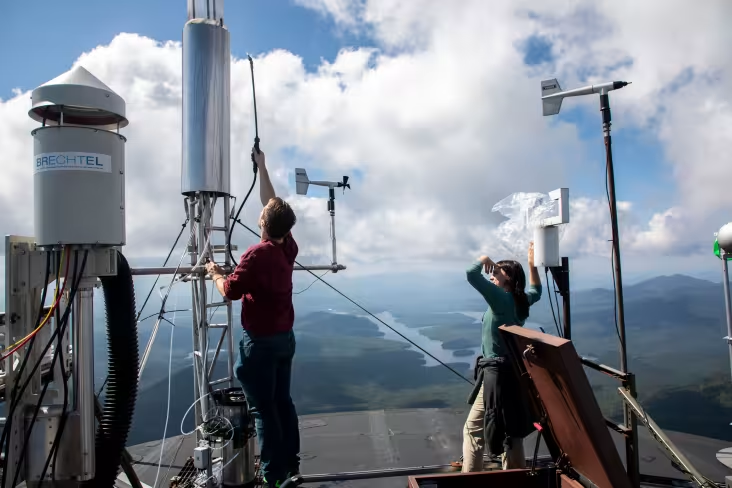
From atop Whiteface Mountain, UAlbany cloud researchers have closely monitored the impact of clean air laws on Adirondack forests and lakes for decades.
Others, meanwhile, are harnessing the power of AI to clean toxic “forever chemicals” like PFAS from our food supply and drinking water and to monitor air quality inside and around urban schools and communities.
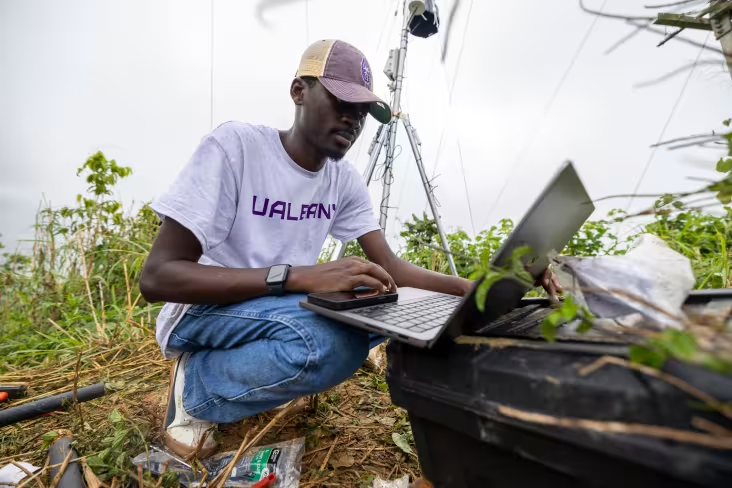
UAlbany’s expertise in atmospheric sciences is critical to accurately forecasting renewable power generation, predicting rapid hurricane intensification and understanding what the profound retreat of Andean glaciers might mean for communities that rely on mountain water.
Our physicists are pioneering new, safer approaches to nuclear energy, our engineers are designing less power-hungry computers and our anthropologists are exploring how ancient cultures grappled with climate change.
UAlbany research is developing treatments for devastating diseases like myotonic dystrophy, exploring how to fight infections like Zika virus, improving HIV prevention among Black women, understanding diet’s role in breast cancer, measuring toxins in young children, and disrupting cardiac disease and cancer progression.
Our faculty are also pioneering new medical technologies, from training AI to suggest better drug candidates to using lasers to detect Alzheimer’s disease earlier and building virtual reality environments that help stroke patients rehabilitate faster.
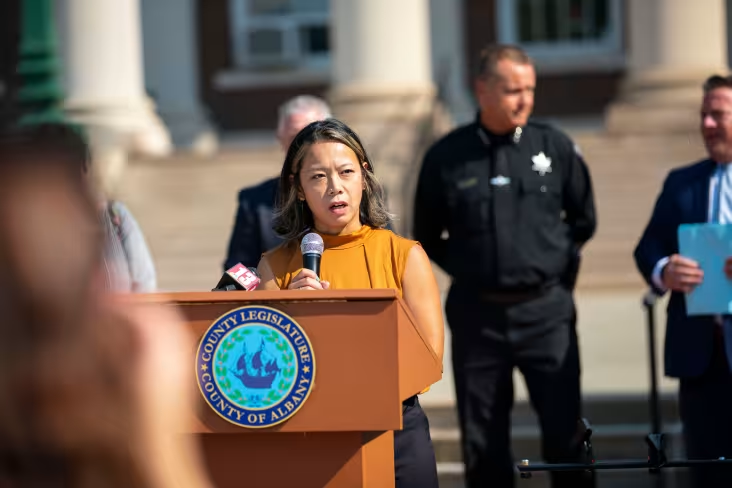
With deep expertise in fields like public health, sociology, criminology and social welfare, UAlbany researchers are tackling persistent health disparities faced by minority communities, exploring the epidemiological dimensions of gun violence and the trauma inflicted on those charged with disrupting it, expanding our understanding the impact of immigration on urban neighborhoods, and devising more effective approaches to combat the personal and social costs of mental illness, drug addiction and sports gambling.
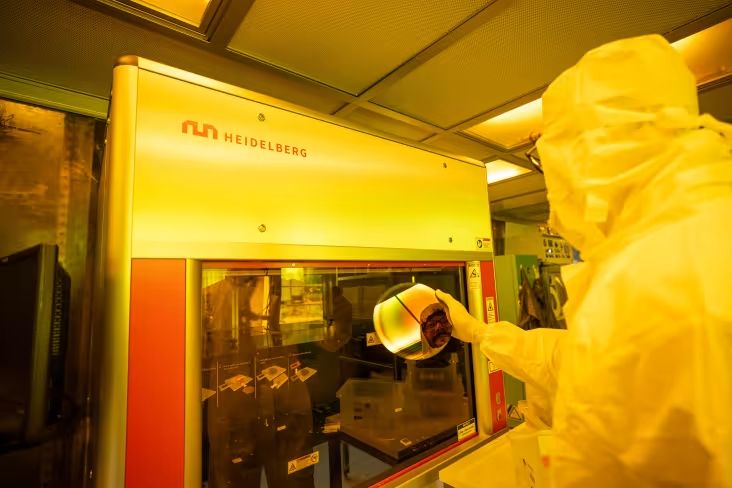
UAlbany researchers are also developing the latest semiconductors and microelectronics critical to U.S. economic and national security, building cutting-edge devices for quantum communication, helping foreign governments keep sensitive technologies out of the hands of potentially hostile actors, building toolkits to protect critical networks from sophisticated cyberattacks, devising new red-teaming methods to test security protocols and assess emerging threats, and tracking terrorism abroad and domestic extremism at home.
Our ability to adapt to climate change and other serious challenges relies on work by UAlbany scientists to harden electric grids against extreme weather, help older adults and those with disabilities better prepare for disasters, explore how attachment to places impacts our decisions to rebuild after a catastrophe, and use AI analysis of social media to make sense of complex systems, including helping emergency managers quickly locate the people most in need of help after a disaster strikes.
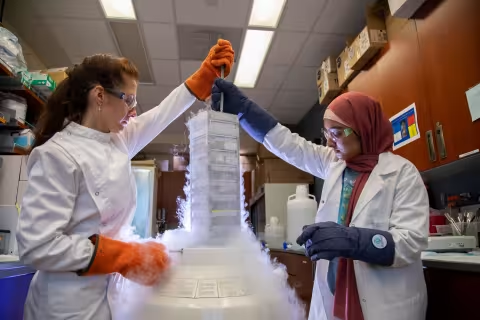
UAlbany is one of fewer than 200 Research 1 (R1) institutions in the United States, a designation from the Carnegie Classification of Institutions of Higher Education signifying the highest levels of research and doctoral activity on a campus.
For students, this means easy access to high impact undergraduate and graduate research opportunities, lab training and mentorship from faculty working at the cutting-edge of their fields.
For faculty, it means unparalleled access to top-flight core research facilities — including the 200mm Innovation Lab at the Albany NanoTech Complex, the Ion Beam Lab particle accelerator, the RNA epitranscriptomics and proteomics capabilities in the Life Sciences Research Building, the best in class New York State Mesonet and UAlbany’s NVIDIA DGX supercomputer.
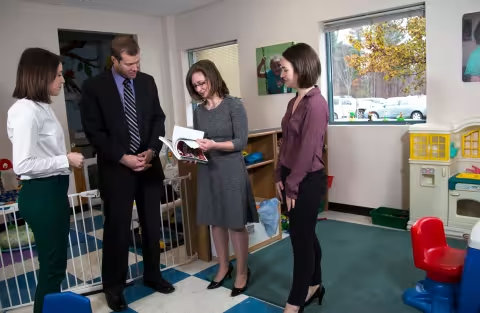
UAlbany is a publicly engaged campus — a commitment seen in our researchers’ dedication to working with communities, locally and globally, to find solutions to the problems important to them.
From improving mental health crisis response in Albany County to collaborating with New York YMCAs to support new mothers and combat childhood obesity, UAlbany faculty are working with partners from the public and private sectors to promote well-being and resilience.
“Working at a public university, we do feel a responsibility to
return the investment that the taxpayers have given us.”
– John D. Cleary, Assistant Director of Research
at the RNA Institute, College of Arts and Sciences
All this vital work relies on funding from federal agencies deeply invested in solving the problems that our expertise can help. In 2024, UAlbany preliminarily reported approximately $105 million in federally supported R&D activity to the National Science Foundation (NSF), some of which has now been impacted by deep federal research funding cuts affecting universities nationwide.
While UAlbany’s resolve to remain a leader in scientific research is unwavering, it is important to be transparent with members of our community about what is at stake.
“It’s not that these cuts might jeopardize one discovery or another. It’s that we risk undermining the entire system that propelled American scientific excellence and economic growth for decades.” – Thenkurussi (Kesh) Kesavadas, Vice President for Research & Economic Development, wrote in an Albany Times Union op-ed
Grant terminations impact faculty, staff and students in several ways — from a reduction in funding that could create a financial hardship to the loss of a research-funded position entirely. Whenever possible, the University has sought to secure alternate funding sources to minimize these impacts on members of our community.
Since January 20, 2025, federal research grant terminations have impacted UAlbany's research, faculty, staff and students as reported below — keeping in mind that number of faculty, staff and students affected in some way will always be larger than the number who have lost positions.
These numbers include grants directly to UAlbany as well as federal pass-through funds that flowed to the University through other entities, such as partner research institutions. Dollar amounts are approximate. Last Updated: October 14, 2026
16
Number of Terminated Federal Grants
$15M
Total Amount of Terminated Grants
54
Number of Faculty & Staff Impacted by Terminated Grants
25
Number of Students Impacted by Terminated Grants
These numbers only partially reflect the impact, as they do not include grants that have been suspended pending further review.
Learn more about the impact of federal research funding at UAlbany and why Indirect Cost Recovery, also known as research overhead, is critical to U.S. scientific and technological leadership:
UAlbany’s $105 million federal R&D portfolio
National Science Foundation (NSF) Research at UAlbany
National Institutes of Health (NIH) Research at UAlbany
U.S. Department of Energy (DOE) Research at UAlbany
Federal Research Facilities & Administration (F&A) Costs at UAlbany