


Grant Development Services

A Brief Introduction


Are you seeking funding to support your research? 

UAlbany's grant writers provide a suite of grant development services to support your efforts. From ideation to submission, they can help every step of the way.

As soon as you find a solicitation to pursue or you have a project idea for which you want funding, get in touch with our grant writers

To get started, they will ask you to:

  • Read the entire solicitation carefully and summarize it
  • Develop a one-pager describing your project (purpose, methods, design, outcomes, etc.)
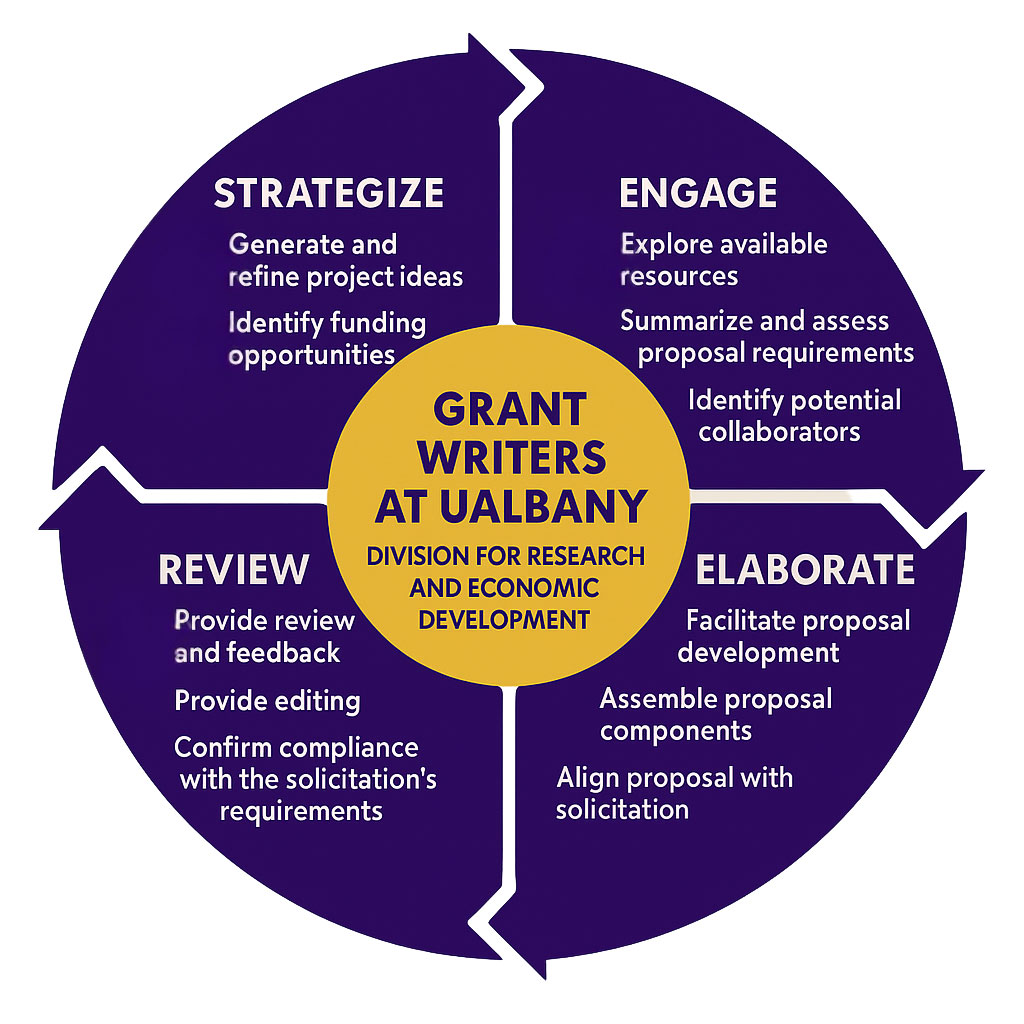
Grant Writers at UAlbany infographic. Text alternative available in accordion below image.
Text alternative for the Grant Writers at UAlbany infographic

Grant Writers at UAlbany, Division for Research & Economic Development

  • Strategize: Generate and refine project ideas. Identify funding opportunities.
  • Engage: Explore available resources. Summarize and assess proposal requirements. Identify potential collaborators.
  • Elaborate: Facilitate proposal development. Assemble proposal components. Align proposal with solicitation.
  • Review: Provide review and feedback. Provide editing. Confirm compliance with the solicitation's requirements.


Grant Submission Journey

Before you start working on a proposal, familiarize yourself with the award lifecycle

To initiate the submission process, fill out a proposal request form at least 20 business days before the sponsor's deadline. 

This form allows the Sponsored Program Administration (SPA) to assign your project to a Research Administrator (RA), who will submit your proposal.
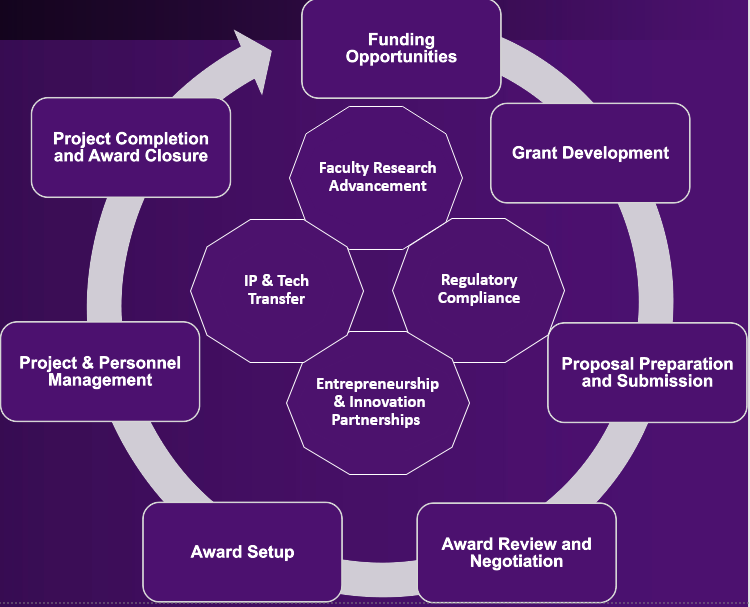
 

Award Lifecycle infographic. Text alternative available in accordion below image.
Text alternative for the Award Lifecycle infographic


Contact our Grant Writers

contact

How Grant Writers Can Help You

Strategize

Generate and refine project ideas. Identify funding opportunities.

Engage

Explore available resources. Summarize and assess proposal requirements. Identify potential collaborators.

Elaborate

Facilitate proposal development. Assemble proposal components. Align proposal with solicitation.

Review

Provide review and feedback. Provide editing. Confirm compliance with the solicitation's requirements.
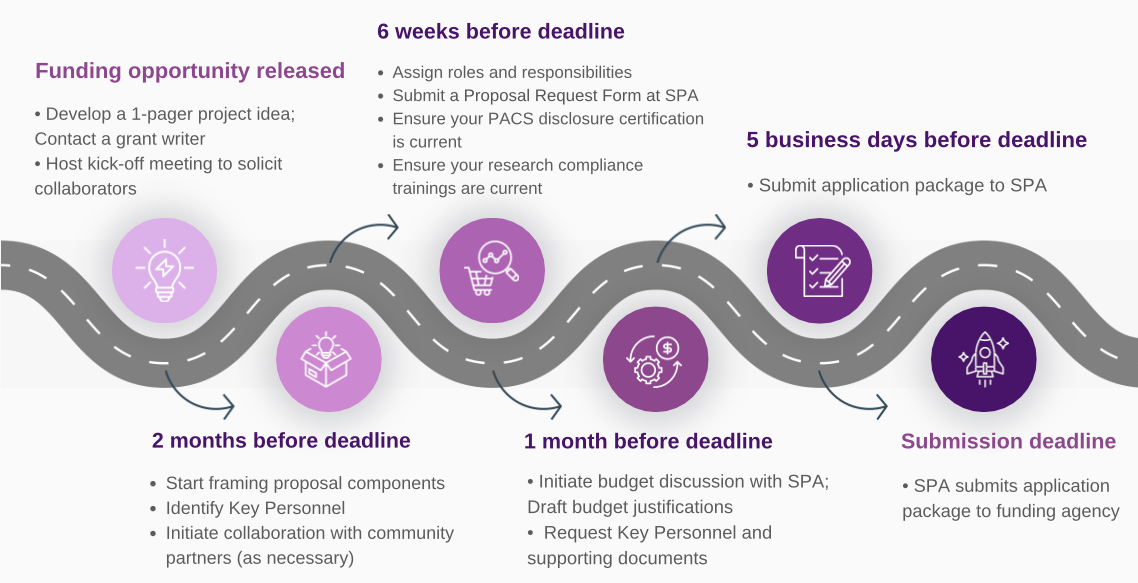
How Grant Writers Can Help You

Strategize

  • Generate and refine project ideas.
  • Identify funding opportunities. 

Engage

  • Explore available resources.
  • Summarize and assess proposal requirements.
  • Identify potential collaborators.

Elaborate

  • Facilitate proposal development.
  • Assemble proposal components.
  • Align proposal with solicitation.

Review

  • Provide review and feedback.
  • Provide editing.
  • Confirm compliance with the solicitation's requirements.

Finding Funding


Database Search

  • SPIN: Access the world’s largest database of funding opportunities using your UAlbany NetID and password.
  • Halo: Use this AI-power matching platform to find corporate R&D teams, science-led accelerators, incubators and venture groups, as well as industry partners aligned with your research interests.
  • Grants.gov: Explore grant opportunities and join forces with government agencies to tackle pressing challenges.

Grants.gov and SPIN allow you to save specific search criteria and receive regular digests of all related federal and private funding opportunities, including individual fellowships. 

Visit the Funding Opportunities webpage — the first step within the Award Lifecycle — to learn more about securing external and internal research funding.


Mailing Lists

Subscribe to funding agencies' mailing list to receive weekly or daily digests of their funding announcements. Here are a few to get you started:


UAlbany Resources

Looking for funds from a private donor or foundation? Please contact the Office of Corporate and Foundation Relations.

Still not finding what you are looking for? Let us help! Email the Office of Strategic Initiatives at [email protected].

Writing Your Proposal


Timeline

Below is a timeline summarizing the major steps involved in developing a proposal. Working with the submission deadline as your end goal, consider dedicating a minimum of two months to prepare your proposal.

Familiarize yourself with the award lifecycle. Don't forget to fill out a Proposal Request Form at least 20 business days before the sponsor's deadline. The Sponsored Program Administration (SPA) will use this form to assign a Research Administrator (RA) to your project.

Visit the Proposal Preparation & Submission webpage — the second step within the Award Lifecycle — for detailed instructions for completing the tasks outlined below.


Proposal Submission Timeline infographic. Text alternative available in accordion below image.


Text alternative for the Proposal Submission Timeline infographic
  1. Funding opportunity released
    • Develop a one-pager project idea, contact a grant writer
    • Host kick-off meeting to solicit collaborators
  2. Two months before deadline
    • Start framing proposal components
    • Identify key personnel
    • Initiate collaboration with community partners (as necessary)
  3. Six weeks before deadline
  4. One month before deadline
    • Initiate budget discussion with SPA, draft budget justifications
    • Request key personnel and supporting documents
  5. Five business days before deadline
    • Submit application package to SPA
  6. Submission deadline
    • SPA submits application package to funding agency


Finding Collaborators

Academic Collaborators

Once you have found the right funding opportunity, you may still need to find collaborators, partners and team members.

For collaborators from UAlbany, tap into the campus’ rich research pool. Explore UAlbany Institutes, Centers and Labs.

To find research collaborators across the entire SUNY system for very large projects (more than $5 million), please contact the SUNY Grants for Research, Opportunity, and Workforce (GROW) Support Unit.

Community Engaged Research

Do you need to address ​​​translational research, write about community engaged research, or develop partnerships between researchers and local communities? Learn more about public engagement and how your research can become more publicly engaged.

The College of Arts and Sciences features public engagement as a central component for research, teaching and service initiatives. If you want to develop a public engagement initiative or join an existing initiative, please contact the Arts & Sciences Public Engagement unit.

Industry Partners
Industry Partners

The Office of Economic Development, Entrepreneurship, and Industry Partnerships and the Office of Technology Transfer support both UAlbany researchers and outside industry partners. Explore entrepreneurship and innovation.


Help on Specific Sections of your Proposal

Information on the Principal Investigator (PI) & Collaborators

Biosketch

To p​​​​repare a resume, CV or biosketch for state and federal agencies, please use SciENcv, a system that gathers and compiles information on expertise, employment, education and professional accomplishments and formats it for use by major funders.


Current & Pending (Other) Support, or Active & Pending Support

Support includes all resources made available to a researcher in support of and/or related to all of research endeavors, regardless of their monetary value and regardless of whether resources are based at the institution the researcher identifies for the current grant. This includes but is not limited to:

  • Resources (e.g., biologics, chemical, model systems, technology, etc.) and/or financial support from all foreign and domestic entities, that are available to the researcher.
  • Consulting agreements, when senior/key personnel will be conducting research as part of the consulting activities.
  • In-kind contributions (e.g., office/laboratory space, equipment, supplies or employees/students supported by an outside source). An item or service given with the expectation of an associated time commitment is an in-kind contribution and must be reported as such.

To compile this document for funding agencies, please use SciENcv, an electronic system that helps researchers assemble the professional information needed for participation in federally funded research.


Disclosures

All external interests and commitments of the research team members who will significantly contribute to the project must be disclosed. 

External interests and commitments are any financial interests that team members have outside of their commitments to the University or the Research Foundation for SUNY.

Fulfill disclosure requirements.


Open Researcher & Contributor ID (ORCID)

ORCID is a free, unique, persistent identifier (PID) for individuals to use as they engage in research, scholarship and innovation activities. This ID is sometimes required on your biosketch.

Research involving Humans and/or Animals

Human Subjects

Applications involving research with human subjects need to address how the project will adhere to basic principles of research with human subjects (people should not be involved in research without their consent; any risk faced by a research subject is the minimal; etc.). 

No individuals may be recruited or involved in research with human subjects without approval from the Institutional Review Board (IRB) for human subject protections. Obtain IRB approval.


Animals

If your project will involve animals in research, testing, teaching or training, your proposal will need to identify the species, include justification that the species are appropriate for the proposed research, and outline how the procedures are designed to minimize any pain or distress. 

No animal may be used in research, testing, teaching or training without Institutional Animal Care and Use Committee (IACUC) approval. Obtain IACUC approval.


Compliance

Are there data restrictions involved with your project? Should your project be National Institute of Standards and Technology (NIST) compliant or follow the General Data Protection Regulation (GDPR)? Please contact the Office of Regulatory & Research Compliance (ORRC) and be sure to inform your Research Administrator.

All research and sponsored activities must be conducted in accordance with the laws and regulations of the United States, regardless of where the research is conducted. Research conducted outside of the United States must also be compliant with the local laws and regulations of the project site. 

ORRC ensures that research is conducted according to federal guidelines and in a responsible, transparent and ethical manner.

Additional Required Documents

Facilities, Equipment & Resources

Access a list of UAlbany's Major Facilities, Equipment & Resources. This is boilerplate material to use as a reference for your proposal. Only pick what is relevant for your proposal, and please be sure to check for accuracy before you use the information.


Information Technology Services (ITS)

Does your research require access to UAlbany computing facilities? Please contact ITS. They will work with you to gather specifications and generate a quote for you that meets those specifications and complies with the latest security guidelines.


Budget

To help you prepare your budget, SPA has created a sample budget template. Note: To download the template, open the link and select “File,” “Create a Copy,” then “Download a Copy.”

Please use this template for preliminary budgeting only, and contact SPA for the latest template, as formulas linking the sheets may change.


Mentoring Plan

Some proposals requires that you describe how you will mentor undergraduate students, graduate students or postdoctoral fellows. We have compiled in a mentoring plan template with a list of points to address.


Evaluation Plan

If your proposal requires an evaluation plan that addresses the extent to which the project delivers on its proposed activities and expected outcomes, please contact the Center for Human Services Research (CHSR)

Their staff are skilled at designing evaluations and research studies using both qualitative and quantitative methods, and at conducting evaluation studies using primary and secondary data with a variety of research techniques. 

CHSR creates and hosts dashboards demonstrating project implementation progress and outcome achievement through interactive data visualizations in Tableau dashboards.


Data Management Plan & Sharing Plan

Access data management templates, training and resources on the Office of Regulatory & Research Compliance's Research Data Management page.

The University Libraries’ Data Services unit can help you find, manage, collect and document, store and analyze, and share and preserve data. Use the DMPTool, available through the University Libraries, to create a DMP. Access the DMPTool's quick start guide.


Feedback & Pre-submission Reviews

The Office of Faculty Research Advancement can arrange external reviews by a subject matter expert. Request a pre-submission review.

Our grant writers can provide feedback on a proposal's structure and narrative, including whether the project adequately answers all the funding agency’s requirements. Contact [email protected] to request assistance.

Sample Proposals

Take a look at successful proposals that your UAlbany peers have agreed to share. Use them as models to develop your own proposal!


National Science Foundation (NSF)

Note: All documents linked below require a UAlbany NetID and password to access, as they are for internal use only. Please do not share or distribute them. 


National Institutes of Health (NIH)

Sample proposals are available on the NIH website

In addition, the NIH RePORTER allows users to search a repository of NIH-funded research projects and access publications and patents resulting from NIH funding.

Additional Resources


Trainings & Workshops

  • Research Events: The Division for Research & Economic Development hosts events for the UAlbany research community. Explore the programming, which includes speaker series, coffee hours, lightning talks, workshops and more.
  • Faculty Research Advancement: The Division for Research & Economic Development offers various programs to encourage and help faculty members and researchers apply for interdisciplinary extramural grant proposals and research projects. The Division periodically hosts:
    • A two-semester proposal writing course
    • Workshops and webinars to share and discuss agency specific grant opportunities with faculty members and researchers
    • Individual consulting, available for junior faculty members who plan to apply for the NSF Faculty Early Career Development Program (CAREER)


School- & College-level Support

If you need additional support, please contact your college’s Associate Dean for Research (ADR). 

ADRs play a key role in advancing the college’s research mission by supporting faculty in securing external funding, navigating internal processes and identifying strategic opportunities.


University Libraries

Our librarians can assist you via chat and email with:

  • Locating information and resources
  • Using library databases and catalogs
  • Guidance on citation styles and resources
  • General research guidance
  • References and Citations
    • To organize your bibliography and in-text citations, we recommend using Zotero or Endnote, the reference management software the University Libraries supports. These tools help researchers collect, manage and cite research sources.

Visit the University Libraries website to get started.


Selected Library Books

Grant Writing (General)

Creating Winning Grant Proposals by Anne L. Rothstein
Call Number: University Library Books; LC243.A1 R67 2019
ISBN: 9781462539093
Publication Date: 2019

How to develop and write a grant proposal by Congressional Research Service
Call Number: Online
Publication Date: 2018

Little Quick Fix: Research Proposal
Call Number: Science Library Books Q180.55.P7 O4 2018
Publication Date: 2018

Proposal Writing
Call Number: Dewey Library Reference HV41 .C548 2017
Publication Date: 2016

The Nuts and Bolts of Grant Writing
Call Number: University Library Books HG 177.5 U6 C37 2015
Publication Date: 2015

Writing Successful Grant Proposals by Ellen W. Gorsevski
ISBN: 9789463003902
Publication Date: 2015

The Only Grant-Writing Book You'll Ever Need
Call Number: University Library Books HG177.5.U6 K37 2014
ISBN: 9780465058938
Publication Date: 2014

Writing Successful Grant Proposals from the Top down and Bottom Up
Call Number: Online
ISBN: 9781412999281
Publication Date: 2014

The Foundation Center's Guide to Proposal Writing
Call Number: Dewey Library Reference HG 177.5 U6 G44 2012
Publication Date: 2012

Write an effective funding application: a guide for researchers and scholars
Call Number: University Library / HG 177 W35 2009
Publication Date: 2009

NIH Grants
NIH Grants

The grant application writer's workbook : National Institutes of Health version
Call Number: Science Library Books R853.P75 R63 2018
Publication Date: 2018

Writing the NIH Grant Proposal (2018)
Call Number: Resource Sharing Requests RA11.D6 G47 2018
Publication Date: 2018

Writing winning proposals for nurses and health care professionals
ISBN: 9780826122735
Publication Date: 2016

Guide to Effective Grant Writing
Call Number: Online
Publication Date: 2012

Complete Writing Guide to NIH Behavioral Science Grants
Call Number: Dewey Library / RA 11 D6 C65 2008
Publication Date: 2008

Writing the NIH Grant Proposal (2006)
Call Number: Science Library / RA 11 D6 G47 2006
Publication Date: 2006