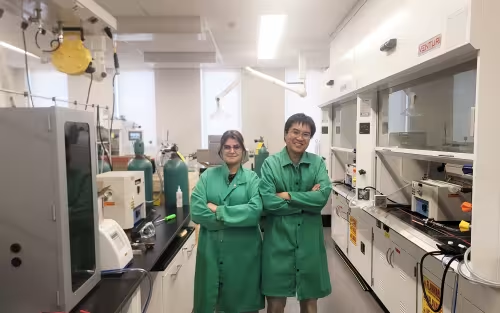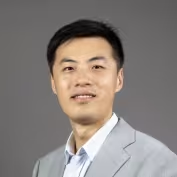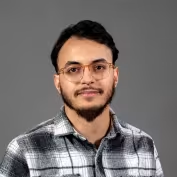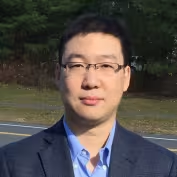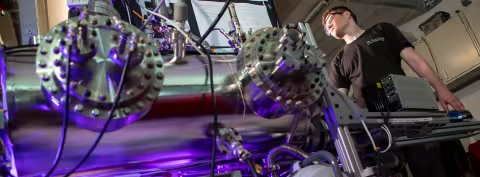
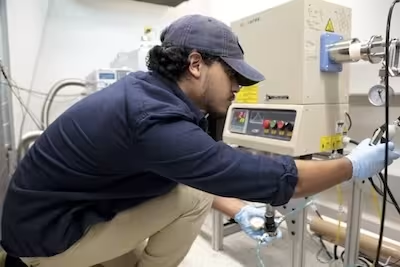
Kevin Reyes, a student researcher at the University at Albany, optimizes a tube furnace for copper deposition in an additive manufacturing project.
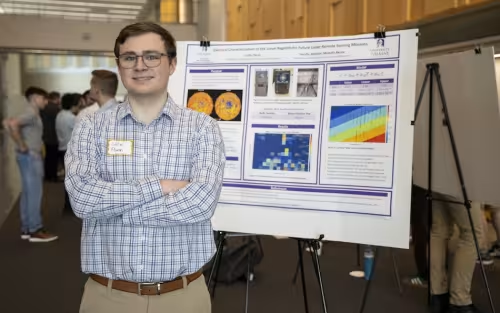
At the conclusion of the SURP, all students will present their research to the University at Albany's faculty, students, staff and representatives of its industrial partners during two poster sessions on the last Thursday, (August 7, 2025) and Friday (August 8, 2025) of the program. The second poster session will be open to the public at UAlbany’s ETEC center.
Travel and Lodging
Expenses related to travel, lodging and meals are the responsibility of each student.
On-campus housing may be available at the Residence Halls (estimated costs $250 per week, depending on unit).
Contact Us
For more information, please contact Carmen Gero at [email protected].
Research Opportunities
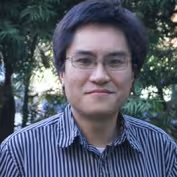
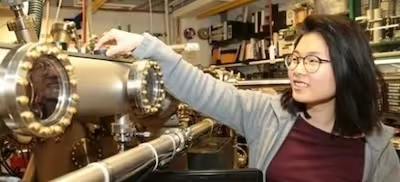
Student researcher Sunny Choi adjusts equipment as part of the Summer Undergraduate Research Program.
SURP participants will work on individual research projects collaborating with UAlbany mentors.
The Principal Investigators and mentors will offer numerous research topics at undergraduate levels.
Students choose their individual research topics based on their interests.
The implementation language is C#. Work with mentor to design and implement a novel operating system. It is not expected to FINISH the operating system. Focus will be on memory management and process switching. Some preliminary design work is already complete. This will be a very collaborative project with the mentor and will require a lot of planning and discussion.
Student Skills / Requirements
Good understanding of low level and assembly (ICSI333, ICSI404)
Good understanding of operating systems (ICSI412)
Location
UAB
Students from the following Tracks are Encouraged to Apply
The high-frequency transformer is an essential component in high density power conversion systems to provide galvanic isolation between the input and the output as well as enable voltage conversion and energy transfer. The non-sinusoidal fast-switching AC modulated waveforms (can dramatically accelerate the electrical aging rate of the transformer windings, due to the high peak voltage, high switching frequency and abnormal dielectric losses. Thus, developing a high-fidelity digital twin modeling is paramount to predict the remaining useful life and enhance the reliability of high-power high frequency isolated converters.
This project will involve running detailed circuit and Finite Element Analysis simulations to relate operating conditions of the transformer and its terminal voltage and current quantities to the main and parasitic parameter values and stress levels exhibited by the high frequency transformer. The generated data will lay the groundwork for developing digital twin models for high frequency transformers. The student will gain experience in transformer circuit models, circuit analysis and finite element analysis of high frequency transformers.
Student Skills / Requirements
Electronic Circuits Analysis and Simulation (IECE 300 or equivalent). Basic programming knowledge. Understanding of transformer operation (IECE 413 or equivalent)
Location
CNSE Downtown Room B014
Students from the following Tracks are Encouraged to Apply
Track 1: SURP-Funded
Track 4: Research for Credit
04. Modular Solid State Breaker with Fault Current Limiting
Modular Solid State Breaker with Fault Current Limiting
Modular solid state circuit breakers are a compact and very fast response method to interrupt fault currents in ac or dc circuits without the risk of arcing. This makes them suitable for modern power distribution and collection systems such as renewable energy systems, electric vehicles, electric aircraft and data centers.
This project will implement and test a modular solid state breaker structure with advanced dual gate control to limit and interrupt fault currents in dc networks. The student involved in this project will work on circuit layout, build a breaker module and test both control and power circuits.
Student Skills / Requirements
Electronic Circuits Analysis and Simulation (IECE 300 or equivalent). Basic programming knowledge. Ability to use electronics lab equipment (e.g. power supplies, oscilloscopes etc.)
Location
CNSE Downtown Room B014
Students from the following Tracks are Encouraged to Apply
Haptic technology holds significant potential for sensory replacement and augmentation. However, a novel actuator capable of simulating multiple sensations, including vibration, pressure, and temperature, is urgently needed. The primary objective is to design an actuator that accurately replicates various tactile sensations with precision. In this project, the student will contribute to the development and characterization of this actuator. The overarching goal is to create a prototype that simulates tactile feedback and showcases its functionality in a digital environment.
Student Skills / Requirements
Third-year engineering students are preferred. They should be interested in learning and developing prototypes using prototyping boards (e.g., Raspberry Pi and microcontrollers). Prior knowledge of Python and C programming and CAD modeling will be helpful.
Location
ETEC Room 1703
Students from the following Tracks are Encouraged to Apply
Track 1: SURP-Funded
Track 3: Volunteer
06. Development of an Assistive Device for Visual Impairment Using AI
Development of an Assistive Device for Visual Impairment Using AI
Recently, several technological innovations utilizing artificial intelligence (AI) have been proposed in the medical field. There remains a significant opportunity to integrate AI into medical applications.
On the same streamlining, this project will employ an AI-based vision approach that not only identifies tissue types but also provides relevant feedback. Our primary objective is to develop a module that accurately identifies various types of tissue and categorizes them precisely.
The developed technology can enhance medical professionals' ability to make informed decisions, ultimately improving patient outcomes.
Student Skills / Requirements
Third/fourth-year engineering students will be preferred. The student should be interested in learning and developing prototypes using prototyping boards (e.g., Raspberry Pi and microcontrollers). Prior knowledge of Python and C programming, artificial intelligence (AI) and 3D modeling will be helpful.
Location
ETEC Room 1703
Students from the following Tracks are Encouraged to Apply
Track 1: SURP-Funded
Track 2: Faculty-Grant Funded SURP
Track 3: Volunteer
07. Tissue Classification Using AI for Medical Applications
Tissue Classification Using AI for Medical Applications
Recently, several technological innovations utilizing artificial intelligence (AI) have been proposed in the medical field. There remains a significant opportunity to integrate AI into medical applications.
On the same streamlining, this project will employ an AI-based vision approach that not only identifies tissue types but also provides relevant feedback. Our primary objective is to develop a module that accurately identifies various types of tissue and categorizes them precisely.
The developed technology can enhance medical professionals' ability to make informed decisions, ultimately improving patient outcomes.
Student Skills / Requirements
Third/fourth year engineering students will be preferred. The student should be interested in learning and developing prototypes using prototyping boards (e.g., Raspberry Pi and microcontrollers). Prior knowledge of Python and C programming, artificial intelligence (AI) and 3D modeling will be helpful.
Location
ETEC Room 1703
Students from the following Tracks are Encouraged to Apply
Track 1: SURP-Funded
Track 3: Volunteer
Department of Environmental & Sustainable Engineering
08. Ambient and Indoor Concentrations of Black Carbon and Brown Carbon in NYS Neighborhoods
Ambient and Indoor Concentrations of Black Carbon and Brown Carbon in NYS Neighborhoods
In the United States, current ambient air quality observation networks are limited in characterizing the diverse group of air pollutants including climate-driven pollutant black carbon that affect exposure across regional to neighborhood scales.
Under the initiatives of EPA enhanced air quality monitoring for communities, we will measure ambient concentrations of black carbon and brown carbon in at least 10 sites in NYS. We will also measure indoor concentrations of black carbon and brown carbon in at least 15-20 homes during the Summer 2025.
The study will increase public awareness and an improved understanding of community-specific air quality problems, identify local source impacts, and guide how to reduce air pollution exposure.
Student Skills / Requirements
Python/R, field trips.
Location
ETEC B309
Students from the following Tracks are Encouraged to Apply
Our group studies various biogeochemical and ecological processes in terrestrial ecosystems that are affected by fires, combining experimental and modeling approaches, field and laboratory studies.
Student Skills / Requirements
STEM majors with wet lab experiences
Location
ETEC
Students from the following Tracks are Encouraged to Apply
Our group studies the recovery of nutrients for agricultural application. We will study the properties of the recovered products and evaluate the agricultural performance.
Student Skills / Requirements
STEM majors with wet lab experiences
Location
ETEC
Students from the following Tracks are Encouraged to Apply
Track 1: SURP-Funded
Track 2: Faculty-Grant Funded SURP
Track 3: Volunteer
Track 4: Research for Credit
11. Integrative Approaches for Addressing PFAS in the Environment
Integrative Approaches for Addressing PFAS in the Environment
Per- and polyfluoroalkyl substances (PFAS) are known to be persistent, bioaccumulative and toxic compounds. They are also ubiquitous in the ecosystem.
To address numerous negative issues brought by PFAS, Liang's lab has been working on a systematic approach integrating bioremediation, phytoremediation and innovative material design.
Through combining different processes together, we have been able to find transformative solutions to minimize the impact of PFAS toward the public and the environment.
Student Skills / Requirements
3rd year and above chemistry, biology and ESE students.
Location
ETEC 024 and BIO 317/318
Students from the following Tracks are Encouraged to Apply
Track 1: SURP-Funded
Track 3: Volunteer
Track 4: Research for Credit
12. The Effect of Hydraulic Behavior on the Treatment of Drinking Water Tanks, Distribution Systems, Clearwells and Pools
The Effect of Hydraulic Behavior on the Treatment of Drinking Water Tanks, Distribution Systems, Clearwells and Pools
Tanks and other flow-through vessels are an important part of the infrastructure used for treating and purveying water for drinking. The analysis of these vessels is similar to that of swimming pools, spas and spray ground treatment tanks.
Sometimes these vessels become contaminated and they must be treated using a recirculation system. There are unanswered questions regarding how the effectiveness of a water treatment unit (filter, UV reactor, etc.), recirculation rate, turnover time and treatment goal affect operations and decision-making.
The focus of this project is to develop a model for a recirculation system and to incorporate the principles of hydraulics and residence time distribution theory into the analysis. This will provide project designers, treatment operators, and end users with an important tool in the event there is a contamination event that must be addressed.
Student Skills / Requirements
MATLAB, calculus and differential equations.
Location
ETEC and possibly in the Corning Tower on Madison Avenue
Students from the following Tracks are Encouraged to Apply
Track 1: SURP-Funded
Track 3: Volunteer
Track 4: Research for Credit
13. PFAS in Land-Applied Biosolids in Agricultural Settings
PFAS in Land-Applied Biosolids in Agricultural Settings
This research project aims to support USEPA-associated stakeholders in understanding the factors influencing PFAS accumulation and plant uptake resulting from the land application of biosolids in agricultural settings. The study will explore how different plant species, biosolids treatment, and soil types affect PFAS uptake by crops.
By examining these variables, the project will provide valuable insights into the movement of PFAS within agricultural ecosystems, contributing to broader efforts in environmental sustainability and food security and informing sustainable land management practices.
Student Skills / Requirements
STEM majors with wet lab experiences.
Location
ETEC B020
Students from the following Tracks are Encouraged to Apply
Track 1: SURP-Funded
Track 3: Volunteer
Track 4: Research for Credit
14. Rescaling Model to Correct the Differences in Aqueous-Phase Microplastic Abundance
Rescaling Model to Correct the Differences in Aqueous-Phase Microplastic Abundance
Microplastics (MPs) are some very tiny plastic particles with a diameter of less than 5 mm in length. Due to their ubiquitous presence in aquatic environments and potential risks to the environment and human health, MPs are considered as an emerging global concern. However, the understanding of the occurrence and impacts of MP pollution in freshwater is still in its infancy.
This project plans to develop a statistical rescaling model to correct the reported MP abundance from the existing studies, facilitating uniform interpretation of data from diverse sampling methods and size ranges.
Student Skills / Requirements
Basic knowledge of statistics and experience in Python or R programming. Open to junior or senior-level engineering students.
Location
ETEC Room 133
Students from the following Tracks are Encouraged to Apply
Track 1: SURP-Funded
Track 3: Volunteer
15. Understand the Spatiotemporal Variations of Aqueous-Phase Microplastic Abundance in North America
Understand the Spatiotemporal Variations of Aqueous-Phase Microplastic Abundance in North America
Microplastics (MPs) are some very tiny plastic particles with a diameter of less than 5 mm in length. Due to their ubiquitous presence in aquatic environments and potential risks to the environment and human health, MPs are considered as an emerging global concern. However, the understanding of the occurrence and impacts of MP pollution in freshwater is still in its infancy.
This project plans to compile the first dataset for MP abundance distribution in North American freshwater systems. The data will be collected from existing papers and reports. Statistical analyses such as correlation analysis and regression will also be conducted to understand the influencing factors for the spatiotemporal distribution of the MPs.
Student Skills / Requirements
Basic knowledge of statistics and experience in Python or R programming. Open to junior or senior-level engineering students.
Location
ETEC Room 133
Students from the following Tracks are Encouraged to Apply
The goal of this project is to develop the methodology for controlling timing of self-assembly of bilayer stacks upon which cells are growing.
The ultimate goal of this project is to determine how shape changes influence the biology of cells.
Students will synthesize polymers and formulate polymers into photoresists, that will be coated onto silicon wafers into multiple stacks of hydrogel films.
Students will study the kinetics of self-assembly of these multi-layer stacks under conditions suitable for cell growth. Students may participate in growing cells onto these stacks.
Student Skills / Requirements
No experience necessary, but strong background in chemistry and/or biology required. Rising sophomores are encouraged to apply.
Location
UAlbany Nanotech Complex CESTM-344 or 135
Students from the following Tracks are Encouraged to Apply
Track 1: SURP-Funded
Track 2: Faculty-Grant Funded SURP
Track 3: Volunteer
Track 4: Research for Credit
17. Molecular Organometallic Resists for EUV (MORE)
The goal of this project is to develop organometallic compounds that can be used as high resolution photoresists in the microelectronics industry to fabricate future integrated circuits.
Students will synthesize and/or characterize compounds containing main-group metals. These compounds are designed to undergo chemical reactions when irradiated with 13.5 nm extreme ultraviolet light resulting in a change in solubility.
Student Skills / Requirements
No experience necessary, but strong background in chemistry required. Rising sophomores are encouraged to apply.
Location
UAlbany Nanotech Complex CESTM-344 or 135
Students from the following Tracks are Encouraged to Apply
Track 1: SURP-Funded
Track 2: Faculty-Grant Funded SURP
Track 3: Volunteer
Track 4: Research for Credit
18. In-Memory Computing: From Chips to Applications
Artificial intelligence and machine learning are taking the world by storm, however, these forms of computing are highly energy intensive. My research group develops unique memory devices called memristors (aka: resistive random access memory - RRAM) that can be used for highly efficient in-memory computing and neuromorphic computing.
These devices could significantly reduce the power requirements for AI and machine learning algorithms and training. Student interns working on this project will gain experience with the fabrication and electrical testing of memristor devices, as well as application development for these devices in microchip-based format.
Student Skills / Requirements
Preferred electrical engineering, materials science or related with computer programming experience.
Location
UAlbany Nanotech Complex 4904 NFE
Students from the following Tracks are Encouraged to Apply
Track 1: SURP-Funded
Track 2: Faculty-Grant Funded SURP
Track 3: Volunteer
Track 4: Research for Credit
19. Fundamental Range and Roughness Measurements in Extreme Ultraviolet (EUV) Photoresists
Fundamental Range and Roughness Measurements in Extreme Ultraviolet (EUV) Photoresists
This project will be to understand the range of electrons and acids in chemically amplified photoresists, especially toward how the number/volume of reactions in the resist correlated with roughness of the resist, which is an important criteria for photoresist performance in semiconductor manufacturing.
Experients will include resist formulation, spin coating, electron exposures, development and thickness measurements with ellipsometry and roughness measurements with atomic force microscopy (AFM).
Student Skills / Requirements
Basic physics or engineering background.
Location
UAlbany Nanotech Complex, CESTM L246
Students from the following Tracks are Encouraged to Apply
Track 1: SURP-Funded
Track 2: Faculty-Grant Funded SURP
Track 3: Volunteer
Track 4: Research for Credit
20. Measurements of Reaction Processes in Molecular Layer Deposition Resists for Extreme Ultraviolet (EUV) Lithography
Measurements of Reaction Processes in Molecular Layer Deposition Resists for Extreme Ultraviolet (EUV) Lithography
We are working with a university that has developed a novel molecular layer deposition material that works as a photoresist for EUV lithography.
Traditional photoresists are spin-coated with no net orientation. A resist that could have vertical reaction processes would have a tremendous advantage since then the reactions would be vertical and not have as much issues of lateral diffusion that limits resolution. This project would study these materials and try to understand the reaction mechanisms.
Student Skills / Requirements
Basic physics or engineering background.
Location
UAlbany Nanotech Complex, CESTM L246
Students from the following Tracks are Encouraged to Apply
Track 1: SURP-Funded
Track 2: Faculty-Grant Funded SURP
Track 3: Volunteer
Track 4: Research for Credit
21. Characterization of Thin Underlayer Films Used for Photolithography
Characterization of Thin Underlayer Films Used for Photolithography
In the semiconductor industry, photolithography uses light to transfer a desired pattern onto a sensitive film in preparation for patterning a wafer. This project explores the use of thin layers beneath the light-sensitive film to improve outcomes, such as faster pattern transfer and higher fidelity. We will perform experiments intended to confirm or disprove the two prevailing hypotheses: interdiffusion of film stacks, and the preferential generation of low-energy ("secondary") electrons from the underlayer that can contribute additional energy to the pattern transfer process. The SURP student will gain experience with thin film deposition, including photoresists, underlayers, and electron-witness molecules. The student will also conduct exposure experiments and correlate the results with thickness, composition, and structure of the films.
Student Skills / Requirements
Year 1 calculus, chemistry, physics.
Location
UAlbany Nanotech Complex, NFE 4907
Students from the following Tracks are Encouraged to Apply
Track 1: SURP-Funded
Track 3: Volunteer
Track 4: Research for Credit
22. Materials Engineering of Hybrid Bonded Wafers for AI Applications
Materials Engineering of Hybrid Bonded Wafers for AI Applications
Hybrid bonding is a technique for enabling higher performance / lower power chips needed for demanding AI applications. This project will assist a graduate student examining bonded wafers received from IBM, to understand what pre-treatments improve mechanical and electrical performance at the interface. Wafer handling, polishing, imaging and other characterization techniques will be taught. Project includes biweekly meetings with IBM scientists to discuss data and build presentation skills.
Student Skills / Requirements
Year 1 calculus, chemistry, physics.
Location
UAlbany Nanotech Complex, NFE 4907
Students from the following Tracks are Encouraged to Apply
Track 1: SURP-Funded
Track 3: Volunteer
Track 4: Research for Credit
23. Bioinformatics of Profiling the Yeast Genome for Carcinogen Resistance
Bioinformatics of Profiling the Yeast Genome for Carcinogen Resistance
We have profiled the yeast genome and mammalian genome for resistance to several potent carcinogens, including the liver cancer carcinogen, aflatoxin B1, and the colon-associated carcinogen, heterocyclic aromatic amines. We have performed computational processing of high throughput data to determine statistical significance and gene ontology groups based on function, process, and pathway. The project will explore different computational methods for processing high-throughput data. Student background: Math, Computer science and Biology.
Student Skills / Requirements
First year chemistry and biology, some course laboratory experience and computational skills are an advantage.
Location
UAlbany Nanotech Complex
Students from the following Tracks are Encouraged to Apply
Track 2: Faculty-Grant Funded SURP
24. Synergizing Artificial Intelligence and High-throughput Biological Screening to Eliminate Unnecessary Animal Testing in Genotoxicity Assays
Synergizing Artificial Intelligence and High-throughput Biological Screening to Eliminate Unnecessary Animal Testing in Genotoxicity Assays
Thousands of new chemicals are synthesized yearly. Determining toxicity of these chemicals is expensive and animal testing raises ethical concerns. We are using AI tools to predict toxicity and high-throughput methods in humanized yeast to confirm AI predictions. These studies will thus facilitate efforts to phase out animal testing in genotoxicity testing.
Student Skills / Requirements
Chemistry and Biology background required, some knowledge of computer programming would be useful, previous laboratory course experience preferred.
Location
UAlbany Nanotech Complex NFE 4908
Students from the following Tracks are Encouraged to Apply
Our goal is to use the combined power of coral species diversity and molecular sciences to identify mRNA-programs and tRNA modification systems that modulate translational responses to ocean stressors.
Using aquacultured hallmark reef building corals, we will characterize how increased temperature, bleaching, dormancy, and age re-programs the epitranscriptome, all while exploring this little explored class of symbiotic marine animals to characterize existing and identify novel tRNA modifications and tRNA writers.
Student Skills / Requirements
STEM student interested in biochemistry and molecular biology.
Location
UAlbany Nanotech Complex, NFE 2901 and 4905
Students from the following Tracks are Encouraged to Apply
Track 1: SURP-Funded
Track 2: Faculty-Grant Funded SURP
27. Implanting and Characterizing Color Centers in Silicon
Implanting and Characterizing Color Centers in Silicon
We are seeking an undergraduate student to assist with experimental research on quantum emitters in silicon, a promising platform for future quantum communication and computing. This project focuses on implanting and characterizing color centers in silicon, which can serve as stable single-photon sources for integrated photonic circuits.
As part of the research, the student will gain hands-on experience with ion implantation, a key process for introducing controlled defects into silicon to create quantum emitters. These emitters will then undergo annealing experiments, where heating is used to activate and stabilize the implanted defects. A major focus will be on determining the optimal implantation doses and annealing conditions to achieve high-performance quantum emitters.
The student will also be involved in optical spectroscopy measurements to study the emission properties of these color centers. This includes using laser-based techniques to excite the emitters and analyze their brightness, wavelength stability, and coherence properties. The goal is to understand how different fabrication conditions influence the quality of the quantum light sources.
This position is ideal for students with an interest in experimental physics, materials science, or photonics. While no prior experience is required, familiarity with optics, semiconductor materials, or laboratory-based research will be beneficial. Through this role, the student will develop valuable skills in nanofabrication, optical characterization, and quantum photonics, contributing to the advancement of scalable quantum technologies.
Student Skills / Requirements
Students should be curious about quantum technologies and comfortable with hands-on experiments. No prior experience is required, but familiarity with optics or semiconductor materials is a plus.
Location
UAlbany Nanotech Complex, NFE 1905
Students from the following Tracks are Encouraged to Apply
Track 1: SURP-Funded
28. Exploration of transcription factor binding to the Cytomegalovirus promoter in Chinese hamster ovary cells
Exploration of transcription factor binding to the Cytomegalovirus promoter in Chinese hamster ovary cells
Students will investigate transcription factor binding to the CMV promoter using a CRISPR-based immunoprecipitation approach. qRT-PCR will be used to verify immunoprecipitation.
Western blotting and proteomics will be used to identify transcription factors.
A commercially available software package (iPathway Guide) will be used to identify downstream targets of the transcription factor. If time permits, transcription factor overexpression will be explored to see what impact that has on productivity.
Student Skills / Requirements
Rising junior or senior in biology, chemistry or nanoscience/nanoengineering. Must have good wet lab skills including making solutions, pipeting, etc.
Location
UAlbany Nanotech Complex
Students from the following Tracks are Encouraged to Apply
Track 1: SURP-Funded
Track 3: Volunteer
Track 4: Research for Credit
29. Conformal Deposition of Nitrides and Metals in High Aspect Ratio Structures
Conformal Deposition of Nitrides and Metals in High Aspect Ratio Structures
One of the most highlighted limitations of plasma assistance to ALD (PEALD – Plasma Enhanced Atomic Layer Deposition) is the difficulty to reach conformal deposition in very high aspect ratio (AR) structures (current limitation is AR> 20 for metals and > 50 for oxides) due to the surface recombination loss of plasma radicals, thus losing a key ALD asset. With this project we will try to find innovative solutions that will permit to obtain a conformal depositon of Co and TiN in high aspect ratio strcutures at the nm scale.
Student Skills / Requirements
Backgrounds in physics and chemistry/materials.
Location
UAlbany Nanotech Complex, CESTM L136
Students from the following Tracks are Encouraged to Apply
Track 1: SURP-Funded
30. Understand Impact of Energetic Positive Ions in a Plasma Atomic Layer Deposition Process
Understand Impact of Energetic Positive Ions in a Plasma Atomic Layer Deposition Process
Atomic Layer Deposition (ALD) process can be assisted by plasma (PEALD). A popular belief is that plasma assistance must only employ radicals to avoid any plasma damage/plasma charging → Ions are forbidden. But low energetic ions (~ 1-30 eV) can improve the plasma deposition processes by creating opening bonds, creating new active sites, desorbing residues, activate surface reactions.
For this work we will use a 200 mm PEALD tool from Oxford and try to understand how ions can locally modify the cristallinity of nm films of HfO2, TiO2, and TiN. A local and precise control of cristallinity will permit to develop a selective deposition process based on a selective etch back step of the amorphous phase.
Student Skills / Requirements
Backgrounds in physics and chemistry/materials
Location
UAlbany Nanotech Complex, CESTM L136
Students from the following Tracks are Encouraged to Apply
Track 1: SURP-Funded
31. Pressure Dependent Characterization of MEMS Devices
Pressure Dependent Characterization of MEMS Devices
This project involves the pressure dependent characterization of MEMS-based RF switches. It is a collaborative project with Menlo Microsystems, Inc.
The goals of the project are to determine the pressure dependent damping coefficient of the MEMS cantilevers and to determine the effect that the pressure and gas composition has on of the number of cycles that the MEMS switches can perform before failure.
Student Skills / Requirements
Background in Physics and/or Engineering preferred.
Location
UAlbany Nanotech Complex, CESTM Room 111
Students from the following Tracks are Encouraged to Apply
The goal of this project is to study the cell-cell interaction and organization in hydrogel. The student will use salivary epithelial and stromal cells cultured in the hydrogel as a model system. The effects of addition of other cell types into the hydrogel on cellular organization and phenotype will be evaluated. The student working on this project will gain hands-on experience on hydrogel fabrication, cell culture, microscopy, and biological assays.
Student Skills / Requirements
No experience necessary, but strong educational background in biology, chemistry, or physics is required. Coding and mathematics modeling experience is a plus.
Location
UAlbany Nanotech Complex
Students from the following Tracks are Encouraged to Apply
In this project, the SURP student will study how entropy can be used to lower the freezing point of multi-component salts. Entropically driven freezing point depression can lower freezing points by hundreds of degrees, but enthalpic considerations for mixing hard ions (e.g., alkali metal and halogen ions) have prevented demonstration of this concept to produce room-temperature liquid salt.
By studying series of salts with closely matched mixing enthalpies, the effects of entropy can be isolated, quantified, and ultimately used to produce the desired result. Salt mixtures that are liquid at room temperature may serve in a variety of applications ranging from advanced coolants to unique media for chemical synthetic transformations.
Student Skills / Requirements
Differential Scanning Calorimetry
Thermogravimetric Analysis
Location
ETEC Room 0272
Students from the following Tracks are Encouraged to Apply
Track 1: SURP-Funded
34. Development of RNA Targeted Small Molecules as Novel Therapeutics of Myotonic Dystrophy
Development of RNA Targeted Small Molecules as Novel Therapeutics of Myotonic Dystrophy
Metal diborides are a class of solid-state materials that contain one metal and two borons. Here, the boron forms a hexagonal sheet that traps the metal atom in place, which allows for single atom chemistry in the bulk. This project will take one of two paths:
the design of solid state depolymerization catalyst to help break down plastics (fun fact: microplastics are NOT good for you) or
developing thermochemical routes to design new high energy fuels for space
Student Skills / Requirements
2nd year Chemistry
Location
ETEC Room 270
Students from the following Tracks are Encouraged to Apply
Track 1: SURP-Funded
Track 3: Volunteer
Track 4: Research for Credit
36. Paper-Based Detection of RNA Viruses Using RNA Nanotechnology
Paper-Based Detection of RNA Viruses Using RNA Nanotechnology
This summer project focuses on developing a paper-based diagnostic method for visually detecting low copies of RNA viruses.
The research will involve identifying conserved genomic regions of RNA viruses from gene databases and designing a biological chain reaction for paper-based detection. The student will collaborate closely with an undergraduate researcher, conducting experiments to develop and test the paper-based sensor while analyzing data using spectroscopy.
This project offers an exciting opportunity for students interested in the intersection of nanotechnology, chemistry, and molecular biology.
Student Skills / Requirements
3rd year Chemistry undergraduate student with interest in assay development.
Location
LSRB 1125
Students from the following Tracks are Encouraged to Apply
College of Integrated Health Sciences; Department of Environmental Health Sciences; College of Nanotechnology, Science, and Engineering; Department of Environmental & Sustainable Engineering
The University at Albany (UAlbany) is an internationally recognized public research university located in New York State's capital and is a diverse community of students and faculty representing 100 nationalities and a wide array of cultures and religions. Albany is near the Berkshires, Catskills and the Adirondack Mountains, and is convenient to Boston, Montreal and New York City.
Albany NanoTech Complex
The Albany NanoTech Complex is home to UAlbany's Department of Nanoscale Science and Engineering. The site offers a fully-integrated research, development, prototyping, and educational facility that provides strategic support through outreach, technology acceleration, business incubation, pilot prototyping, and test-based integration support for onsite corporate partners including IBM, GlobalFoundries, Samsung, Applied Materials, Tokyo Electron, ASML and Lam Research, as well as other “next generation” nanotechnology research activities, including hands-on internships for students along with career opportunities.
ETEC
ETEC
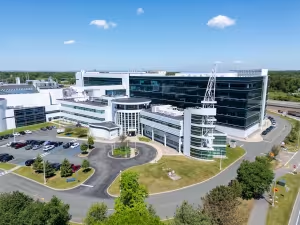
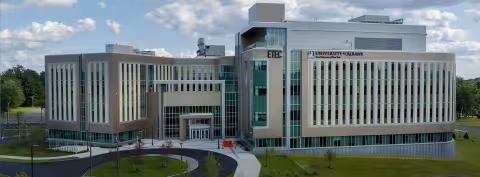
ETEC is a $180 million, 246,000 square foot state-of-the-art building that houses researchers, educators and entrepreneurs under the same roof. Its 40+ labs house more than 200 full-time faculty and researchers, 100 research and industry partners. As many as 800 students will work in its 20 classrooms and teaching labs and other innovative spaces.
ETEC offers state-of-the-art research facilities and access to important scientific and technological resources. This unique facility is designed to drive economic growth, create jobs, and enhance New York’s competitiveness.
Application Deadlines
Application deadline is Wednesday, March 19.
Please ensure the email address listed in the application is current and checked on a regular basis.
Eligibility
This opportunity is available to undergraduate students currently enrolled at the University at Albany or other colleges or Universities.
How to Apply
Student Applications will require
Resume
Statement of interest - less than 100 words
Unofficial transcript
Combine these documents into a single PDF file named in the following format:
Lastname_Firstname_SURPapplication.pdf
You'll submit this PDF with your application when you complete the application form.
When completing the application form, you'll also be asked to provide
Your top three research project choices (see the Projects tab for details)
Your GPA
The names of two references, their phone numbers and e-mail addresses