


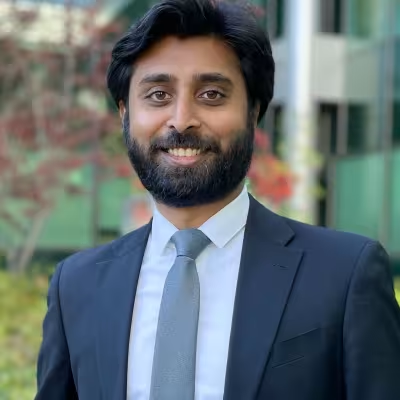
Arun Richard Chandrasekaran
BSc in Zoology, The American College, Madurai, India
MTech in Nanoscience, University of Madras, Chennai, India
MS, Chemistry, New York University
PhD, Chemistry, New York University
About
Arun Richard Chandrasekaran is an Assistant Professor of Nanoscale Science and Engineering at UAlbany. He formerly ran his independent lab at The RNA Institute at UAlbany.
Prior to his independent position, Professor Chandrasekaran did his PhD in Chemistry in Ned Seeman's lab at New York University and his post-doctoral research with Ken Halvorsen at UAlbany. He later worked in a diagnostics start-up company in Boston for two years and as an Entrepreneur-in-Residence at UMass Lowell.
Dr. Chandrasekaran’s research lab focusses on using DNA as a material to build nanoscale structures, with applications in drug delivery, data storage and crystallography. Professor Chandrasekaran is an editorial advisory board member in the journal iScience at Cell Press and is a member of the Nanoscale Horizons journal Community Board.
Research
Arun Richard Chandrasekaran on Google Scholar
Research Interests
Our group focusses on using DNA as a material to design and build synthetic nanostructures and functionalizing them for different applications.
We currently work on developing strategies to enhance the biostability of DNA nanostructures so that they can survive in physiological conditions (for example, withstand degradation by nucleases), to attach drug molecules at specific sites of the nanostructure (for example, click chemistry) and to release drugs by external stimuli (for example, biological stimuli such as other nucleic acids or physical stimuli such as light).
Working with biological and clinical collaborators, we are currently developing DNA nanostructures that can act as drug delivery platforms.
We are also interested in rationally designing DNA motifs that can assemble into 3D DNA crystals. These crystals will contain cavities that can accommodate other guest molecules, acting as a scaffold for X-ray based structure determination.
Some of our other interests are in designing DNA devices that can perform logic operations and act as short-term information storage devices.
Grants/Funding
National Institute of General Medical Sciences (NIGMS) - National Institutes of Health (NIH)
National Institute on Aging (NIA) - NIH
Publications
BR Madhanagopal and AR Chandrasekaran, DNA nanocarriers for nucleic acid drug delivery. Expert Opin. Drug Del. DOI: 10.1080/17425247.2025.2565418 (2025).
H Talbot and AR Chandrasekaran, Mismatch-induced toehold-free strand displacement used to control a DNA nanodevice. ACS Synth. Biol. 14: 1931 (2025).
A Rodriguez, BR Madhanagopal, K Sarkar, Z Nowzari, J Mathivanan, H Talbot, A Patel, V Morya, K Halvorsen, S Vangaveti, JA Berglund and AR Chandrasekaran, Counterions influence the isothermal self-assembly of DNA nanostructures. Sci. Adv. 11: eadu7366 (2025).
[Cover feature] BR Madhanagopal, H Talbot, A Rodriguez and AR Chandrasekaran, Switchback RNA. ACS Chem. Bio. 19: 2394 (2024).
[Cover feature] BR Madhanagopal, H Talbot, A Rodriguez, JM Louis, H Zeghal, S Vangaveti, K Reddy, AR Chandrasekaran,* The unusual structural properties and potential biological relevance of switchback DNA. Nature Communications 15: 6636 (2024).
BR Madhanagopal, A Rodriguez, M Cordones, AR Chandrasekaran,* Barium concentration-dependent anomalous electrophoresis of synthetic DNA motifs. ACS Appl. Bio Mater. 7: 2704 (2023).
H Talbot, BR Madhanagopal, A Hayden, K Halvorsen, AR Chandrasekaran, Fluorometric determination of DNA nanostructure biostability. ACS Appl. Bio Mater. 6: 3074 (2023).
[Cover feature] A Rodriguez, D Gandavadi, J Mathivanan, T Song, BR Madhanagopal, H Talbot, J Sheng, X Wang, AR Chandrasekaran, Self-assembly of DNA nanostructures in different cations. Small 19: 2300040 (2023).