





Undergrad Research Project Develops Haptics to Assist the Visually Impaired

By Bethany Bump
ALBANY, N.Y. (Sept. 2, 2025) — Rohan Patrick Jr. has always been interested in computers and technology, and knew he wanted to pursue a career that would allow him to innovate in these areas.
That’s why the UAlbany senior was excited to participate in the College of Nanotechnology, Science, and Engineering’s Summer Undergraduate Research Program (SURP). The 10-week program provides young scientists and engineers with opportunities to conduct hands-on research under the guidance of UAlbany faculty mentors to solve real-world problems.
Working with Aishwari Talhan, a senior research scientist in the Division for Research & Economic Development and affiliated faculty in the Department of Electrical & Computer Engineering, Patrick was able to develop a vest this summer that provides navigation assistance to the visually impaired using a mix of camera vision, machine learning and haptic technology that sends vibrations to the user.
“I’ve always had a real drive to innovate, invent and think of cool ideas,” said Patrick, who is majoring in electrical & computer engineering. “So this was really a good program for me to get into and that’s why I’m really happy to be here.”
Patrick was one of a handful of students whose summer research focused on haptics, or the science of touch. Throughout the 10-week program, students developed haptic devices that can assist individuals with disabilities, better train surgical students, and enhance social and emotional connections.
What is Haptics?
Haptics refers to the sense of touch, encompassing both tactile and kinesthetic information that enables people to perceive and interact with objects in their environment. When incorporated into technology, haptics produces sensations — often through forces, vibrations and other feedback — to enhance the user experience.
Initially used in the aviation industry to provide pilots with pre-stall warnings through natural control vibrations, it eventually spread across industries and is now used in everything from video game controllers, mobile phones, steering wheels, medicine, dentistry and virtual reality.
“Ours is the only lab at UAlbany focused on haptics technology in a more innovative way to enhance the user experience,” Talhan said, referring to the Immersion Lab where she, as founder and principal investigator, supervises UAlbany researchers in developing haptics technologies for immersive experiences.
Over the summer, SURP students worked with Talhan to develop a range of haptic wearable devices she had specifically tailored problems for them to work on using haptics and artificial intelligence technologies. They presented their findings at two poster sessions held Aug. 7 in the Albany NanoTech Complex and Aug. 8 in ETEC.
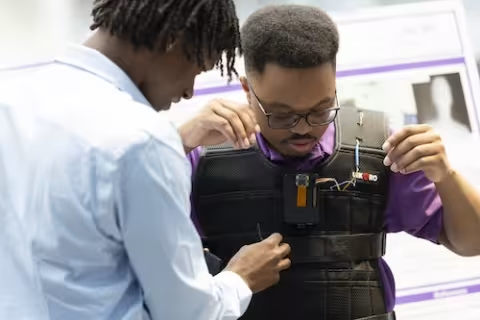
To make a haptic vest, Patrick mounted a single camera to the front and installed vibrating motors along specific patterns on the back. He used two different machine learning models — one for object detection and another for depth estimation — running on a Raspberry Pi to process the camera’s video feed.
“So basically as the user is walking through indoor environments, the camera will interpret the environment and communicate what it sees through specific vibrations,” he said. “Estimating the distance helps us determine the intensity of that vibration. So the closer you are to an object, the more intense that vibration becomes.”
Currently, the vest can detect staircases, exit signs and doors, and communicates these obstacles to the user through a set of specific vibrations. Patrick said with more time the vest could be developed further to navigate many more objects in increasingly complex environments.
“I’m most proud of training my own model,” he said. “I'm a machine learning fanatic. I really love machine learning and I see its potential application. So training the model, and not only training the model, but researching to find a framework that checks all the boxes for what I needed programmatically, is something I was proud of.”
Kesh Kesavadas, a co-founder of the Immersion Lab and a faculty member at CNSE who also serves as vice president for research and economic development at UAlbany, has been a leader in the field of haptics for over two decades.
"The sense of touch is often the missing piece in simulations, from medical training to online shopping," said Kesavadas. "I'm thrilled about the SURP summer program because it lets students explore science and technology in a way traditional classroom education can't. These haptic projects are good examples where students are developing and demonstrating incredible concepts with future applications but also gaining valuable skills that are highly sought after in today's AI-driven technical fields.”
Widespread Application
The widespread application of haptics across industries was evident in the other devices developed by students through the SURP program this summer.
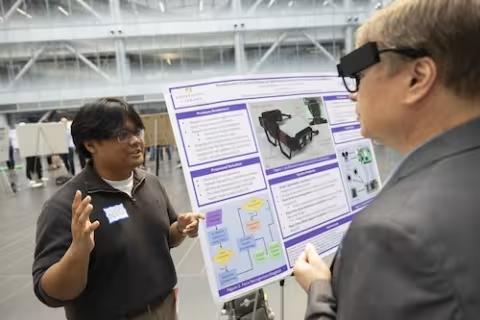
Neoren Rapisura, a rising sophomore at UAlbany majoring in electrical & computer engineering, built a pair of smart glasses that can help visually impaired users to interact with their surroundings and navigate in the real world. The glasses provide discrete feedback through multimodal output.
Ethan Valente, a McGill University student who was among a handful of non-UAlbany students accepted into the SURP program, developed a video calling application that combines a previously developed haptic headset by Talhan, which can be used during video conferencing to communicate emotions. The headset was programmed to trigger a specific set of sensations for the user to enhance their experience.
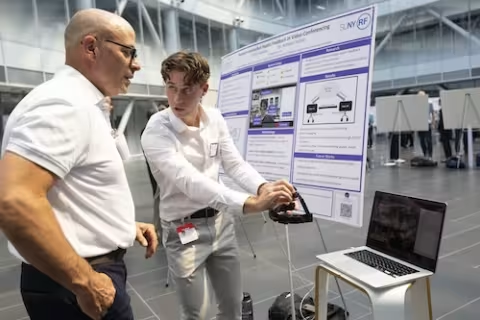
Toluwani Alao, a senior electrical & computer engineering major at UAlbany, developed a haptic-based surgical device that can be used to train dentists and surgeons in non-clinical settings.
Jaleel Khan, a senior electrical & computer engineering student at UAlbany, worked on the development of a soft-haptic actuator to deliver various human touch sensations in digital settings.
“In just a 10-week short SURP timeframe, we are committed to ensuring students gain exposure to fundamental aspects of research,” said Talhan. “Our goal is to equip them with essential skills that may have previously been inaccessible, ultimately helping them fill gaps in their profiles. This experience will foster a strong sense of achievement and boost their confidence.”
These projects will continue for further exploration under Talhan's supervision in the Immersion Lab.
Summer Undergraduate Research Program
CNSE’s Summer Undergraduate Research Program initially launched about 10 years ago, and has expanded to include faculty mentors from all four departments in the college — Nanoscale Science & Engineering, Electrical & Computer Engineering, Computer Science, and Environmental & Sustainable Engineering — as well as the Department of Chemistry in the College of Arts and Sciences.
This year, the program raised $237,500 to fund 37 summer research positions, including $52,000 from industry partners.
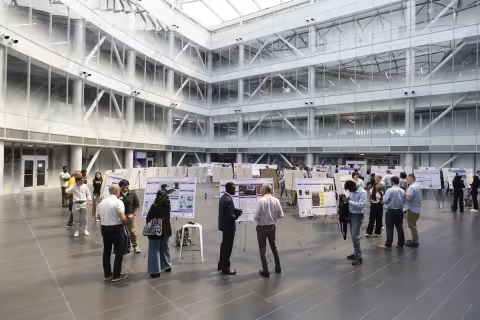
“The program allows young students to explore completely new areas of science and engineering,” said Robert Brainard, professor of nanochemistry and chair of the SURP committee. “Unlike laboratory classes, these research projects allow students to explore new areas of science and engineering where no one knows the answers — even their faculty mentors.”
In addition to gaining valuable research experience, students developed important communication skills throughout the 10-week program by presenting their research to non-experts at a midway point through the summer, as well as at final poster sessions in August.
“This skill will help them in many ways in their life, specifically job interviews and working in interdisciplinary teams in their professional work life,” Brainard said. “Ultimately, each SURP student creates a technical story that they can tell in their next steps in their career, including job interviews and interviews for graduate school.”