


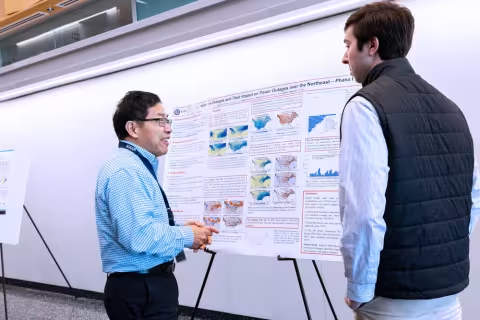
UAlbany Atmospheric Science students conducting field research at a weather station on Whiteface Mountain.

Master of Science  in
Atmospheric Science

Program of Study

programofstudy

With a focus on research, you will study with faculty who specialize in atmospheric dynamics, physics, and chemistry, or climate science. 

Through coursework, you will develop broad knowledge of the physical processes that govern our atmosphere and oceans. With guided research, you will specialize in synoptic, tropical, and mesoscale meteorology (extreme weather), atmospheric chemistry and physics (active gases and particles), or climate and environmental systems (climate prediction), culminating in your master’s thesis.


Atmospheric Science Courses

(18 credits minimum)

  • Introduction to Atmospheric Physics I and II
  • Atmospheric Dynamics
  • Synoptic-Dynamic Meteorology
  • Tropical Meteorology
  • Large-scale Dynamics of the Tropics
  • Basic Concepts of Atmospheric Transfer Processes
  • Climate Dynamics and Modeling
  • General Circulation of the Atmosphere
  • Boundary Layer Meteorology
  • Mesoscale Processes

Master’s Thesis

(6 credits)


Supporting Courses

(0-12 credits) - Courses in other fields, as advised


Major Field Examination in Atmospheric Science

Oral presentation of research.


Ancillary Duties

Satisfactory performance in teaching, research, or practicum duties contributing to academic development.


Professional Development

You will work with your faculty advisor to develop a mentoring plan that includes professional development support.

In most instances, financial support is available through research grants to attend national conferences and for travel support. Some annual meetings, such as the AMS and AGU, offer travel funding.

Research
 

Research projects are funded by federal, state and corporate grants. In addition to covering the costs of doing research and presenting results at international conferences, grants cover student tuition and a stipend.

Research projects may include:

  • Tropical Cyclones and Hurricanes
  • Mountain and Topography Influences
  • Climate Modeling
  • Urban Climate and Weather
  • Glacier-Climate Interactions
  • Thunderstorm Electrification and Lightning
  • Solar and Wind Energy
  • Synoptic / Dynamic Meteorology and Atmospheric Chemistry


As a graduate researcher you will have access to UAlbany’s Atmospheric Sciences Research Center (ASRC), with opportunities to study atmospheric physics, chemistry and renewable energy.

Beyond the ASRC, take advantage of the National Weather Service, which is right on campus. Here you can apply for internships and cooperative research.


Opportunities for individuals from underrepresented groups

We encourage individuals from underrepresented groups to contact faculty members to discuss research opportunities. In addition to the opportunities below, other opportunities might exist through university or external diversity fellowship programs that will allow you to work with a faculty member to craft a unique research project. For more information, email individual faculty members with whom you are interested in working, or contact Brian Tang, Chair of the department's Inclusion and Diversity Committee.

ms-atmos-research
Graduate Student Research Opportunities
Research Opportunities

Dr. Sukanta Basu

2026 opportunities coming soon.


Dr. Kristen Corbosiero

Dr. Tang and Dr. Corbosiero are jointly recruiting a graduate research assistant to work on tropical cyclone downshear reformation. Downshear reformation occurs when the center of a tropical cyclone reorganizes in deep convection that is displaced from the center due to vertical wind shear. Possible research directions include: 

  1. Analyzing mesoscale precursors and processes to downshear reformation in model simulations.
  2. Investigating observations collected in downshear reforming storms
  3. Understanding the predictability of downshear reformation.

This project is in collaboration with the NOAA Hurricane Research Division.


Dr. Aiguo Dai

Pending funding availability, Dr. Dai may be able to recruit a new student to work on land surface humidity changes.


Dr. Oliver Elison Timm

Dr. Timm does not anticipate admitting new students in 2026.


Dr. Jeffrey Freedman 

2026 opportunities coming soon.


Dr. Jorge González-Cruz 

2026 opportunities coming soon.


Dr. Aubrey Hillman 

2026 opportunities coming soon.


Dr. Jiaxi Hu

Dr. Hu invites applications for one to two PhD positions to study extreme weather-related topics using remote sensing (radar, satellites, etc.) with AI/ML preferred. This opportunity is ideal for candidates passionate about severe weather and cloud physics. Potential research topics include:  

  • Microphysics Focus: Investigate extreme weather microphysics using polarimetric radar and satellite observations. Research will characterize precipitation processes in severe convection, tropical systems and winter storms. Candidates should have strong programming skills (Python/MATLAB) and interest in cloud physics, remote sensing and data analysis.  
  • QPE/Rainfall Focus: Develop advanced quantitative precipitation estimates for extreme rainfall events and study its mechanism. Work involves integrating multi-platform observations (radar, satellites, lightning) with machine learning techniques to improve precipitation retrievals. Background in atmospheric sciences, remote sensing or data science preferred. Programming experience essential.  
  • Aerosol-Cloud Interaction Focus: Study aerosol-cloud interactions and impacts on precipitation systems. Utilize polarimetric radar, satellite remote sensing and AI/ML methods to investigate how aerosols affect convective development and microphysics. Ideal candidates have interests in cloud physics, dynamics and computational methods.


Dr. Sara Lance 

Pending funding availability, Dr. Lance will be recruiting two new graduate students to assist with a new research project involving measurements of atmospheric particulates, gases and/or cloud water chemical composition collected in the Adirondacks at the Whiteface Mountain (WFM) field station.

Learn more about previous and ongoing research in the Lance Lab


Dr. Cheng-Hsuan (Sarah) Lu 

2025 recruitment opportunities TBD.


Dr. Scott Miller 

2026 opportunities coming soon.


Dr. Justin Minder 

Pending funding availability, Dr. Minder may be recruiting a student to research regional climate change over the Andes Mountains. This research would involve analysis of high-resolution regional climate simulations to understand patterns and mechanisms of temperature change over complex terrain.


Dr. Jake Mullholland

2026 opportunities coming soon.


Dr. Sujata Murty 

Dr. Murty does not anticipate admitting new students in 2026.


Dr. Brian Rose 

Dr. Rose may be recruiting a new PhD student to work on a project of mutual interest in the broad area of global climate dynamics. 

Current research foci in the Rose group include:

  • Arctic amplification and high-latitude climate processes
  • Understanding the role of the oceans in multi-decadal climate variability and climate sensitivity
  • Land-atmosphere interactions
  • Understanding the holistic climate response to stratospheric aerosol injection

Dr. Rose also has strong interests in Open Science, computational reproducibility, scientific software and communication. Learn more about the Rose Group.


Dr. Paul Roundy 

2026 opportunities coming soon.


Dr. Kara Sulia 

Dr. Sulia does not anticipate admitting new students in 2026.


Dr. Brian Tang 

Dr. Tang and Dr. Corbosiero are jointly recruiting a graduate research assistant to work on tropical cyclone downshear reformation. Downshear reformation occurs when the center of a tropical cyclone reorganizes in deep convection that is displaced from the center due to vertical wind shear. Possible research directions include: 

  1. Analyzing mesoscale precursors and processes to downshear reformation in model simulations.
  2. Investigating observations collected in downshear reforming storms
  3. Understanding the predictability of downshear reformation.

This project is in collaboration with the NOAA Hurricane Research Division.


Dr. Chris Thorncroft 

2026 opportunities coming soon.


Dr. Ryan Torn 

Dr. Torn does not anticipate admitting new students in 2026.


Dr. Mathias Vuille 

Dr. Vuille does not anticipate admitting new students in 2026.


Dr. Zheng Wu 

Dr. Wu does not anticipate admitting new students in 2026.


Dr. Fangqun Yu 

Dr. Yu is seeking 1-2 graduate students with strong backgrounds in physics, mathematics and modeling to join the Yu Lab. 

Research opportunities will focus on the following topics: 

  • Aviation's Non-CO2 Climatic Impacts: Aviation influences the climate not only through CO2 emissions but also through non-CO2 effects, such as contrail formation and their impact on cirrus clouds. Currently, non-CO2 effects account for about two-thirds of aviation's climate forcing, yet significant uncertainties remain in the assessment of these impacts. This research will seek to address the challenges the aviation industry faces in reducing its climate footprint. Students will have the opportunity to engage directly with industry partners and collaborate on cutting-edge solutions. 
  • Solar Radiation Management (SRM): While the immediate priority in addressing the climate crisis is to reduce greenhouse gas (GHG) emissions, SRM is gaining attention as a potential method to temporally reduce global warming and associated damages until we have reached the net zero GHG goal and GHG removal techniques are developed and scaled up. A 2021 report from the National Academies of Sciences, Engineering, and Medicine, titled "Reflecting Sunlight," underscores the urgent need for a deeper understanding of SRM’s processes, feasibility and its potential risks and benefits.  
  • Atmospheric Particles and Their Impact on Climate and Air Quality: This project focuses on understanding the role of atmospheric particles in cloud formation, precipitation and their broader effects on climate and air quality. Research will include process-level investigations of aerosol-cloud interactions, regional to global-scale modeling, and usage of machine learning to improve models.  

These projects offer a unique opportunity to contribute to critical environmental and climate research while working in a dynamic and collaborative setting.


Dr. Xueying Yu

Dr. Yu is looking for one PhD student. Example study topics for this position include:

  • Applying satellite remote sensing techniques in atmospheric chemistry.
  • Modeling greenhouse gases and air pollutants using chemical transport models.
  • Conducting Bayesian inversion analyses to interpret carbon and climate processes. 


Dr. Liming Zhou 

Dr. Zhou has an opening for one MS/PhD student to join his group as a research assistant on a new NSF-funded project studying land–atmosphere interactions—specifically, soil moisture–precipitation feedbacks over the Congo rainforest.

Dr. Zhou is seeking a student with a strong background in data analysis and/or mesoscale modeling experience. If you're interested or have any questions, please contact Dr. Zhou at [email protected]

Teaching and Research Assistantships

You will have teaching assistant (TA) and research assistant (RA) opportunities under the supervision of departmental faculty. TAs and RAs are typically paid for 20 hours of work per week. TA and RA graduate students have equal annual pay. See the Graduate Student Handbook for details on stipends. 

Teaching Assistant 

The major duties of TAs include grading course assignments, quizzes and exams, leading discussion sections, monitoring lab exercises, holding office hours and assisting with other tasks as assigned. Some courses are taught fully online and the main interaction with students takes place via online resources, such as Brightspace.  

TAs are expected to conduct research work during summer, which is paid for through funds from research grants from your faculty advisor.  

The funds for TAs come from the state of New York through the University’s Graduate School and the College of Arts and Sciences to assist the teaching of a course. 

Research Assistant 

The major duties of RAs are to assist the professor with a specific research project. This typically includes analyses, experiments and labs, simulations, programming, and writing and publishing research papers. This work is usually immediately related to your thesis or PhD work. 

The funds for RAs come from a research grant under a professor.

Should I apply to the MS or PhD Atmospheric Science program? 

If you have a bachelor's degree in atmospheric science or a closely related field, including physics, mathematics, and environmental science, you have the option to apply to the MS program or the PhD program.  

MS Atmospheric Science Degree

An MS degree can be earned as a terminal degree or as part of the path toward a PhD. MS students typically take 2 to 2.5 years to complete their degree. You will work on your research thesis under the supervision of your faculty advisor(s) and write a master’s thesis. 

PhD Atmospheric Science Degree

The PhD degree usually takes an additional three years beyond the MS. The total time from start of graduate school to PhD averages 5-6 years. The goal of the PhD program is to train scholars to create and communicate new knowledge. You will work towards the goal of successfully defending your dissertation topic. 

Applying directly to the PhD program provides you with more flexibility in terms of funding options. If you apply and are accepted into the PhD program, you can earn a master’s degree along the way to your PhD degree. However, you are not required to complete your PhD. You can leave the program after completing your master’s. If you decide to pursue a PhD later, you will not need to reapply and pay the application fee. 


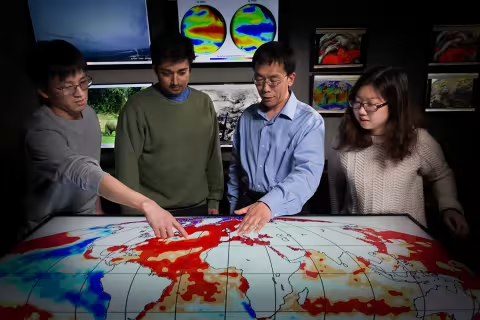
4 people looking at a weather map on a table with screens of weather maps behind them

Career Outcomes

With an MS in Atmospheric Science, you will be fully equipped to pursue a career that involves research, forecasting or education.

Potential job titles with an atmospheric science master's degree include:

  • Meteorologist
  • Science teacher
  • Insurance consultant
  • Agriculture analyst
  • Laboratory technician
  • Scientific instrument engineer
  • Earth data support scientist
  • Catastrophe analyst
  • Science writer
career

"Choosing UAlbany for my graduate studies was the best academic decision I've made. The department specializes in a wide range of topics, giving students a variety of classes and thesis concentrations to choose from. I've always found the faculty to be approachable and willing to make time to help me understand concepts and discuss research questions. This commitment to students led to numerous opportunities to attend conferences and workshops around the country to present my research."

- Matt Vaughan, MS ’15, PhD ’20 (expected)

International Students

This degree is designated as a STEM program. International students maintaining F-1 status are allowed to apply for up to 12 months of post-completion Optional Practical Training (OPT) following completion/graduation from their degree program. Currently, this degree program is also designated by the Department of Homeland Security (DHS) as an eligible degree for the F-1 STEM OPT work authorization extension; students who secure qualifying employment may be eligible to apply for the STEM OPT extension for a cumulative total of up to 36 months of F-1 OPT work authorization.

Accelerated Undergraduate/Graduate Option

If you’re a current UAlbany undergraduate student with at least a 3.0 GPA, you may be eligible to begin your graduate degree coursework as early as your junior year. Save time and money by applying up to 12 academic credits, billed at the undergraduate rate, towards both degrees. By doing so, you may be able to complete your combined program in only 5 years and spend less than you would if you completed each program separately.

Contact your undergraduate advisor to see if you’re eligible and learn about your combined graduate program options.

UAlbany graduate with confetti at Commencement.
Admissions Requirements
Deadlines
Deadlines

Priority Review Deadline

  • Fall: January 5 
  • Spring: Not Available 
  • Summer: Not Available


No Departmental Assistantship Consideration

  • Fall: Rolling
  • Spring: November 1
  • Summer: Not Available
Other Important Dates
  • Before January 5: If you’re applying for admission for the Fall semester, explore research opportunities in advance and contact faculty members with any questions
  • January 5: When you submit your application by this deadline, you are eligible, contingent on offer status, to be invited to visit our department in February
  • Beginning February 1: Offers for RA / TA / ASRC fellowships are sent out to admitted applicants; Invitations to visit DAES/ASRC are sent out
  • End of February: Recruitment visit weekend; More admissions offers are made for self-funded MS positions
  • March-April: Make your decision to accept or decline offer
  • April 15: Final date for applicants to decide on pending offers
  • After April 15: Additional offers for RA / TA positions are made

For more information, please contact Oliver Elison Timm at [email protected].

Required Application Materials
  • Transcripts from all schools attended
  • Three letters of recommendation
  • Statement of goals

Applications for the Fall term received by January 5th will receive priority consideration.

Application Requirements

In addition to the general University at Albany requirements for admission to graduate study, an applicant's undergraduate preparation should include: 

  • 3 semesters of a college calculus sequence for science/engineering majors, with a course in differential equations
  • 2 calculus-based, college physics courses or related physics and math-based engineering or natural sciences courses
  • At least one college-level chemistry or geochemistry course

Note: GRE scores are not required when applying for admission to the MS Atmospheric Science program.

A student who is deficient in these subjects will be expected to make up the deficiencies during the first year of graduate study, in consultation with their faculty advisor(s). A lack in one or more of these courses does not automatically disqualify a student from admission. Alternative courses, research or work experience that demonstrate a strong background in math and physics can provide equivalent preparation. With the increasing demand for data analysis skills in professional positions, incoming students are expected to have basic skills in at least on computer coding language.

Application Review Process

 The Atmospheric Science department’s Graduate Recruitment Committee will evaluate and rank each applicant on a holistic view (academic preparation; potential for scholarship; alignment with the program; diversity, equity and inclusiveness; self-appraisal and areas of personal growth) based on all submitted documents, such as GPA, grades for key courses, recommendations, statement, research experiences, any publications and supplemental materials. In addition, there may be an interview by faculty members if they have a specific interest in your application.

For questions about the application review process, contact Oliver Timm at [email protected].

Tips for Writing Your Goals Statement

Your statement should explain why you’re applying to the program and what makes you a strong applicant, both of in terms of your scholarly and non-cognitive skills. Your statement also allows you to differentiate yourself by sharing a little bit about what makes you unique. Please include a brief description of your field(s) of interest, related background, desired area of study, and research emphasis/career goals. Additionally, you should address the following items in your statement:

1. If you feel that any aspect of your past that is included in your application could be unfavorable to your admission (for example, a poor undergraduate GPA), you should discuss this aspect and how you have addressed it.


2. Please self-appraise your strengths and weaknesses, along with areas for personal growth that will make you successful in graduate school. For example, you may write about how you overcame obstacles in the past and what you have learned from those experiences about yourself. Or, you may want to tell us more about your plans or ideas on how to be aware of, and better respond to, potentially challenging situations as a graduate student.

3. Please include additional information that puts your application in a broader context. For example, you may write about your service and outreach activities and/or goals, including furthering equity, diversity, and inclusion in STEM for marginalized and minoritized individuals.

What Happens After I Apply?

Individual faculty will communicate directly with prospective students who share similar research interests. All students to be admitted should have identified and mutually agreed academic advisors. UAlbany's Graduate School will make the admission offer for each student once the student-advisor agreement is reached. If funding is offered, in a separate offer letter the academic advisor will be named, and the position and stipend as a research assistant or a teaching assistant will be specified. You will have until April 15 to accept or decline the offer.

admissions
Student Learning Objectives

Learning objectives that UAlbany students are expected to attain through their course of study within their academic program.

Master of Science
Master of Science
  • Demonstrate a clear mastery of advanced concepts in atmospheric physics, chemistry and dynamics
  • Carry out a limited-scope, directed research project on an atmospheric science related topic that includes:
    • Review of literature on past experiments on research topic
    • Application of common scientific practices in observational data analysis, numerical modeling, and/or mathematical analysis of relevant phenomena
    • Analysis of results using appropriate quantitative methods
  • Document, detail, and defend the research conducted in a formal written thesis, including an oral presentation and defense
  • Develop effective written and oral communication skills that lead to the dissemination of research results to fellow atmospheric scientists and the broader community under the direction of an advisor  
slo