AI & Society College

About the College

Founded in Spring 2025 with a $2.4 million investment from the State University of New York (SUNY), the AI & Society College prepares undergraduate and graduate students, faculty and staff for a world shaped by artificial intelligence (AI).  

With a strong emphasis on trustworthiness, equity, privacy and accountability, the College serves as a catalyst integrating AI education across all nine schools and colleges at the University at Albany.

The College ensures that every student — whether they are pursuing a degree in STEM, business, social sciences or the arts — has access to AI-infused learning through cross-disciplinary courses, microcredentials and teaching initiatives.
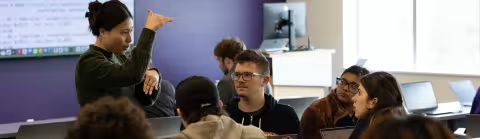
 

A UAlbany professor gestures as she speaks to a group of students working in a full classroom.


Physical Space & AI Makerspace

The College will be housed in a multifunctional space in the Lecture Center (LC) 30 and LC 31 designed for collaboration and innovation.  

Features will include individual and group workspaces for fellows, AI-enabled meeting room for hybrid events, a lounge for informal exchange and networking, and GPU workstations in the AI Makerspace.  

The AI Makerspace will be open to all members of the UAlbany community, supporting hands-on exploration of generative, predictive and automated AI.
Stay tuned for news about our Spring 2026 ribbon cutting ceremony!


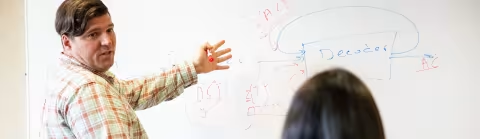
A UAlbany professor gestures toward a white board, where he's drawn a sketch labeled "Decoder." A seated student is visible in the foreground.


Contact the College

There's a place for everyone in shaping the future of AI and its impact on society.  

  • Campus Community: Faculty, staff and students are invited to co-create innovative teaching, learning experiences, interdisciplinary programs and ways to promote ethical AI use.
  • Partners Beyond Campus: The AI & Society College welcomes partnerships with industry, nonprofits, government and philanthropists to explore how AI can serve society.

Contact us at [email protected] to start a conversation or to invite us to speak to your team/organization.  
Follow the AI & Society College on LinkedIn. 

Opportunities


Apply Now: 2026-2027 AI & Society Fellowships

Interested in applying to the Faculty Research Fellowship? Visit the AI & Society Research Center for more opportunities!


AI & Society Faculty Innovation Fellowship

The AI & Society College is now accepting Faculty Innovation Fellowships applications for the 2026-2027 Academic Year.  
 

faculty-fellowship
Faculty Innovation Fellowship Description

The aim of the Faculty Innovation Fellowship is to incubate, catalyze and support innovative, faculty-led, academic initiatives that expand the range and depth of UAlbany’s AI-infused curriculum.  

This includes engaging students in the development of AI, the application of AI, critical inquiry into broader questions of AI’s significance for the human condition, and creative projects that deploy or comment on AI.  

Outputs may include the development of:

  • Courses and academic programs
  • Faculty training and upskilling (applicant could be the trainer or the trained)
  • Microcredentials
  • Creative projects, exhibitions, events
  • Symposia or campus events
  • Educational software or AI-tools for the classroom
  • Teaching materials, textbooks

We are also open to applications that combine the above elements as well as suggestions for other kinds of initiatives. Priority will be given to projects that meaningfully engage experts across disciplines.

If you are not sure whether your project is appropriate, feel free to reach out to Hany Elgala at [email protected] or Mila Gasco Hernandez at [email protected].  

Faculty Innovation Fellowship Expectations

Tasks: Fellows will complete the project described in their application within the 2026-2027 Academic Year.

Mentoring: Fellows will meet every other week with their assigned mentor.

Participation: Fellows will be expected to take part in the AI & Society College and AI & Society Consortium events. In addition, fellows will be expected to participate in a videotaped interview with AI & Society College leadership for the College’s website and/or to write one to two articles/blog posts.

Progress and final reports: Fellows will be expected to report their progress at the end of the Fall 2026 semester and to write a detailed final report describing the work undertaken at the end of the Spring 2027 semester. 

Faculty Innovation Fellowship Eligibility & Application

We encourage applications from non-tenure-track, tenure-track and tenured faculty across academic units.

Applicants must submit a CV (maximum three pages) and a document that includes responses to the following prompts:

  1. Describe the aim and scope of your project. (300 words maximum)
  2. Describe the steps necessary to realize this project. (300 words maximum)
  3. Do you have collaborators on this project on or off campus? (200 words maximum)
    • Preference will be given to projects that involve collaborations across disciplines and academic units.
  4. What form of support would be most useful to support the completion of your project?  
    • You may select one course release (specify semester), or you may select one or more of the following options, with the total funding not to exceed the total of one course release ($6,000):
      • Research funds (specify use of research funds, including equipment, training, travel and supplies)
      • Graduate Assistant (specify number of hours)
      • Stipend or summer salary
      • Other (please specify)

Materials should be submitted to Dr. Mila Gascó-Hernandez at [email protected].

Applications are due by March 15, 2026, and decisions will be communicated by April 15, 2026. The fellowship will start on August 24, 2026.


AI & Society Doctoral Dissertation Fellowships

The AI & Society College is now accepting Doctoral Dissertation Fellowships applications for the 2026-2027 Academic Year. These fellowships support PhD students conducting research at the intersection of artificial intelligence (AI) and society.  
 

dissertation-fellowship
Doctoral Dissertation Fellowship Description

The fellowship provides a $25,000 stipend as well as tuition waiver for one year to support PhD students as they work on their dissertations and pursue AI research aimed at addressing societal challenges.  

AI & Society Doctoral Dissertation Fellows will join a vibrant, interdisciplinary community of scholars dedicated to leveraging AI for positive social impact.

Doctoral Dissertation Fellowship Expectations

Fellows will be expected to:

  • Teach one section of UUNI 118: Introduction to Artificial Intelligence, which is a one-credit, three- to four-week course. No previous specialized or technical training is required to teach this class, and fellows will be provided with all teaching materials.
  • Present work-in-progress at AI & Society College roundtables with other fellows or at AI & Society College events, such as interdisciplinary research discussions
  • Mentor undergraduate and master’s students working on AI & Society projects
  • Contribute to the College’s development by monitoring the email account, posting on social media, organizing events, providing administrative support, and finding funding opportunities, among other tasks. A specific task will be given to each of the fellows, with assignments taking each fellow’s background and interest into account. Follow-up meetings with the director and/or associate director will be scheduled on a regular basis.
  • Be ambassadors of the College by representing the College with integrity, engaging actively in its events and outreach, promoting a positive image in all interactions, and sharing experiences to inspire others 
Doctoral Dissertation Fellowship Eligibility

We seek proposals on AI research from disciplines across UAlbany's nine schools and colleges. Successful proposals must demonstrate attention to the social or ethical implications of artificial intelligence.

This may include critical or historical reflection on AI’s significance for the human condition, artistic practice that deploys AI or critical analysis of the implications of AI for creative practice, and the application of AI for addressing real-world problems.  

Required Qualifications:

  • Be a current UAlbany doctoral student in the final year(s) of a PhD program (preference will be given to fourth- and fifth-year PhD students)
  • Demonstrate academic excellence and research potential
  • Describe research focuses on AI in the context of societal impact

Preferred Qualifications:

  • Involved in interdisciplinary collaboration and public engagement

Note: Applicants will not be eligible if they are already funded (for example, through graduate or research assistantships) or are already working at the allowed PhD student work hours. 

Doctoral Dissertation Fellowship Application

Applicants must submit:

  • A research proposal (maximum two pages), outlining:
    • Project objectives and potential societal impact
    • Methodology and timeline
    • Interdisciplinary collaboration plans
  • A one-page personal statement on their commitment to AI for social good and the fellowship expectations
  • A CV (maximum three page)
  • A letter of recommendation from their dissertation supervisor  

Fellows will be selected based on:

  • Their academic record
  • The rigor, originality and relevance of their proposed research
  • Their interdisciplinary approach and collaborative potential
  • Their commitment to responsible AI development and public engagement

Materials should be submitted to Dr. Mila Gascó-Hernandez at [email protected]

Applications are due by March 15, 2026, and decisions will be communicated by April 15, 2026. The fellowship will start on August 24, 2026.


AI & Society Public Engagement Fellowships

The AI & Society Consortium is now accepting Public Engagement Fellowships applications for the 2026-2027 academic year.
 

Public Engagement Fellowship Description

The Public Engagement Fellowship supports faculty-led initiatives that engage the public, policymakers, practitioners, artists or community organizations in meaningful dialogue or collaborative work related to artificial intelligence (AI) and society.  

This includes public-facing events, participatory research, creative and cultural programming, policy engagement, and other innovative approaches to bridging University research and the wider world.  

Outputs may include:

  • Public events, exhibitions or performances
  • Policy briefs, toolkits or community resources
  • Co-designed workshops or training programs
  • Hackathons or design challenges
  • Storytelling or media projects
  • Outreach strategies with underserved communities
  • Applied partnerships with public or nonprofit entities

If you are unsure whether your project qualifies, please contact Hany Elgala at [email protected], Mila Gasco Hernandez at [email protected], Elizabeth Gray at [email protected], or Eric Stern at [email protected]

Public Engagement Fellowship Expectations

Tasks: Fellows will complete the project described within the 2026-2027 academic year.

Participation: Fellows will be expected to take part in AI & Society Consortium events, including an engagement-focused conversation or spotlight feature. In addition, fellows will be expected to present their work at AI & Society events associated with UAlbany Showcase.

Representation: Fellows will be expected to become ambassadors of the AI & Society Consortium, by representing the Consortium with integrity, engaging actively in its events and outreach, promoting a positive image in all interactions, and sharing experiences to inspire others. 

Progress and final reports: Fellows will be expected to report their progress at the end of the Fall 2026 semester and to write a detailed final report describing the work undertaken at the end of the Spring 2027 semester.

Public Engagement Fellowship Eligibility & Application

We encourage applications from all tenure-track, tenured and non-tenure-track faculty across disciplines.

Applicants must submit a CV (maximum three pages) and document that includes responses to the following:

  1. Describe the aims and scope of your project. (400 words maximum)
  2. Describe the steps necessary to realize this project. (400 words maximum)
  3. Do you have collaborators on this project on or off campus? (200 words maximum)
    • Preference will be given to projects that involve collaborations across disciplines and academic units.
  4. What form of support would be most useful to support the completion of your project?
    • You may select one course release (specify semester and indicate whether you have already secured permission from your department), or you may select one or more of the following options, with the total funding not to exceed the total of one course release ($6,000):
      • Stipend or Summer Salary
      • Graduate Assistant (specify role and number of hours)
      • Event or production budget (specify needs)
      • Other (please specify)

Materials should be submitted to Dr. Mila Gascó-Hernandez at [email protected]

Applications are due by March 15, 2026, and decisions will be communicated by April 15, 2026. The fellowship will start on August 24, 2026. 

Fellowship Programs

Through fellowships, faculty and students join the College’s interdisciplinary network dedicated to exploring AI’s societal impact — from ethical frameworks to creative applications.  

The Faculty Innovation Fellowship funds faculty-led initiatives that expand UAlbany’s AI curriculum. Projects may involve student engagement in AI development and application, critical inquiry into AI’s human implications, and creative works that deploy or critique AI. Meet our current faculty fellows.

The Dissertation Fellowship supports PhD research at the intersection of AI and society, including historical and philosophical reflections on AI, artistic practices using AI, and critical analysis of AI’s role in creative and civic life. Meet our current dissertation fellows.

Applications for 2026-2027 fellowships are now open! Please visit the Opportunities tab above for details.


2025-2026 Faculty Innovation Fellows

faculty-innovation-fellows

Cecilia Bibbò
Cecilia Bibbò
Visiting Assistant Professor
Department of Educational Policy & Leadership, School of Education
Sukwoong Choi
Sukwoong Choi
Assistant Professor, Information Systems and Business Analytics (ISBA)
Massry School of Business
Jared R. Enriquez
Jared R. Enriquez
Assistant Professor
Department of Geography, Planning, and Sustainability
Rey Koslowski
Rey Koslowski
Professor, Director of the Master of International Affairs Program
Department of Political Science, International Affairs, Rockefeller College of Public Affairs and Policy
Luis Felipe Luna-Reyes
Chair of Public Administration and Policy, Professor
Department of Public Administration & Policy, International Affairs, Rockefeller College of Public Affairs and Policy
Sweta Vangaveti
Sweta Vangaveti
Research Scientist, Advanced Computational Facility Manager
The RNA Institute
Jianwei Zhang
Jianwei Zhang
Professor
Department of Educational Theory & Practice, School of Education


2025-2026 Dissertation Fellows

dissertation-fellowship

Rawan Abdelaal

Doctoral Student, Curriculum and Instruction

[email protected] 

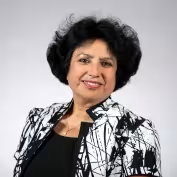
Rawan Abdelaal.
About Rawan Abdelaal and her dissertation
About Rawan Abdelaal 

Rawan Abdelaal is a PhD student in curriculum and instruction at the University at Albany. 

She holds a bachelor’s degree in biotechnology from the City College of New York and a master’s degree in curriculum development and instructional technology from UAlbany. 

Her research explores the relationship between artificial intelligence (AI) and computational thinking (CT) at the intersection of science education. 
 

About Rawan Abdelaal's Dissertation

With the rapid advancement of AI and its ubiquitous presence in daily life, she seeks to investigate and develop methods that promote ethical, critical and effective uses of AI in K–12 classrooms, empowering educators and students to engage thoughtfully and responsibly with intelligent technologies. 

Karan Bhasin

Doctoral Student, Economics

[email protected] 

Karan Bhasin.
About Karan Bhasin and his dissertation
About Karan Bhasin

Karan Bhasin is a PhD candidate in Quantitative Economics and Econometrics at the University at Albany, SUNY.

His research lies at the intersection of monetary economics and applied econometrics, with a focus on how economic agents process information and update their expectations — insights that are critical for understanding inflation dynamics, fiscal policy, and macroeconomic stability.

Karan’s work has been featured in The Economist and The Wall Street Journal and has also appeared in leading policy platforms such as the Brookings Institution, VoxEU and Econofact, reflecting its broad relevance to both academic and policy audiences.

He has held research and policy roles at the International Monetary Fund, World Bank, Empire State Development (New York State), and MyGov, Government of India, bringing a global and applied perspective to his academic work. 

Currently, Karan is exploring the use of natural language processing (NLP) techniques to identify and quantify policy shocks, leveraging textual data to uncover latent signals in economic policymaking.
 

About Karan Bhasin's Dissertation

This thesis investigates the behavior of professional forecasters using data from the Blue-Chip Economic Indicators, applying a Bayesian learning framework that incorporates forecaster inattention. We address a central challenge in macroeconomic policy evaluation: identifying unanticipated monetary policy shocks. Unlike the natural sciences, macroeconomics cannot rely on controlled experiments to establish causality. 

To overcome this limitation, we deploy Large Language Models (LLMs) to systematically extract unanticipated shocks from textual data. By conditioning LLMs on specific sources and temporal contexts, we constrain their information set and improve the precision of causal inference. 

This methodology offers a robust tool for policymakers and researchers to evaluate the effects of monetary interventions and to better understand how professional forecasters respond to economic developments. Moreover, we introduce a novel identification strategy for forecaster inattention that utilizes both individual and consensus forecast revisions. 

Our analysis reveals that zero forecast revisions tend to overstate inattention, and that inattention is horizon-specific, driven in part by the regularity of statistical data releases. Persistent forecast disagreement is attributed to heterogeneous interpretations of news, although periods of club-convergence emerge during large economic shocks.

Anastasios Karnazes

Doctoral Student, English

[email protected] 

About Anastasios Karnazes and his dissertation
About Anastasios Karnazes

Anastasios Karnazes is a PhD candidate in English Studies at UAlbany, researching the material transformation from book technologies to artificial intelligence (AI) systems and its effects on aesthetic production. 

He is the author of Rainbow Sonnets 20, published by The Song Cave, and founder of Theaphora, an experimental book and game publisher. His work has been covered in Artforum, ARTnews, Spike Magazine, and Forbes.
 

About Anastasios Karnazes' Dissertation

This dissertation positions artificial intelligence as the exhaustion point of book logic — the moment when Enlightenment systems of knowledge production, replication, and distribution culminate in computational infrastructure and become fully legible as a unified financial, political, and aesthetic project. 

The work traces how information compression functions transformed through the printing press, encyclopedia, digital storage, networked infrastructure, and cloud computing to the memory systems undergirding AI development, arguing that this transformation refracts into dual domains: the collapse of financial systems into speculative bubbles and the aesthetic-cultural reconfigurations that respond to this trajectory. 

Drawing on both historical analysis of dissemination infrastructures and documentation of experimental work in publishing and text editor development, the dissertation demonstrates the prefiguring relationship between literary production mechanisms and computational intelligence systems, positioning AI not as revolutionary break but as the terminal form through which the book's historical trajectory becomes visible.

Iris Aleida Pinzón Arteaga

Doctoral Student, Sociology

[email protected]

About Iris Aleida Pinzón Arteaga and her dissertation
About Iris Aleida Pinzón Arteaga

Iris Aleida Pinzón Arteaga is a PhD candidate in the Department of Sociology at the University at Albany and member of the AI & Society Research Center. Her research examines how young users adopt generative AI technologies for academic and non-academic purposes, with particular attention to patterns of digital inequality.

An interdisciplinary scholar with a background in psychology and social research, she helped co-design the AI for Social Change Lab with Professor Angie Chung, one of the first courses offered in the Department of Sociology to promote critical reflection on the possibilities and limitations of AI technologies. 

Her forthcoming article: ‘It Will Comfort You’: Analysing Undergraduates’ Interactions with AI Chatbots through a Postdigital Feminist Lens in Postdigital Science and Education analyzes students’ interactions with generative AI chatbots from a feminist perspective.

Iris has also conducted prior research on the therapization of society and the post-truth condition, published in journals such as the European Journal of Psychotherapy & Counseling and Awry: Journal of Critical Psychology, as well as a chapter in the edited volume Creative Disruption: Psychosocial Scholarship as Praxis (2025). 

She is also a member of the interdisciplinary research group Violence, Language, and Cultural Studies at the Autonomous University of Bucaramanga (Colombia).

Access Iris Aleida Pinzón Arteaga's ORCID iD.
 

About Iris Aleida Pinzón Arteaga's Dissertation

The dissertation examines how young people engage with generative AI chatbots in educational settings and how these engagements reflect broader digital inequalities.

While public debate around AI in education tends to frame chatbots as either empowering or threatening, this study instead traces how these technologies are enacted in practice, attending to the boundaries young users draw around authorship, authenticity and legitimate learning.

Adopting a sociomaterial genealogical approach, the study unfolds in two phases: a diagnostic phase that maps how young users in the United States and Colombia interact with generative chatbots within their sociotechnical networks, and a problematization phase that explores the institutional, cultural and material conditions shaping these engagements. 

The comparative design highlights how global asymmetries in digital infrastructures, literacies and access to AI tools produce layered forms of inclusion and exclusion. Through interviews, prompt diaries and document analysis, the project seeks to advance a more nuanced understanding of digital inequality in the age of AI.

Curriculum


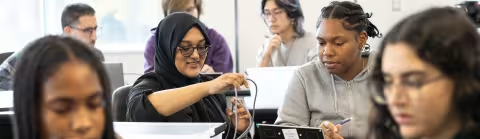
Two students sit inside a full classroom and work together to build an electronic device during an AI-focused class.


Current Offerings

More AI courses, microcredentials and degrees programs for all disciplines are coming soon! Check back for updates.
 

Undergraduate Courses

The College encourages undergraduate students interested in artificial intelligence to explore the following courses:

Visit the Schedule of Classes to explore upcoming course offerings.

Microcredentials
Microcredentials

Microcredentials are a collection of courses and certificates that help learners build in-demand skills and competencies.

Visit the Professional and Continuing Education (PaCE) website to learn more about microcredentials. 

Google AI Certificates

Google and SUNY have partnered to give SUNY students, faculty and staff free access to Google AI learning opportunities.  

Visit the Free Google AI Certificates at SUNY webpage for more information.

 

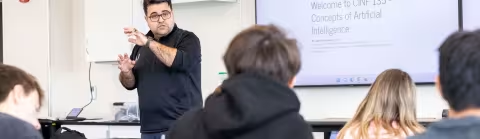
Dr. M. Abdullah Canbaz gestures as he teaches a classroom full of students. The screen behind him shows the course name, CINF 135: Concepts of Artificial Intelligence.


Teaching & Learning Resources 

University Libraries’ Generative AI and Academic Integrity Guide: Learn about the relationship between generative AI and academic integrity, and access other AI resources from the University Libraries.

CATLOE’s Guides for Supporting Students' Learning in the Age of AI: The Center for the Advancement of Teaching, Learning, and Online Education (CATLOE) offers guidance for all instructors, regardless of AI experience level.

Events

Join us for public panels, workshops and conversations throughout the year. Explore all AI Plus Events.


A woman stands among a seated crowd at a UAlbany AI Plus event and speaks into a microphone to ask a question.

2025-2026 Leadership

Acting Director

Hany Elgala
Hany Elgala
Acting Director, AI & Society College, Associate Professor
College of Nanotechnology, Science, and Engineering; Department of Electrical & Computer Engineering

Acting Associate Director

Mila Gascó-Hernandez
Associate Professor & Research Director for the Center for Technology in Government
Department of Public Administration & Policy; International Affairs; Rockefeller College of Public Affairs and Policy

Advisory Board

The College's advisory board includes faculty and student representatives.


Faculty Representatives 


Marcie Newton
Marcie Newton
Assistant Director & Lecturer II
Writing & Critical Inquiry Program
Rita Biswas
Rita Biswas
Ackner-Newman Endowed Professor and Associate Professor, Finance
Massry School of Business
Alessandra Buccella
Alessandra Buccella
Assistant Professor
Department of Philosophy
M. Abdullah Canbaz
M. Abdullah Canbaz
Assistant Professor, Information Sciences and Technology Department
College of Emergency Preparedness, Homeland Security and Cybersecurity, Department of Information Sciences and Technology
Ming-Ching Chang
Ming-Ching Chang
Associate Professor
College of Nanotechnology, Science, and Engineering, Department of Computer Science, Department of Electrical & Computer Engineering
Daniel Goodwin
Daniel Goodwin
Professor of Studio Art, Photography and Related Media Area Head, and Department Chair
Department of Art & Art History
Cecilia Levy
Cecilia Levy
Associate Professor
Department of Physics
Mary Valentis
Mary Valentis
Visiting Associate Professor; CHATS Founder & Director
Department of English
Xin Wang
Xin Wang
Assistant Professor
Department of Epidemiology & Biostatistics, College of Integrated Health Sciences
Jianwei Zhang
Jianwei Zhang
Professor
Department of Educational Theory & Practice, School of Education


Student Representatives 


Alana Borrero

Undergraduate Student
[email protected] 

Alana Borrero.

Shannon Sutorius 

Graduate Student
[email protected] 

Shannon Sutorius.