AI & Society Research Center

AI is reshaping our world. How can we shape AI?

The AI & Society Research Center at the University at Albany is a cross-disciplinary research hub focused on the human and societal dimensions of artificial intelligence.  

The Center brings together faculty, students and partners from across the arts, humanities, social sciences and technical fields to explore how AI is reshaping public life, culture, ethics, and governance — and to design technologies that support, reflect and protect what matters most about the human experience and the society we live in.

Our work explores how artificial intelligence is reshaping the world we live in — and how we might shape it in return. 
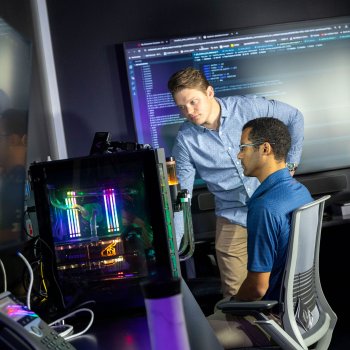
 

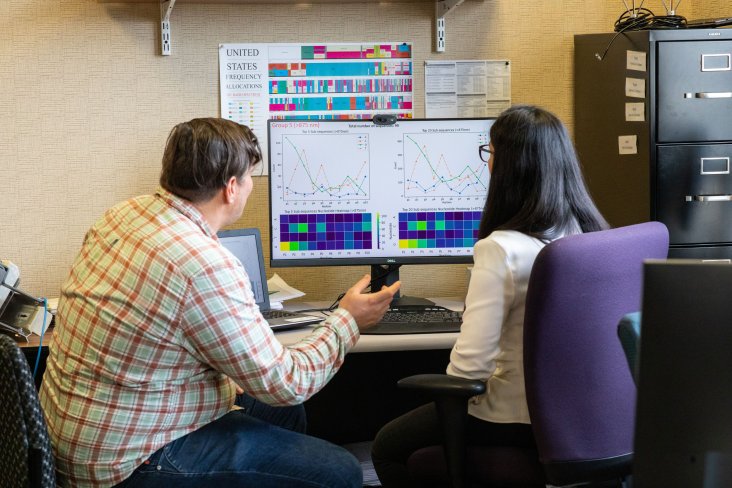
One researcher sits in a chair in front of several computer monitors while a second researcher leans over and says something while looking at the computer.

SUNY's $2.4M Investment in UAlbany

The AI & Society Research Center and UAlbany’s AI & Society College were founded in 2025 with a $2.4 million investment from the State University of New York to position UAlbany as a leader in responsible, human-centered AI.  

While the College leads curricular innovation under the Division of Academic Affairs, the Center advances interdisciplinary research, fosters scholar-practitioner collaboration and supports the development of tools, frameworks and insights to identify AI’s possibilities, anticipate its risks, and help utilize and shape AI for public good.  

The Center is embedded within the AI Plus Institute and overseen by the Division for Research and Economic Development.


About the AI & Society Research Center’s Work

Our work is grounded in a deep curiosity about the human experience and a belief that technology should enhance, not erode, what is most vital about it.

The Center’s research and programming are guided by broad themes, like resilience, solidarity, connection, imagination and flourishing, that invite expansive exploration of AI’s role in shaping human experience. These themes serve as points of departure, not limits — opening space for exploration into artistic practice, social systems, technological infrastructures and the evolving ways we live, work and connect.  

By organizing our work around these generative concepts, we create space for wide-ranging collaboration across disciplines, methods and communities, and we discover possibilities for research, storytelling, design and public engagement that respond to the questions and challenges of our time.


Get Involved

Join a community of researchers, innovators, skeptics and advocates working to ensure AI enriches our lives while protecting what matters most. There are many ways to get involved with the AI & Society Research Center.

We welcome participation from faculty, students, administrative units, community organizations, industry partners and funders who share our commitment to shaping the role of AI in public life. 

Whether through collaborative research, themed semester programming, fellowships, events or strategic partnerships, we invite you to connect with us and explore how your work, perspective or mission might align with ours.

Please follow the links below to get involved or email the Center at [email protected] to learn more about how you can support our work, including through monetary donations and industry partnerships.


get-involved
Join Our Community
Two professionals sit in front of a computer monitor displaying data graphics. One individual gestures as he speaks.

Connect with researchers, students and collaborators working at the intersection of AI and society.

Attend an Event
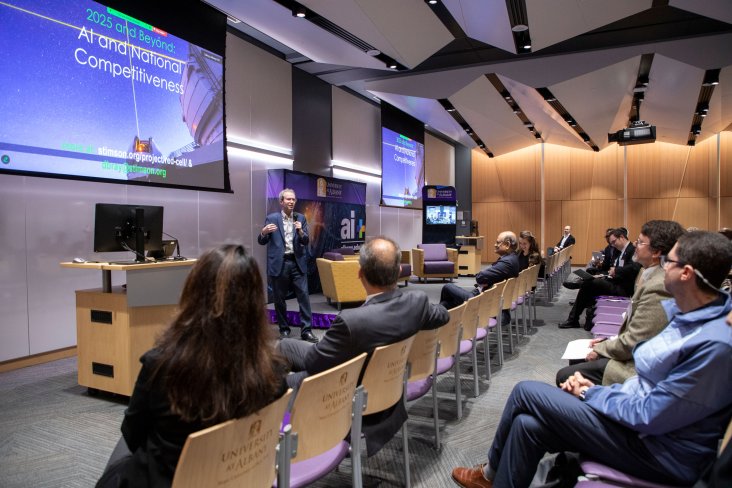
Audience members sit and listen during a presentation on AI on UAlbany's campus.

Take part in public conversations, workshops, panels and programs throughout the year. 

Collaborate With Us
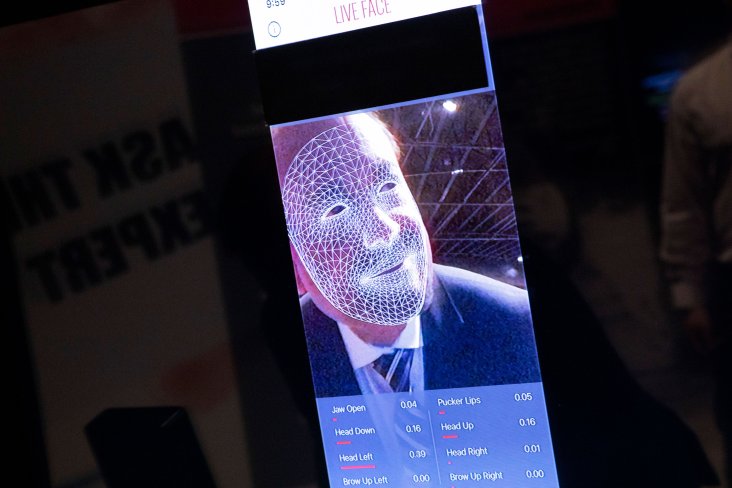
A cell phone screen with a man's face covered in an AI matrix, with the facial features detected listed below the image.

Work with our team on research, programming or cross-sector initiatives.

AI Plus Collaborative Research Experience (AI Plus CoRE)

The AI Plus Collaborative Research Experience (AI Plus CoRE) supports interdisciplinary faculty-led research teams focused on the human and social dimensions of artificial intelligence.  

Each CoRE team is co-led by two faculty members from different disciplines, supported by a graduate assistant and joined by undergraduate researchers who contribute directly to active, publishable research projects.

Learn more about AI Plus CoRE and meet our research teams.

collaborative-research

Faculty Fellowships

Research Fellows   |   Faculty Engagement Fellows

fellowships


Research Fellows

research-fellows
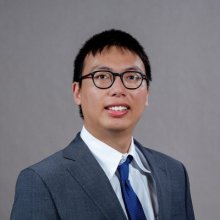
Sukwoong Choi.

Dr. Sukwoong Choi, Assistant Professor​
Information Systems and Business Analytics, Massry School of Business​

Generative AI’s self-perception of its ability to replace human jobs, particularly managerial roles, and compare it with human expectations using a systematic methodology

Jonathan Foster.

Dr. Jonathan Foster, Assistant Professor​
Department of Educational Theory & Practice, School of Education​​

Methodologies for evaluating human and AI-pairings in classroom observation rating systems, focusing on inter-rater reliability and bias​

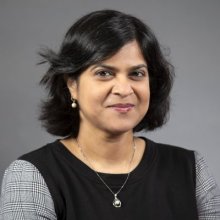
Archana Krishnan.

Dr. Archana Krishnan, Associate Professor​
Department of Communication, College of Arts and Sciences​

Testing currently-available GenAI models to conduct lexical simplification of health information​

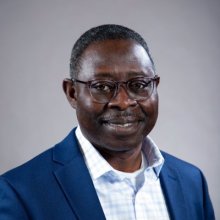
Alex Kumi-Yeboah.

Dr. Alex Kumi-Yeboah, Associate Professor​
Department of Educational Theory & Practice, School of Education​

Fostering artificial intelligence ethics literacy students and faculty in higher education,​ in collaboration with Dr. Benjamin Yankson

Cheng Ren.

Dr. Cheng Ren, Assistant Professor​
School of Social Welfare​, College of Integrated Health Sciences

Leveraging artificial intelligence techniques to analyze text-heavy court files to extract key information to help the public understand the characteristics (e.g. reasons lead to eviction) and variations among eviction cases​

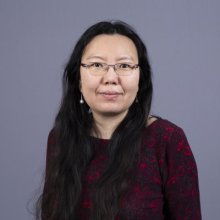
Xiaobo Xue Romeiko.

Dr. Xiaobo Xue Romeiko, Associate Professor​
Department of Environmental Health Sciences, College of Integrated Health Sciences​

Creation of a spatially and temporally explicit database describing the origins, redistribution routes, destinations, types and quantities of donated foods in New York State​

Piotr Szpunar.

Dr. Piotr Szpunar, Associate Professor​
Department of Communication, College of Arts and Sciences​​

Research in the areas of anxiety, politics, technology and collective memory, and their collective implications to AI for democratic governance​

Ying Wang.

Dr. Ying Wang, Associate Professor​
Finance, Massry School of Business​

Bridging Minds and Machines: Uncovering Human Insight in Credit Ratings through AI Interpretation​

M. Abdullah Canbaz.

Dr. M. Abdullah Canbaz, Assistant Professor​
Department of Information Sciences and Technology, College of Emergency Preparedness, Homeland Security and Cybersecurity

Development and evaluation of AI-assisted mental health tool to support individuals experiencing mild to moderate mental health challenges, such as anxiety, ADHD and depression​

Benjamin Yankson.

Dr. Benjamin Yankson, Associate Professor
Department of Cybersecurity, College of Emergency Preparedness, Homeland Security and Cybersecurity

Fostering artificial intelligence ethics literacy students and faculty in higher education, in collaboration with Dr. Alex Kumi-Yeboah 


Faculty Engagement Fellows​

faculty-engagement-fellows
Eric Best.

Dr. Eric Best, Assistant Professor​
Department of Emergency Management and Homeland Security​, College of Emergency Preparedness, Homeland Security and Cybersecurity

Forum for AI Resilience and Safety (FAIRS)​

Kyra Gaunt.

Dr. Kyra Gaunt, Associate Professor​
Department of Music & Theatre, Department of Women's, Gender & Sexuality Studies, College of Arts & Sciences

​TEDxUAlbany: Digital Justice and Innovation​

Angie Y. Chung.

Dr. Angie Y. Chung, Professor​
Department of Sociology, College of Arts & Sciences

Open Access Textbook on AI & Society​

Alessandra Buccella.

Dr. Alessandra Buccella, Assistant Professor​
Department of Philosophy, College of Arts & Sciences​​

Graduate coursework development in ethics and AI

Alandeom Oliviera.

Dr. Alandeom Oliviera, Professor​
Department of Educational Theory & Practice, School of Education​

​Reflective workshops on AI in interpersonal and educational contexts​

E. Stefan Kehlenbach.

Dr. E. Stefan Kehlenbach, Assistant Professor​
Department of Political Science, Rockefeller College of Public Affairs and Policy​

AI and Democracy: Critical Questions Speaker Series​, in collaboration with Dr. Haesol Bae

Haesol Bae.

Dr. Haesol Bae, Assistant Professor
Department of Educational Theory & Practice, School of Education​

AI and Democracy: Critical Questions Speaker Series​, in collaboration with E. Stefan Kehlenbach