About the Peace Corps Prep Certificate

The Peace Corps partners with select universities across the United States to grant Peace Corps Prep Certificates to undergraduate students who complete a recommended sequence of skill, language, intercultural and professional development.

Students who attain the Certificate increase their chances of being selected as a Peace Corps volunteer after graduation and are well prepared for careers in international development.

UAlbany was the first SUNY institution and the third university in New York State to be selected by the Peace Corps to offer its volunteer preparatory program, Peace Corps Prep. Ninety-nine students have completed UAlbany’s program since it began in 2019, and 12 have become Peace Corps volunteers.

Gain the right combination of knowledge, skills and attitudes to make the most of your world. Visit the Earn a Certificate tab above for more information or contact us today! 


Student Spotlight
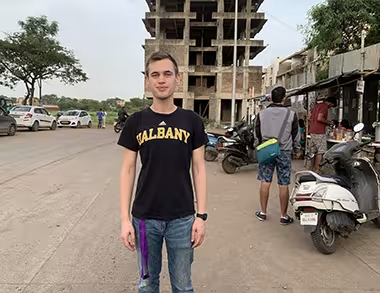
Andrew Bishop ’19 poses for a photo while traveling abroad.

Andrew Bishop ’19 earned Peace Corps Prep Certificate while completing his bachelor’s degree at UAlbany and was accepted into the Peace Corps — specifically as a small enterprise and entrepreneurship development volunteer in Namibia — in 2020.

As a UAlbany student, Bishop studied abroad in Pune, India, and interned for the Center for Development Studies and Activities, working on a UNICEF project focused on getting college students involved in participatory urban planning.

Bishop worked with UAlbany Peace Corps Prep Coordinator Annette Richie to meet the Peace Corps Prep Certificate’s requirements. Richie also connected him with Returned Peace Corps Volunteers who had also attended UAlbany and a Peace Corps recruiter.  

“I am incredibly proud to have received an invitation on my first try,” said Bishop, who is from North Tonawanda, New York. “I have always had a passion for helping others but never thought it would lead to a career.” 


Contact Peace Corps Prep at UAlbany

Peace Corps prep logo, which is a light blue and dark blue circle with white stars.

Please contact [email protected] with any questions. You can also select the Sector Coaches tab above to contact a specific sector coach.

If you're hoping to serve in the Peace Corps within the next year, connect with a Peace Corps recruiter as soon as possible.

Check out our upcoming events

contact

Earn a Peace Corps Prep Certificate

Any UAlbany undergraduate student in good academic standing, regardless of major, can earn a Peace Corps Prep Certificate and bolster their chance of becoming a Peace Corps volunteer or international development specialist after graduation.  

Note: International students may earn a Peace Corps Prep Certificate, but Peace Corps volunteers must be U.S. citizens.

Click a link below to skip to that section:


Certificate Requirements

To earn a Peace Corps Prep Certificate at UAlbany, you must fulfill all the following requirements:

  • Training & Experience: Three courses and 50 hours of volunteering in one of six sectors (Agriculture, Community Economic Development, Education, Environment, Health and Youth in Development)
  • Intercultural Humility, Curiosity & Agility: Three intercultural development courses or similar experiences, such as study abroad
  • Professional Development Activities: Leadership experience, application preparation and support, such as résumé critiques and practice interviews with Office of Career and Professional Development advisors 
  • Optional Language Study: Required only for students hoping to serve as Peace Corps volunteers in Latin America (two semesters of Spanish: ASPN 101 or ASPN 105) or in West Africa (three semesters or equivalent of French: AFRE 221Y). Fluency in other languages is also welcome!

Visit the Course & Volunteering Guide tab above for detailed information. 


requirements
UAlbany Peace Corps Prep Certificate


Support UAlbany Provides

UAlbany's program offers students skills, coaching and community. Everyone is welcome!

  • Skills: UAlbany has identified courses and volunteer opportunities for all six work sectors and optional language training. Visit the Course & Volunteering Guide tab above for detailed information. 
  • Coaching: UAlbany’s Returned Peace Corps Volunteers and Faculty Council guide students in course and volunteering options, as well as Peace Corps résumé and interview preparation. Every participant has a mentor and receives timely application support. Visit the Sector Coaches tab above for detailed information. 
  • Community: Each year, UAlbany’s Returned Peace Corps Volunteers and Faculty Council host networking, intercultural and professional development events for Peace Corps Prep candidates. 


support

“Completing Peace Corps Prep demonstrates just how serious you are about serving in the Peace Corps and that you have given your application quite a lot of thought. You have taken the relevant courses, you have language skills and you are committed.”  

— John Justino, co-chair of UAlbany’s Peace Corps Prep Faculty Council


How to Apply

The Peace Corps issues Certificates to current undergraduate students who are nominated in mid-October and mid-March by their university’s Peace Corps Prep Coordinators.

To apply to UAlbany’s Peace Corp Prep program, please adhere to these deadlines:

  • Fall deadline: UAlbany undergraduate students who want to qualify for the Peace Corps Prep Certificate during the fall semester must apply and complete all requirements by October 10. 
  • Spring deadline: UAlbany undergraduate students who want to qualify for the Peace Corps Prep Certificate during the spring semester must apply and complete all requirements by March 10.

Students are accepted on a rolling basis. Note: If you miss the deadline, you will need to wait until the next cycle in order to receive the Certificate. 
 

Apply for Peace Corps Prep 


apply

Next Steps

Once you’ve applied for Peace Corps Prep and been accepted, you’ll be assigned a Sector Coach and begin completing the program requirements.
 

next-steps
How long does it take to complete the Certificate?

The length of time it takes a student to complete the program depends: Students who have already completed most requirements may be certified in as little as one semester. Other students apply before completing any requirements.

The earlier you begin the program, the better, because you will be matched with a Sector Coach to help you in identifying your best fits for courses and volunteering, and you will have more time to connect with other candidates and the Peace Corps recruiter.

You can earn the Certificate at any time while enrolled at UAlbany as an undergraduate student.  

However, if you want to serve in the Peace Corps after graduation, we recommend completing all requirements by the semester before your final semester, since the Peace Corps volunteer application-to-overseas placement period can take up to nine months.

Do I have to choose a sector to earn a Certificate?

Yes! Choosing a sector is necessary to identify and complete the three sector-specific courses and 50 hours of volunteering.

You may also complete coursework and volunteering in additional sectors. That breadth is welcome in Peace Corps applications and service.  

Note: You don’t need to earn a Certificate in a specific sector to serve in that sector as a Peace Corps volunteer. You can qualify in more than one sector, and they will be noted on your Peace Corps Prep exit checklist, which you will upload when you apply to the Peace Corps. Your specific sector is not listed on your Certificate.

You may choose any sector based on your interests and career goals. Not sure what to choose? Some majors are natural fits for certain sectors. For example:

  • Agriculture Sector: Anthropology, Biology, Environmental and Sustainable Engineering, Environmental Science, Environmental Studies, Human Biology 
  • Community Economic Development Sector: Any business major, Computer Science, Cybersecurity, Economics, Electrical and Computer Engineering, Informatics, Public Policy and Management, Quantitative Economics and Data Analysis 
  • Education Sector: Any education major, any STEM major, English, Human Development, Public Policy and Management 
  • Environment Sector: Atmospheric Science, Environmental and Sustainable Engineering, Environmental Science, Environmental Studies, Emergency Preparedness, Geography, Physics, Public Policy and Management 
  • Health Sector: Biology, Chemistry, Human Biology, Public Health, Public Policy and Management 
  • Youth in Development Sector: Human Development, Psychology, Public Policy and Management, Social Welfare
Do I need to apply to the Peace Corps if I participate in the Peace Corps Prep program?

No, the choice is entirely up to you!  

Some students want to earn the Certificate because it’s a formal recognition of their professional and intercultural development.

Other students join the Peace Corps Prep program to improve their Peace Corps application. Note: Earning the Certificate does not guarantee acceptance or placement as a Peace Corps volunteer. 

Sector Coaches

Students participating in UAlbany’s Peace Corps Prep program receive specialized advising and mentorship from experienced Sector Coaches.

If you have not yet chosen a sector, please contact UAlbany Peace Corps Prep Coordinator Dr. Annette Richie at [email protected] for assistance.

Click a link below to skip to that section:


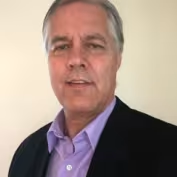
Michael Elliott

Agriculture Sector & Environment Sector Coach

Michael Elliott 
[email protected] 


agriculture-environment
About Michael Elliott

Michael Elliott is the Director of International Student and Scholar Services (ISSS) at UAlbany and teaches First Year Experience courses for new students.

He has worked in the field of international education for more than 25 years and has had several experiences abroad, including studying in Germany, participating in a Fulbright administrators program in Japan, and recruiting students in China, South Korea and Taiwan.

Michael has traveled to many countries, including Argentina and Spain, where members of his immediate family are dual citizens. One of the most formative international experiences Michael has had is with the Peace Corps (1989 to 1991), where he taught biology and physics in a Kenyan high school off the East African coast of Mombassa. 


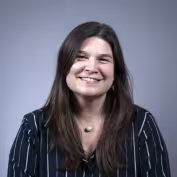
Susan Appe

Community Economic Development Sector & Youth in Development Sector Coach

Susan Appe 
[email protected] 


community-youth
About Susan Appe
About Susan Appe

Susan Appe is an Associate Professor of Public Administration and Policy at UAlbany's Rockefeller College of Public Affairs and Policy. She researches and teaches courses on nonprofit management, philanthropy, public management and public policy.

Dr. Appe is regularly invited to guest lecture and has held visiting professor appointments at universities in Latin America and Africa. She is a Returned Peace Corps Volunteer, serving in North Macedonia (2001) and Bolivia (2002 to 2004).


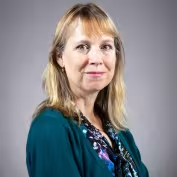
Susan Gorga

Education Sector Coach

Susan Gorga 
[email protected] 


education
About Susan Gorga
About Susan Gorga

Susan Gorga has been teaching at the Intensive English Language Program (IELP) at UAlbany for more than 25 years. She also organizes events and activities for IELP students and UAlbany student volunteers.

She was in the first Peace Corps group to go to Poland (1990 to 1992) and taught in Chełm. Other international teaching experience includes IREX grants to Romania, teacher training in China, and two more teaching stints in Poland and Brazil.


John Justino

Health Sector Coach

John Justino 
[email protected] 


health
About John Justino
About John Justino

John Justino serves as the Director of UAlbany's Center for Global Health and holds a faculty appointment in the Health Policy, Management and Behavior Department at UAlbany's College of Integrated Health Sciences.

He has nearly 30 years of experience working in global health and international development, and he has lived and worked extensively abroad. Mr. Justino is a proud Returned Peace Corps Volunteer, having served in Cameroon from 1992 to 1994.


Annette Richie

Peace Corps Prep Coordinator

Annette Richie
[email protected] 


coordinator
About Annette Richie

Annette Richie serves as Director of Global Academic Programs at the UAlbany. Annette spearheads UAlbany’s inclusive global learning initiatives, which include Collaborative Online International Learning (COIL), Global Distinction Transcript Milestone, International Studies Minor and Peace Corps Prep.  

Annette is a “third culture kid” who researched and taught in medical anthropology, archaeology and ethnohistory for two decades before finding her way to global career and curricular mapping. Annette holds a doctorate in Anthropology from UAlbany. Annette also serves as the Peace Corps Prep Coordinator and approves Peace Corps Prep Exit Checklists.

Course & Volunteering Guides

To get started, we recommend downloading the Peace Corps Prep Certificate Planning Worksheet. You’ll complete this form with your Sector Coach during your one-on-one meetings and as you work to complete the program requirements.

All students participating in Peace Corps Prep must complete Intercultural Competence course requirements, as well as their Sector’s course and volunteering requirements.


Courses

Students in any major can complete the Peace Corps Prep Certificate.

Sector-specific and Intercultural Competency courses fit into most students’ existing majors, minors, General Education and elective requirements. Depending on your program, the same course may even count toward more than one requirement.

Study abroad experiences and some community volunteering options also count toward the Intercultural Competency requirement.

Visit the Schedule of Classes to explore upcoming course offerings and the Undergraduate Bulletin to review course descriptions.
 

Intercultural Competence Courses

You'll need to complete three courses or relevant immersive experiences.

You'll complete one of these core courses:

  • AAFS 240 Classism, Racism, and Sexism: Issues (ALCS/AWSS)  
  • AANT 108 Introduction to Cultural Anthropology  
  • ACOM 371 Theories of Intercultural Communication    
  • ECPY 360 Psychology, Cultural Diversity, and Social Justice  
  • RSSW 299 Multiculturalism  
  • Similar intercultural competencies course offered during a semester abroad

And you'll need to complete two additional electives from this list:

  • AAFS 240 Classism, Racism, and Sexism: Issues (ALCS/AWSS)  
  • AANT 108 Introduction to Cultural Anthropology  
  • ACOM 371 Theories of Intercultural Communication    
  • ECPY 360 Psychology, Cultural Diversity, and Social Justice  
  • RSSW 299 Multiculturalism  
  • AGLO 350 Leadership in the International Arena (AEAPS)  
  • ALIN 325 Sociolinguistics (AANT)  
  • BBUS 494 Multi-Cultural Work Environments
  • A semester study, research or internship abroad program in a current or former Peace Corps participating country
  • Pre-approved relevant courses offered in the U.S. or abroad
  • Pre-approved prolonged intercultural experience based in the U.S, and lasting at least 50 hours, such as volunteering with the U.S. Committee for Refugees and Immigrants (USCRI) or volunteering within the Albany school district 
Agriculture Sector Courses

You'll need to take three courses from one of the following areas:

  • Agronomy
  • Horticulture Botany
  • Entomology
  • Agricultural Science
  • Agribusiness
  • Agricultural Economics
  • Business or Economics
  • Biology

Sample UAlbany courses include:

  • AANT 355 Environment, Economy, and Culture  
  • AANT 415 Nutritional Anthropology  
  • AATM 405 Water and Climate Change  
  • ABIO 117 Nutrition  
  • ABIO 218 Introduction to Plant Biology  
  • ABIO 222 Biological Consequences of Global Climate Change ABIO 401 Ecology  
  • AECO 130 Developing Economies  
  • AENV 250 Sustainable Development: Energy and Resources  
  • AGOG 424 Landscape Ecology  
  • AHIS 277 Culture and History of Food in the United States  
  • AUSP 433Y Urban Ecology (AGOG)  
  • HBMS 314 Animal and Cell Culture Model Systems  
  • IESE 451 Water Resource Engineering  
  • IESE 452 Groundwater Hydrology  
  • TANT 242 Food, Culture, and Power in Mesoamerica (TLCS) 
Community Economic Development Sector Courses

You'll need to take three courses from one of the following areas:

  • Business or Public Administration
  • Nonprofit Management
  • Accounting, Banking or Finance
  • Computer Science
  • Graphic Design
  • Mass Communications
  • International Business

Sample UAlbany courses include:

  • ACOM 363 Marketing Communication and Media Campaigns  
  • ACOM 377 Communication and Technology in Organizations  
  • ACOM 388 Communication and Global Organizations  
  • AECO 330 Economics of Development  
  • AECO 350 Money and Banking  
  • AGLO 327 World Regions and Global Markets (AGOG)  
  • AGOG 560 Local Economic Development Strategies  
  • ASOC 395 Capitalize on Community  
  • AUSP 425 Community Development and Neighborhood Planning and Workshop  
  • BACC 211 Financial Accounting  
  • BFIN 300 Financial Management  
  • BITM 215 Information Technologies for Business  
  • BMGT 460 Social Entrepreneurship  
  • BMKT 411 Marketing Strategy in Globalized Market Environment  
  • BMKT 440 New Venture/Product Development  
  • ICSI 418Y Software Engineering  
  • ICSI 422 Introduction to Computer Graphics  
  • IINF 108 Programming for Problem Solving  
  • IINF 301 Emerging Trends in Information and Technology  
  • IINF 467 Technology-Based Community Support  
  • RPAD 204 Computer Modeling for Decision Support  
  • RPAD 303 Public Administration and Management  
  • RPAD 411 Special Topics in Public Administration: Program Evaluation Training 
Education Sector Courses

You'll need to take three courses from one of the following areas:

  • Elementary, Secondary or Special Education
  • English or Linguistics
  • TEFL/TESL
  • Math
  • Computer Science
  • Engineering
  • Any Physical or Biological Science

Sample UAlbany courses include:

  • AENG 110Z Writing and Critical Inquiry in the Humanities
  • AENG 121 Reading Literature
  • AENG 360Y Tutoring and Writing
  • ALIN 220 Introduction to Linguistics (AENG 217)
  • ALIN 326Z Writing, Reading, and Language
  • EEAPS 300 Social Foundations of Education
  • ELTL 410 Literacy in Social Contexts
  • EPSY 400 Instructional Psychology
  • ESPE 460 Introduction to Human Exceptionality
  • ETAP 201 Exploring Teaching as a Profession
  • ETAP 501 The Teaching of English to Speakers of Other Languages
  • ETAP 536 Second Language Learning
  • ETAP 652B Perspectives in Bilingual Education
  • Hundreds of courses in Biology, Chemistry, Computer Science, Engineering, Math, Physics, and Statistics 
Environment Sector Courses

You'll need to take three courses from one of the following areas:

  • Environmental Science or related field
  • Natural Resources or Wildlife Management
  • Natural Resources Conservation
  • Park Administration
  • Wildlife Biology
  • Forestry
  • Biology, Botany or Ecology
  • Geology 

Sample UAlbany courses include:

  • ABIO 218 Introduction to Plant Biology  
  • ABIO 401 Ecology  
  • ABIO 432 Animal Behavior  
  • AENV 250 Sustainable Development: Energy and Resources  
  • AENV 365 Environmental Science Fieldwork Exp.  
  • AGOG 407 Biogeography  
  • AGOG 424 Landscape Ecology  
  • APHY 202 Environmental Physics  
  • AUSP 330 Principles of Environmental Management (AGOG)
  • AUSP 430 Environmental Planning (AGOG)
  • AUSP 432 Parks, Preservation, and Heritage Planning  
  • AUSP 436 Landscape Planning and Workshop  
  • IESE 301 Introduction to Environmental and Sustainable Engineering  
  • IESE 381 Energy Engineering  
  • IESE 411 Water and Wastewater Treatment  
  • IESE 451 Water Resource Engineering  
  • IESE 452 Groundwater Hydrology  
  • IESE 471 Hazardous Waste Management  
  • RPAD 366 International Environmental Policy 
Health Sector Courses

You'll need to take three courses from one of the following areas:

  • Nursing  
  • Nutrition or Dietetics  
  • Health Education  
  • Pre-Med  
  • Biology  
  • Technical Education  
  • Environmental or Sanitary Engineering

Sample UAlbany courses include:

  • AANT 319 Physical Growth and Development  
  • AANT 416 Human Anatomy and Physiology I and II (418)  
  • ABIO 117 Nutrition  
  • ABIO 130 General Biology I: Molecular and Cell Biology  
  • ABIO 131 General Biology II: Genetics, Ecology, Evolution, and Physiology  
  • ABIO 212Y Introductory Genetics
  • ABIO 213 Microbiology in Health and Disease
  • ABIO 365 Biological Chemistry  
  • ABIO 453 Ecology and Evolution of Infectious Diseases  
  • ACOM 465 Communication in Health Care Organizations  
  • APSY 329 Health Psychology  
  • HSPH 201 Introduction to Public Health  
  • HSPH 231 Concepts in Epidemiology  
  • HSPH 321 Global Environmental Issues and their Effect on Human Health HSPH 332 Introduction to Biostatistics  
  • HSPH 341 Promoting Healthy People and Communities  
  • HSPH 389 Introduction to Emergency Health Preparedness and Response (CEHC)  
  • HHPM 486 International Health and Human Rights: an Interdisciplinary Approach (RPAD / RPOS)  
  • HSPH 490 Field Placement in Public Health
Youth in Development Sector Courses

You'll need to take three courses from one of the following areas:

  • Social Work  
  • Counseling  
  • Community Development  
  • Developmental Psychology  
  • Human Development  
  • Family Studies  

Sample UAlbany courses include:

  • APSY 223 Emotional and Social Development  
  • ASOC 250 Sociology of Families  
  • ASOC 386 The Social Worlds of Children and Youth  
  • ECPY 301 Methods in Peer Helping I-III (302, 303)  
  • ECPY 311 Helping Skills in Human Services: Sexuality and Young Adults
  • ECPY 360 Psychology, Cultural Diversity, and Social Justice  
  • ECPY 421 Introduction to Counseling Psychology  
  • ECPY 462 Psychology of Disability  
  • EPSY 420 Child and Adolescent Development  
  • ESPY 360 Positive Youth Development  
  • RSSW 305 Social Work Practice I-IV (306, 405Z, 406Y) 


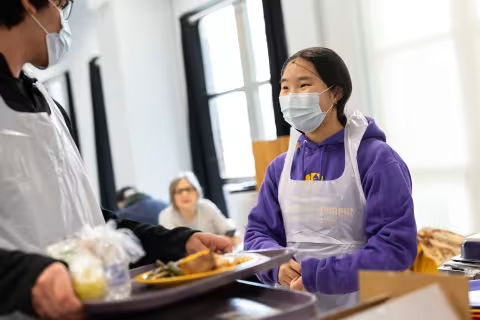
A student in a purple UAlbany sweatshirt, surgical mask, plastic apron smiles at another volunteer who is clearing trays at a soup kitchen.


Volunteering

Find local and virtual volunteering and training activities using Engage UAlbany, the Community & Public Service Program and Career & Professional Development. You can also contact your school or college’s internship and experiential learning coordinator. 
 

Agriculture Sector Volunteering

You'll also need to build 50 hours of related volunteering, interning or work experience. Some ideas include:

  • Working with a large-scale or family-run business involving vegetable gardening, farming, nursery work, tree planting or care urban forestry landscaping livestock care and management fish cultivation and production 
  • Working or interning with a local business or organization, such as the Honest Weight Co-op, a local farmers market or farm-share, a local cidery or brewery, the Albany Pine Bush Preserve, Radix Ecological Sustainability Center, Capital Roots and/or a local food pantry 
  • Teaching or tutoring the public in environmental or agricultural issues and/or activities, including through the Cornell Cooperative Extension and public library system 
  • Studying and researching abroad in the Galapagos for a semester with UAlbany’s partner, the University of San Francisco, based in Quito, Ecuador, or erecting bio-sand-filters in the Dominican Republic over spring break under the direction of community leaders and a Returned Peace Corp Volunteer 
  • Becoming a volunteer for the Office of Sustainability, which could include farming in UAlbany’s garden, planting and pruning on campus, composting food waste from classroom and University offices, and advocating for local ingredients in campus dining halls and area restaurants 
  • Cleaning Albany's streets and tending to the Adirondack Park
Community Economic Development Sector Volunteering

You'll also need to build 50 hours of related volunteering, interning or work experience. Some ideas include:

  • Working and/or volunteering with businesses, organizations or cooperatives in accounting, finance, micro-finance management, project management and/or budgeting marketing  
  • Working for UAlbany's Information Technology Services (ITS) Help Desk and/or Educational Technology Services 
  • Starting and running your own business or other entrepreneurial activity, such as Blackstone Launchpad 
  • Training others in computer literacy, maintenance and repair 
  • Working on website design or online marketing for a non-profit or student organization 
  • Founding or leading a community- or school-based organization, perhaps by serving as treasurer 
  • Interning in accounting with a government agency, such as the New York State Comptroller’s Office 
  • Assisting with pro bono tax form preparation or teaching computer security basics at a local library 
  • Volunteering to help a local nonprofit, such as a school, church or charity, with web marketing or outreach 
Education Sector Volunteering

You'll also need to build 50 hours of related volunteering, interning or work experience. Some ideas include:

  • Teaching English as a Foreign/Second Language, special education, drama or a STEM subject in a classroom, with a community outreach organization or in a formal tutoring capacity
  • Advanced School of Education students can practice teaching in elementary and secondary schools through the Pathways into Education program (PIE) 
  • Students with high grades in introductory STEM courses can apply to be peer tutors at UAlbany
  • Students are paid to tutor in English Learning Centers at exchange partner universities 
  • Working as a Conversation Partner with the Intensive English Language Program (IELP)
Environment Sector Volunteering

You'll also need to build 50 hours of related volunteering, interning or work experience. Some ideas include:

  • Significant experience in mechanical repairs, construction, carpentry, masonry, plumbing, hydrology, set design, gardening, farming, nursery management, organic or low-input vegetable production, and/or landscaping 
  • Intern with the New York State Parks, Recreation and Historic Preservation or the Albany Water and Sewer Board 
  • Volunteering and/or working with neighborhood/campus clean-up days, community garden projects, local parks' summer program, farm, food co-ops, UAlbany's Office of Sustainability and/or UAlbany's Office of Environmental Health and Safety 
  • Educating the public on environmental or conservation issues, or working on environmental campaigns  
  • Conducting biological surveys of plants or animals  
  • Providing technical assistance and training in natural resource management 
  • Attending UAlbany’s NSF PIRE-funded Environmental Science summer school
Health Sector Volunteering

You'll also need to build 50 hours of related volunteering, interning or work experience. Some ideas include:

Youth in Development Sector Volunteering

You'll also need to build 50 hours of related volunteering, interning or work experience. Some ideas include:

  • Experience in teaching or counseling in at-risk youth program, leading a church youth group, and/or acting as a guidance counselor assistant or assistant coach at a local high school 
  • Activities involving planning, organizing, assessing community needs, counseling and leadership in areas such as education, youth development, health and HIV/AIDS, environment, and/or business 
  • Volunteer with UAlbany's Middle Earth Peer Assistance Program, Disability Access & Inclusion Student Services (DAISS) and/or Department of Residential Life 
  • Participate in supervised community service placements through RSSW 190 (Community Engagement) or RSSW 290, 291, 390 (Community and Public Service Program/Human Service in the Community) 
  • Participate in field placements for fourth-year Social Welfare students through RSSW 400, 410 (Field Instruction in Social Welfare I-II) 
  • Serve in Educational Counseling Psychology through ECPY 312 (Service Learning: Designing Sexuality Education and Peer Helping Programs for Young Adults)
  • Earn experiential learning credits towards your major while serving your community