



Two researchers on a boat collecting lake sediment samples for climate-related research at Black Pond in the Adirondacks.

Master of Science  in
Climate Science

Program of Study

programofstudy

The MS in Climate Science requires two academic years of full-time study and research. The curriculum provides a solid foundation in climate science and data fluency, and the ability to tailor your degree to your interests.

Once you’ve chosen a track – Climate Dynamics or Climate Chemistry and Physics – you can further focus on your preferred area of research specialization, such as climate dynamics and modeling, polar environments, atmospheric chemistry, paleoclimate reconstruction, environmental geochemistry, physical oceanography and ocean-atmosphere interactions, remote sensing, urban climate, renewable energy, or applications of machine learning.

Climate Dynamics Track

Required Courses

  • Atmospheric Dynamics
  • Introduction to Atmospheric Physics I
  • Fundamentals of Earth’s Climate
  • Data Fluency elective

Climate Chemistry & Physics Track

Required Courses

  • Paleoclimatology
  • Fundamentals of Earth’s Climate
  • Climate Chemistry or Physics elective
    Choose at least one:  
    • Introduction to Atmospheric Physics I  
    • Environmental Geochemistry  
    • Atmospheric Chemistry  
    • Global Biogeochemical Cycles
  • Data Fluency elective 

Electives

Data Fluency Elective

Choose at least one:

  • Climate Variability and Predictability
  • Advanced Geophysical Data Analysis and Visualization
  • Applied Data Analysis in Atmospheric and Environmental Science
  • Climate Modeling
     

Other Electives

You’ll fulfill your remaining elective requirements with coursework and/or research, to be determined with guidance from your advisor.  

Sample courses:

  • Introduction to Atmospheric Physics II
  • Remote Sensing in Atmospheric Sciences
  • Large-scale Dynamics of the Tropics
  • Atmosphere-Ocean Interaction
  • Renewable Energy Issues
  • Climate Change
  • Marine and Estuary Systems
  • Research in Atmospheric Science
     

Master's Thesis

Research must make up at least six credits, and lead to an acceptable master’s thesis and satisfactory completion of a major field examination.

Research and Experiential Learning


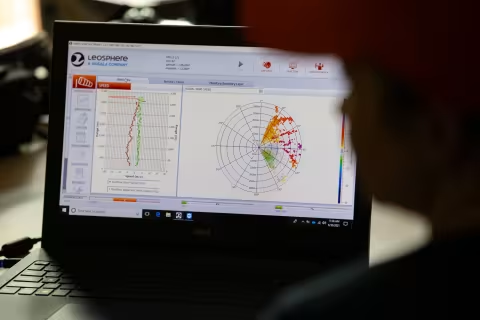
You’ll have the opportunity to perform cutting-edge, internationally-recognized, interdisciplinary research on important climate issues under the advisement of world-class faculty. In addition to your course and research requirements, you’ll gain further hands-on experience through ancillary teaching, research or practicum duties, assigned with your educational objectives in mind, that will contribute to your academic development. 


A researcher looking at radial wind speed data charts on a laptop.
ms-climate-research

Career Outlook


Climate scientists play a vital role in the future of our world. They will continue to be in high demand to help find solutions to the climate-related issues we face and lead the way in bringing those solutions to life. With the rigorous research training you’ll gain in this program, you’ll be ready to address climate challenges of global importance while working in the public or private sector in areas such as climate data analysis and modeling, laboratory and field studies, environmental consulting or education.

Potential job titles with a MS in Climate Science include: 

  • Environmental Scientist
  • Climate Scientist
  • Clean Energy Advocate
  • Director of Sustainability
  • Research Scientist
  • Climate Data Analyst
  • Environmental Program Specialist 


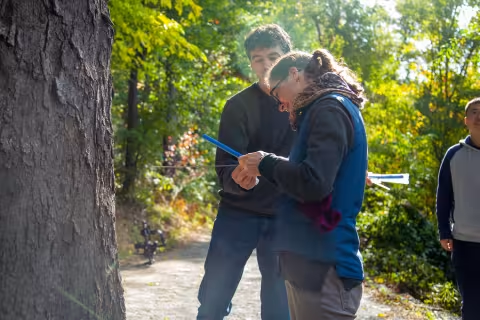
A UAlbany student and professor conducting field research in a forrest.
career

International Students

This degree is designated as a STEM program. International students maintaining F-1 status are allowed to apply for up to 12 months of post-completion Optional Practical Training (OPT) following completion/graduation from their degree program. Currently, this degree program is also designated by the Department of Homeland Security (DHS) as an eligible degree for the F-1 STEM OPT work authorization extension; students who secure qualifying employment may be eligible to apply for the STEM OPT extension for a cumulative total of up to 36 months of F-1 OPT work authorization.

Accelerated Undergraduate/Graduate Option

If you’re a current UAlbany undergraduate student with at least a 3.0 GPA, you may be eligible to begin your graduate degree coursework as early as your junior year. Save time and money by applying up to 12 academic credits, billed at the undergraduate rate, towards both degrees. By doing so, you may be able to complete your combined program in only 5 years and spend less than you would if you completed each program separately.

Contact your undergraduate advisor to see if you’re eligible and learn about your combined graduate program options.

UAlbany graduate with confetti at Commencement.
Admissions Requirements
Deadlines
Deadlines

Priority Review Deadline

  • Fall: January 5
  • Spring: Not Available
  • Summer: Not Available


No Departmental Assistantship Consideration

  • Fall: Rolling
  • Spring: November 1
  • Summer: Not Available
Required Application Materials
  • Transcripts from all schools attended
  • Three letters of recommendation
  • Statement of goals

Applications for the Fall term received by January 5 will receive priority consideration.

Application Requirements

In addition to the general University at Albany requirements for admission to graduate study, an applicant's undergraduate preparation should include:

  • Two semesters of a college calculus sequence for science/engineering majors
  • One semester of college-level physics
  • Two semesters of college-level chemistry
  • Basic skills in at least one computer coding language
  • At least one college-level chemistry or geochemistry course
  • For the Climate Chemistry & Physics track: one semester of college-level environmental science, geology or geochemistry
  • For the Climate Dynamics track: one additional semester of calculus sequence for science/engineering majors AND the required physics course must be calculus-based

Note: GRE scores are not required when applying for admission to the MS Climate Science program.

A student who is deficient in these subjects will be expected to make up the deficiencies during the first year of graduate study in consultation with their faculty advisor(s). A lack in one or more of these courses does not automatically disqualify a student from admission. Alternative courses, research or work experience that demonstrate a strong background in math, physics, chemistry and/or environmental science can provide equivalent preparation.

Available information for International Applicants.

admissions
Student Learning Objectives


Learning objectives that UAlbany students are expected to attain through their course of study within their academic program.

Master of Science
Master of Science

Students who successfully complete the MS in Climate Science degree are able to:

  • Demonstrate a clear mastery of advanced concepts in either climate dynamics or climate chemistry and physics.
  • Demonstrate master’s-level fluency in tools and practices of climate data analysis.
  • Carry out a limited-scope, directed research project on a climate science topic that includes:
    • Review of relevant previous literature on the research topic.
    • Application of common scientific practices in field or laboratory investigations, observational data analysis, numerical modeling and/or mathematical analysis of relevant phenomena.
    • Analysis and interpretation of results using appropriate quantitative methods.
  • Document, detail and defend the research conducted in a formal written thesis, including an oral presentation and defense.
  • Develop effective written and oral communication skills that lead to the dissemination of research results to fellow climate scientists and the broader community under the direction of an advisor.
slo