


Ilka Kressner
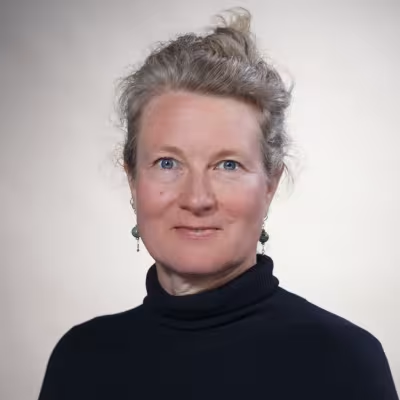
PhD University of Virginia
About
My scholarship and teaching examine contemporary Latin American film, literature and visual arts within a Pan-Latin American perspective, often with a comparative focus.
Research
Research Interests
My research areas are the environmental humanities, ecofeminisms, conceptions of space in art and of art in space, and intermediality (word, sound, image). I am currently researching portrayals of water in Latin American eco-cinema (contamination, inundations, water shortage…) and alternatives to colonial and neocolonial conceptions of ecology in cultural production from the region.
Publications
Books:
1. Contact Zones in Motion: Fritz Neugass’s and Ellen Auerbach’s Latin American Travel Photography (1940s to 70s). (de Gruyter/Brill, 2026). This book explores the Latin American photography of German-born Jewish American émigré photographers Fritz Neugass (1899–1979) and Ellen Auerbach (1907–2004) by analyzing their portraits of children and dancers in addition to their many series of still lifes as artistic creations of trans-cultural exploration with a camera in hand. By doing so, it helps broaden the archive of travel photography from Argentina, Chile, Mexico, and Colombia—as well as the United States—in the 1940s–1970s by adding both exiled artists’ transnational perspectives conceived as the shaping of engaged cultural practices.
2. Sites of Disquiet: The Non-Space in Spanish American Short Narratives and their Cinematic Transformations. Purdue University Press, PSRL, Vol. 58 (2013, open access: 2025). This study analyzes representations of alternative spaces—including sites of deferral, merging perspectives, and regions of darkness and emptiness—in Spanish American short narratives and their adaptations to the screen.
Edited volumes and special issues:
1. Ecologies of Resistance: Arts, Activism, and Transdisciplinary Futures in Latin America and the Latinx Worlds. Co-edited with Ana María Mutis and Elizabeth M. Pettinaroli (forthcoming, University of Virginia Press, 2026). This volume presents critical studies, interviews, and artistic interventions on Latin American and Latinx cultural expressions and activism that challenge colonial and neocolonial ecological concepts informing the current environmental crisis.
2. Ecofictions, Ecorealities and Slow Violence in Latin America and the Latinx World. Co-edited with Ana María Mutis and Elizabeth M. Pettinaroli. Routledge (2020). Our volume examines the topic of ecological violence, particularly in the context of slow violence (Rob Nixon) in Latin American and Latinx writings, films, visual arts and performances.
3. Walter Benjamin Unbound. Co-edited with Alexander Gelley and Michael G. Levine. Annals of Scholarship Vols. 21:1 and 2 (2015).
Current projects:
I currently work on two individual book projects: the first one examines how recent films and literary works from the Southern Cone imagine water, particularly that connected with rain, wetlands, and aquifers as powerful agents that connect the organic with the inorganic, expand beyond our human timeframes and spatial constructs. The second one is dedicated to the works of Colombian author William Ospina, tentatively titled, ‘“Man Doesn’t Know, But the Stone Remembers”: William Ospina’s Ecocritical Writings.”
Work with Doctoral Students:
Doctoral students working with me have worked or are currently working on topics such as: ‘Transformations of Greek monstrous figures in contemporary Latin American literature and film; biofictions, postmemory and transgenerational trauma in the works by Chilean author Nona Fernández and Dominican artist/author Rita Indiana; portrayals of female figures in narco novels, feature films and telenovelas from Colombia, Mexico and Puerto Rico and their adaptations in the Global North; narrative and filmic responses to the 1989 U.S. led 1989 invasion of Panama; forms of resisting cultural, social and religious repression against women in Ecuadorian fiction and film; memory writing from legacies of neglect in contemporary Spanish and Peruvian novels; the figure of the cyborg in contemporary Spanish American novels; baroque bodies in Post-Franco literature; portrayals of the female body in the literature about the feminicidios in Ciudad Juárez; imagination and the imaginary in the short stories by Colombian author Marvel Moreno and British writer Angela Carter; Spanish American experimental poetry; the concepts of consciousness and nothingness in the oeuvre of Venezuelan poet Hanni Ossott; and female detectives in contemporary Latin American fiction.
Instruction & Advising
Courses
- Ecologies in Latin American Literature and Film
- Research Methods in Spanish American Literature and Cultural Studies
- Contemporary Latin American Fiction
- Latin American Film
- Legacy of the 60’s in Latin American Literature
- Colonial Literature from a Postcolonial Perspective
- Literature and Human Rights
- Popular Cultures in Latin America
Additional Information
Awards & Honors
My research has received the support of an NEH Humanities Summer Stipend; Individual Development Awards (College of Arts and Sciences, University at Albany), Faculty Research Awards (FRAP-B, University at Albany), a Dr. Nuala McGann Drescher Award (semester-long leave, NYS/UUP Joint Labor-Management Committees), and a Conversations in the Disciplines Grant (The State University of New York, SUNY Central). In the summer of 2024, I was a fellow at UTulsa’s Second Book Institute.
I was a Visiting Scholar at the Department of Comparative Literature at Harvard University. While on sabbatical I was a Visiting Scholar in the Department of Communication at the University of Montevideo, Uruguay (Aug–Nov 2024), and an affiliated researcher in Ibero-American Studies at the University of Basel, Switzerland (Feb-July 2025).
For seven years, I have co-organized, together with Helen Elam (English), the annual Living in Languages Colloquium and am editorial adviser of The Living in Languages Journal that originated from UAlbany’s colloquium and has expanded to include participants form multiple institutions.
Finally, I am the proud faculty mentor of UAlbany’s Tango Club.