





Connecting Visitors with History at Albany Rural Cemetery

ALBANY, N.Y. (May 18, 2026) — At Albany Rural Cemetery, where nearly two centuries of history stretch across 467 acres in Menands, N.Y., two UAlbany students are putting interdisciplinary training into practice by developing mapping tools that help visitors navigate the past.
Micah Wang and Weiming Lan, who both graduated this spring, are part of the Albany Rural Cemetery Explorer (ARCE) project, a public engagement effort supported by the Bender Family Foundation, led by Rui Li, associate dean for social sciences in the College of Arts and Sciences and associate professor in the Department of Geography, Planning and Sustainability.
The students, both computer science majors at UAlbany's College of Nanotechnology, Science, and Engineering are helping develop and refine the project’s location capabilities.
Launched in 2019, ARCE uses digital mapping tools to help visitors explore the cemetery, find graves and learn more about the people buried there.
From a game world to a historic landscape
For Wang, the path to Albany began with a video game.
Growing up in Chongqing, China, he spent hours playing Minecraft, drawn not just to the world on screen but to how it was built. That curiosity — how the game worked and how to change it — led him to coding, first to create his own modifications, then to a broader interest in computer science.
That interest eventually brought him to UAlbany through a joint 3+1 program with Chongqing University of Posts and Telecommunications.
“What interests me the most about this project is the way it connects technology with a real community resource,” he said. “That combination made the work feel both practical and meaningful.”
Wang has focused on the app’s interface and navigation, helping shape how users move through the cemetery and interact with its history.
Curiosity that builds real-world solutions
Lan’s interest in technology grew from troubleshooting software and figuring out how computers worked.
As a middle school student in Chongqing, he often found himself troubleshooting software — figuring out how to install programs, adjust settings or fix things when they didn’t work. Each challenge gradually revealed computers not just as tools, but as systems to be understood.
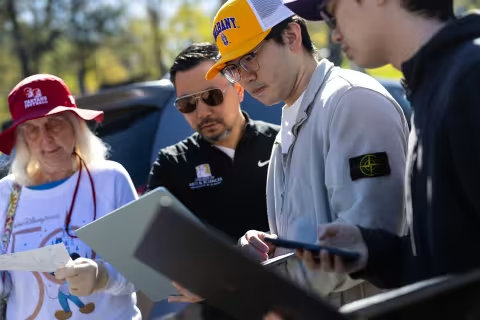
“My original reason for joining this project was that I wanted to apply what I had learned in class to a real-world project,” Lan said. “At the same time, this project gave me a special opportunity to learn more about local history and community culture.”
At UAlbany, Lan has focused on making the project accessible on mobile devices, including work on a Progressive Web App that allows visitors to use it without relying solely on a traditional app store.
Now preparing to return to UAlbany this fall for graduate study, he said the experience of living and learning abroad has been just as important as the technical work.
“This is my first real experience of living by myself overseas for a long period of time,” he said. “It has helped me become more independent and understand different cultures and lifestyles more deeply.”
Connecting people, places and history
Li said the project reflects how mapping technologies can help people better understand and move through meaningful places.
“Most people are using GIS-powered tools in their daily lives without realizing it,” he said. “This project shows how those tools can be applied to help people connect with history and place in a meaningful way.”
M. Patricia (née Cassidy) Parker of Guilderland, N.Y., recently used the mapping tools, along with guidance from Li and his students, to locate the burial site of her great-great grandmother, Eliza Girvin. Born in Ireland around 1817, Girvin emigrated to North America, spending time in Canada before eventually traveling to Albany with her husband, Joseph and their children. Parker believes the family likely traveled via the Erie Canal before settling in Albany.
“It’s such a large place, I wouldn’t have found it on my own,” Parker said. “It really brings those family stories into focus when you can connect them to a place like this.”
Today, the cemetery welcomes thousands of visitors each year — from families tracing ancestry to walkers and history enthusiasts exploring its scenic paths. Projects like ARCE are helping ensure those experiences remain accessible and engaging, using technology to bridge generations and bring the stories of the past into the present.