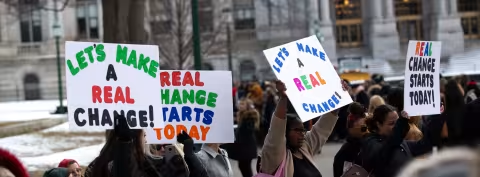
Protesters at the New York State capital Protesters at the New York State capital

Online Masters of Social Work Students

School of Social Welfare

Online Masters of Social Work

We are delighted that you are considering the University at Albany School of Social Welfare for your MSW. On behalf of the Dean, Director, faculty, staff and current students, welcome!  

The Online MSW program will be challenging but exciting. To help you plan for the program, this website will provide you with information regarding registering for courses, planning for your future field practicum, funding opportunities and more. Please be sure to read the material carefully and bookmark this page.

The Online MSW program is a structured program with asynchronous classes and in-person field practica in your home community. The program is three years and requires classes in all three semesters – fall, spring and summer.

Important Dates
  • February 23, 2026 – Accepted Online Cohort Students Day via zoom 5:30 to 6:30 p.m.
  • April 1, 2026 – Registration for Fall 2026 classes 
  • TBD – Exemption Exams offered
  • August 1, 2026 – An asynchronous orientation will be sent to your UAlbany email. Complete this prior to the August 10 synchronous orientation
  • August 10, 2026 – First day to access your courses on Brightspace. Book lists available
  • August 10, 2026 – Mandatory New Online Cohort Student Orientation from 5:30 to 7:00 p.m. via zoom
  • August 21, 2026- Exemption Exams offered
  • August 24, 2026 – First day of Fall semester

For more information, see the Fall Academic Calendar.

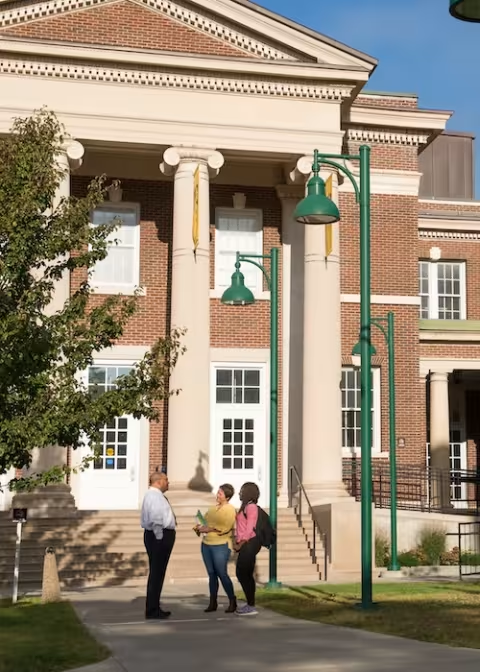
People stand before Milne Hall

Overview

Registration for the online MSW courses for Fall 2026 will begin on April 1, 2026. The courses designated for students in the first year of the Online MSW program are closed to hold seats for you; they are not full. You will receive information to your UAlbany email address about how to register.

Classes will be accessible starting August 10 in Brightspace (our learning management system). A link to Brightspace can be found at the MyUAlbany log in page. We do not keep a centralized record of textbooks required by your professors for purchase. You will receive information from your professors via your UAlbany email about course materials. Please check your UAlbany email regularly as all important communication will come via that email. 


Things To Do

Fulfill requirements outlined in your admissions letter

Please note the University at Albany requirements in your admissions letter and start early to complete them. All health requirements must be completed before you can begin field instruction.

Set up your UAlbany email account

Visit Manage your Account for information on how to set up your Albany.edu email. It is the policy of the University at Albany that email is an official means of communication with students. This policy pertains to all students and stipulates that the University can convey relevant academic and administrative information to students using their UAlbany email address. 

Students are responsible for checking their email account regularly so as not to miss important, time-sensitive communications.

You will need to set up your Albany.edu email in order to receive your Advisement Verification Number (AVN). 

Obtain your Personal Identification Number (PIN)

The University will provide the PIN and directions for using MyUAlbany. This notice will be sent to the email address listed on your graduate application. The email will be sent one to two weeks after you confirm your acceptance. If you do not receive this email, contact the Information Technology Services Help Desk at 518-442-3700.

Obtain your Advisement Verification Number (AVN)

Your Advisement Verification Number (AVN) is used to verify that you’ve received academic advisement about the courses to take for the upcoming semester and are moving toward completing the degree requirements in an academically feasible manner.

You must set up your UAlbany email account to receive your AVN. The AVN will be emailed to students who have accepted admission into the Online program after the Accepted Students Day on March 31st. The AVN will be emailed directly to your Albany.edu email address ONLY!

In future semesters, you will receive your AVN directly from your academic advisor.

Familiarize yourself with MyUAlbany

Please log on to MyUAlbany and familiarize yourself with the system before you register. Review the steps for registration. If you have questions about MyUAlbany or your PIN, call the Information Technology Services Help Desk at 518-442-3700 for assistance. 

Register on or after April 1

Shortly before April 1, you will receive an email at your Albany.edu email address with your AVN. You will need both your PIN and AVN in order to register. Be sure to keep this information in a safe and easily accessible place.


Register for your courses

These are the two classes for Fall 2026.

  • RSSW 604  Social Justice and Social Work 
  • RSSW 610 Human Behavior and the Social Environment 

You may, if you wish, register for an elective during the summer session. This is not required nor will it shorten your time in the program. It can, however, reduce the workload during year 3. Should you wish to register for a summer class, you must email the SSW admissions coordinator, [email protected], and will need an additional summer AVN from your academic advisor, Linda Mertz. Email [email protected] for a list of courses available.

If you have questions about your AVN or social work courses or have trouble with registration, please contact the School of Social Welfare Help Desk at 518-442-5320 or [email protected].

Your academic advisor will be Linda Mertz, the Online MSW Program Coordinator. You do not need to meet with an academic advisor in order to register for this first semester. In future semesters you will obtain your AVN from your advisor. If you have completed some coursework and need an adjusted schedule, you may request a meeting with the Online MSW Program Coordinator ([email protected]).


Deferring Admissions

You can defer your admission for one year. In order to do so, you must follow the instructions under the “Confirmation of Acceptance” link in your electronic acceptance letter. Please note that there is a fee to defer and your admission is not guarantee when you request a deferral. Your application may be reconsidered within the pool of applicants received for the new term. 

Deferral for one year is automatically granted. Applications can be deferred for up to one year of the original application admit term. You will need to submit a request via the Graduate Term Change Deposit link in your electronic acceptance letter. You will have to reapply to the program if you wish to defer for more than one year.


Changing Status

You are able to switch from the Online MSW program into the in-person full time or part time program. However, once changed to an in-person MSW program, access to online courses cannot be guaranteed. Additionally, the Field Office cannot then guarantee that a student will complete field practicums in the year desired. It is strongly recommended that students work closely with their Academic Advisor if contemplating a change in program.

Be advised that the School of Social Welfare defines full-time study as 12 credits. However, other agencies or institutions may define it differently. If you are required to be a full-time student for a specific reason (e.g. health insurance or student loans), be sure to check with the source setting this requirement (e.g. your health insurance company or bank, etc.).


Attend Online New Student Orientation

All new Online MSW students are required to attend the orientation scheduled for Monday, August 10 from 5:30-7:00 p.m. via zoom and complete an asynchronous information orientation prior to August 10. 

Tour the campus (optional)

If you would like to visit the campus, please contact the School of Social Welfare Help Desk ([email protected] or 518-442-5320) to schedule a tour.


Exemption Examinations and Courses

Exemption exams are only available to matriculated students (upon acceptance into the MSW program) and may only be taken once. All exams are closed book. Since exemption exams are based on previous learning, there are no study materials available. If you think you have covered the course content in other classes, we recommend you review previous textbooks and notebooks. All exams are short answer and essay, except for the SSW 660 IPTV Research Evaluation exam, which is multiple choice.

Students who wish to take one or more exams, or who have taken previous graduate level courses and want information on transferring credit, should contact Linda Mertz at [email protected].

Online MSW students are eligible to take exemption exams for the following courses:

tentative
SSW 600 - Social Welfare Policy Practice

This course is an introduction to the analysis of social policies and programs, based upon frameworks of policy dimensions, values and knowledge.


Objectives include:  

  • knowledge of selected social policies and programs in historical and contemporary context
  • awareness of differential impact on at-risk oppressed populations
  • understanding of political, economic, ideological context and role of social values in social policy formulation, modification, change, monitoring and evaluation
  • ability to analyze critical policies and their implications for social work practice including issues of social and economic justice, discrimination and oppression
SSW 610 - Human Behavior and Social Environment I

This is an introductory course that focuses on bio-psycho-social development and the nature and impact of oppression and discrimination as individuals and families transact with their environment through the life cycle.


Objectives include: 

  • understanding and evaluating different theoretical perspectives and empirical knowledge about human development
  • understanding interactions among human biological, social, psychological, economic, cultural and environmental systems
  • understanding factors affecting development of women, people who belong to ethnic and racial minority groups, people who identify as non-heterosexual and non-cisgender, people with disabilities and other emerging and historically oppressed groups
  • understanding age-related tasks associated with different life stages as affected by culture, economics, historical time and gender
  • understanding the effect of oppression, discrimination, privilege and power
SSW 611 - Human Behavior and the Social Environment II

This is an introductory course that focuses on psychosocial dysfunction and multiple determinants of human behavior including biological, psychological, social and environmental factors.

Objectives include: 

  • understanding and evaluating different theoretical perspectives and empirical knowledge about psychosocial dysfunction
  • understanding interactions among human biological, social, psychological, economic, cultural and environmental systems regarding dysfunctional behavior
  • understanding gender, cultural, and racial differences in expressing and ameliorating psychosocial dysfunction
  • differentiate between functional and dysfunctional adaptive patterns and coping strategies
  • using the Diagnostic and Statistical Manual of Mental Disorders
  • awareness of levels of interventions appropriate for various psychosocial dysfunction
  • identifying areas appropriate for interdisciplinary collaboration
  • understanding role of discrimination and oppression in relation to human development
SSW 660 - Integrated Theory and Practice IV: Research and Evaluation

Introduction to research methods in social work is a generalist course that focuses on a variety of methodological techniques with an emphasis on social welfare practice.  

Objectives include:  

  • defining social work research problems
  • developing and testing hypothesis
  • the logic of causal inference, sampling, measurement including reliability and validity
  • basic skills in data analysis and research utilization
  • ethical considerations
  • evaluating quality and relevance of research studies for practice and policy
  • understanding the complex relationship between human diversity and the research process
    In addition this course will cover the basic concepts and principles of qualitative methods.

Transfer of Credits & Deferral Policy

Students are eligible to transfer up to 18 credits from another graduate program or up to 30 credits from another CSWE accredited MSW program. These credits need to have been completed within 3 years of your matriculation to MSW program.

Learn more about eligibility and how to submit a transfer of credit request.

Transfer of Credits Regulations
  1. Courses completed before entering graduate study at this University for which transfer credit is desired should be presented to the program faculty for consideration upon admission.
  2. Candidates in graduate programs at this University are required to receive the approval of their advisors and The Graduate School before registering for courses at other universities/colleges if they plan later to present them for transfer credit.
  3. Candidates in graduate programs at this University must be in good academic standing (3.0 GPA) if they are requesting to pursue transfer credit at other universities/colleges in a future term, post matriculation.
  4. Courses presented must be appropriate to the student's graduate program.
  5. Courses presented must have been given by an accredited institution authorized to grant graduate degrees.
  6. Courses presented must be graduate courses, that is, applicable to a graduate degree at the institution offering them.
  7. Graduate courses presented for transfer credit completed while the student was in undergraduate status shall be eligible for transfer only upon receipt of documentation from the institution certifying that such course work was not used to fulfill undergraduate degree requirements at that institution.
  8. Courses at other universities/colleges requested for transfer must be completed with grades of B or better.
  9. Unless submitted as part of the application for program admission, an official transcript of the student's record in the course(s) presented for transfer credit should be sent to The Graduate School, State University of New York at Albany, 1400 Washington Avenue, Albany, New York 12222. International transcripts require additional review, and the Graduate School utilizes external resources to determine if the graduate credits conform to the transfer credit policies (i.e. AACRAO Edge, World Education Services, Education USA).
  10. An official description of the course(s) should accompany the request for transfer credit.
  11. Courses taken at other universities/colleges accepted for transfer credit are not used in computing the student's academic average.
  12. Requirements for the satisfactory completion of capstone activities, including but not limited to research seminars, theses, field courses, clinical courses, student teaching, internships and practicums may not be satisfied by transfer courses, and they are not eligible for transfer credit for these purposes. Transfer credit cannot be used to satisfy any culminating/capstone program requirements.
  13. Subject to Resident Study Requirements as defined above, no more than 30% of the graduate program credits required in one pursued (or concurrently pursued) graduate degree or certificate program shall be accepted/applied from an initial program at that same credential level.
  14. If a graduate program requires an earned master's degree as an application requirement (from a regionally accredited institution of higher education or from an institution authorized by the Board of Regents to confer degrees), transfer credit cannot be granted from that master’s program into a University at Albany graduate program. Such master’s credits are considered preparatory for entry into the graduate program and therefore cannot additionally be used to satisfy curricular requirements for that graduate program. Prior graduates of University at Albany master’s degree programs who have taken coursework included in the newly admitted graduate program curriculum as part of the earned master’s used for admission will need to register for more advanced coursework to fulfill the curricular requirements.
  15. Students cannot be granted more credits for a course than the credits earned in the course at the external institution (e.g. if the student earned 3 graduate credits at the external institution, then UAlbany can award a maximum of 3 graduate transfer credits for the course). Departments may approve less credits than the student earned at the external institution.

Advanced Standing/Transfer Credit Request Form

Deferral
Deferral

Students who decide to defer their application to a future term will have their deposit applied to the future term. To defer your term of entry, you must pay a $20 fee via the Graduate Admission Deferral Request Form.

If you are enrolled in coursework, you will need to drop your courses via your MyUAlbany portal before a defer request can be processed. If coursework is not dropped you may incur financial liability for the coursework you are registered for.  

Applications can be deferred for up to one year of your original application term. Please note that your admission is not guaranteed when you request a deferral, and your application may be reconsidered within the pool of applications received for the new term. 

Curriculum

The curriculum is designed for students to gain a generalist perspective. This perspective is essential to 1) assess and address social needs, and 2) to help individuals, families, groups, and communities develop and function effectively. The generalist perspective fosters:

  • An eclectic theoretical grounding within a systems framework for assessing multiple points and levels for potential intervention.
  • The need for effective multi-level interventions which may focus simultaneously on individuals, families, groups, communities, or organizations and society
  • Multi-system and multi-level interventions, using an evidence based and outcomes oriented planned change model.


Field Practicum

Online MSW students will take their first (generalist) field practicum in the second year of their program. Students will then take their second (advanced generalist) field practicum in the third year of their program.

Online MSW students will work directly with the Field Education Office to secure two year-long, in-person field practicums near their home. The Field Education Office will host a synchronous Zoom meeting early in the fall semester of Year 1 to provide students with the field practicum process; students, please do not contact any agencies until you have learned our practicum process.

All students are required to be available on Mondays and Tuesdays for first field and Thursdays and Fridays for second field (eight-hour in-person days, during typical workday hours) during the fall and spring semesters of Years 2 and 3. There are very few field practicums that meet accrediting body requirements and have evening or weekend availability, so it is imperative that students utilize Year 1 of their program to make arrangements to be available for the required field practicum. Please plan accordingly!

Online MSW students who are part-time or full-time employees at a human services agency can apply to have their employment hours count as field hours for one of the two required field practicums. Note: not all applications can be approved, so please continue to be available for an agency-based field practicum until your application is reviewed and approved.

Students will be invited to a synchronous Zoom meeting with the Field Education Office during the fall semester – check your UAlbany email account regularly.

We look forward to guiding you to obtain high quality field practicums that will meet all accrediting body requirements and help you build a strong set of social work practice skills! 


Program Model for Online MSW Program

A 3-Year 60 credit MSW Program 

The curriculum is very structured with classes building upon each other. Classes must be taken in sequence. Deviation from the curriculum may result in delaying your graduation.  

All classes (except Field Practica) will be offered through Brightspace, our learning management system, which can be accessed after August 10. Brightspace can be found at the MyUAlbany login page.

Year 1
Year 1

Fall 1

  • RSSW 604 – Social Justice and Social Work (3 credits)
  • RSSW 610 – Human Behavior in the Social Environment I (3 credits)

Spring 1

  • RSSW 600 – Social Welfare Policy Practice (3 credits)
  • RSSW 611 – Human Behavior in the Social Environment II (3 credits)

Summer 1

  • RSSW 605 – Integrated Theory and Practice (ITP) I: Foundations (3 credits)  
  • RSSW 660 – Integrated Theory and Practice (ITP) IV: Research and Evaluation (3 credits)
Year 2
Year 2

Fall 2

  • RSSW 550 – Learning Community I (1 credit)  
  • RSSW 606 – Integrated Theory and Practice (ITP) II: Engagement and Assessment (3 credit)
  • RSSW 650 – Field Instruction I (2 credit)


Spring 2

  • RSSW 551 – Learning Community II (1 credit)
  • RSSW 607 – Integrated Theory and Practice (ITP) III: Action and Accompaniment (3 credits)
  • RSSW 651 – Field Instruction II (2 credits)


Summer 2

  • RSSW 7xx – Advanced Practice Area 1- Advanced Practice with Individuals, Families and Groups (3 credits)
  • RSSW 7xx – Advanced Practice Area 1- Advanced Practice with Individuals, Families and Groups (3 credits)
Year 3
Year 3

Fall 3

  • RSSW 752 – Field Instruction III (3 credits)
  • RSSW xxx  – Advanced Practice Area 3 - Advanced Research (3 credits)
  • Graduate Level Elective (3 credits) - May be taken in a different semester or in Summer before beginning online MSW program if preferred.


Spring 3

  • RSSW 753 – Field Instruction IV (3 credits)
  • RSSW 7xx – Advanced Practice Area 2 - Advanced Practice with Communities, Organizations and Systems (3 credits)
  • Graduate Level Elective (3 credits) - May be taken in a different semester or in Summer before beginning online MSW program if preferred.


Summer 3

  • RSSW 7xx – Advanced Practice Area 1- Advanced Practice with Individuals, Families and Groups (3 credits)
  • RSSW 7xx – Advanced Practice Area 1- Advanced Practice with Individuals, Families and Groups (3 credits)


Resources


Disability Access and Inclusion Student Services (DAISS)

DAISS supports and empowers students by cultivating an accessible and inclusive living and learning environment at the University at Albany. DAISS works with each student to determine reasonable accommodations. Reach out to DAISS if you need assistance.


Financial Aid

All your questions regarding financial aid can be answered by the Office of Student Financial Services. Contact them at [email protected] or 518-442-3202 with any questions.


Identification Card (UAlbany ID Card)

In order to enter the Downtown Campus and use services such as the library, fitness center and public transportation, you will need a University issued photo ID card. This card is called a UAlbany ID Card.  


Parking Permit

If you wish to park on campus, you will need to register your car and pay for a parking decal.  


Buying or Renting Textbooks

Most courses use required or recommended textbooks. A few instructors use packets of articles in lieu of textbooks. Textbooks are sold at the AcaDamien’s, University at Albany Official Bookstore located in the Campus Center on the Uptown Campus. The bookstore also offers rental books and digital books. You may order them online or in the store. 

Before purchasing textbooks, be sure you have the course number, class number, and name of the instructor for your section. Many students also choose to order textbooks through Amazon.com or another online book seller.