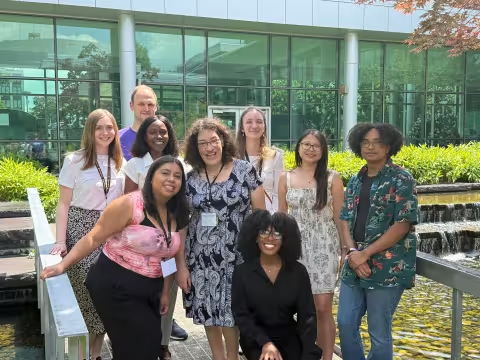
Trainee Insights - Broadening Horizons at the REU in RNA Program

By Sydney Johnson, Undergraduate Researcher at the RNA Institute, from St. John's University
Though I expected to learn much from the REU (Research Experience for Undergraduates), I still find myself surprised at all the ways it’s helped me to grow. I came across the opportunity at the suggestion of my PI at home, who had long encouraged me to do research elsewhere in the summer of Junior year.
When I started my summer internship at the RNA Institute at SUNY Albany, I had no wet lab experience outside of coursework. Years of computational chemistry research set a sturdy foundation for my understanding of the scientific research process— it allowed me to see biology as a web of disciplines, with countless intersections— but it didn’t feel complete. I wanted something more hands-on: to be able to shift concepts from class and a growing love for molecular biology into practical application. I was sure of a few things (my desire to be a scientist, go to grad school, and finally try my hand at experimental research), but not much beyond that. I hoped that this program would afford me the space and resources to figure out everything in between.
Through the REU in RNA program, I had the opportunity to do research with Dr. Gabriele Fuchs, where my time both in and out of the lab taught me more about myself every day. I learned that I like to copy my procedures onto scrap paper before I begin anything, that I enjoy the bustle of making a gel while I wait for samples to finish spinning in the centrifuge. It was both fun and terrifying trying to become familiar with the ins and outs of vector cloning and cell culture, to understand the purpose of each step and the ways you can modify them to fit your experiment’s needs. With the help of my mentors (which have grown to include everyone in the lab), I slowly discovered that while caution is always advisable, the lab is not going to eat you alive.
In the best way possible, I have even more questions now. I think more carefully about what goes into setting up the day’s experiments and how to troubleshoot when they don't turn out as expected. I find myself asking about how much independence I’d want in the lab in the future, curious about the optimal balance between the reliability of an assigned task and the thrill of figuring it out myself. The best (and most difficult) thing about being in an environment with so many complex ideas and capable people is that you’re inevitably challenged. A seminar springs a leak of questions you’d never found yourself asking before; a casual chat with a grad student forces you to revisit something you’d written off. I was prompted to think about my own capabilities, goals, and non-negotiables, and was given lots of guidance about future applications.
In more ways than one, the progress I’ve made this summer wouldn’t have been possible without a community to help guide my growth. My deepest hope is that one day I can create one as welcoming as this.