


Valverde Participates in Inter-American Development Bank Regional Education Forum
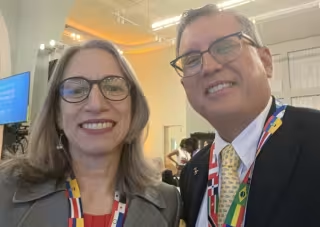
Santo Domingo, Dominican Republic (September 29-30, 2026) – Gilbert A. Valverde, associate professor in the Department of Educational Policy & Leadership at the University at Albany, participated as an invited presenter at the regional forum Built to Last: What Works in Teaching Reading and Math, a high-level policy event co-hosted by the Inter-American Development Bank (IDB) and the Ministry of Education of the Dominican Republic. The gathering brought together education leaders and technical experts representing 18 IDB member countries to examine evidence-based approaches for improving student learning across Latin America and the Caribbean.
The Dominican Republic served as host for the event under the leadership of Dr. Ancell Scheker Mendoza, Vice Minister of Education for Technical and Pedagogical Affairs and a doctoral alumna of the University at Albany's Department of Educational Policy & Leadership. During the forum, Dr. Valverde contributed to discussions on educational quality, evidence-based policymaking, and the interpretation of large-scale assessment data. His participation drew upon ongoing research examining how countries can make more analytically rigorous use of international educational evidence while remaining attentive to local contexts and priorities.
Following the conference proceedings, Dr. Valverde held exploratory discussions regarding potential future research collaborations related to PROGRESA (Project for the Global Reassessment of Evidence on Student Achievement in Overlooked Systems), a multi-year research initiative he directs. PROGRESA seeks to generate new insights from international assessment data by focusing on educational systems that are often overlooked in global comparisons and by examining student engagement, opportunity to learn, and national interpretations of educational evidence.
These conversations included most notably representatives of the governments of Uruguay and the Dominican Republic, as well as technical staff from the IDB. Discussions explored opportunities for collaboration the use of international assessment data, and the development of more context-sensitive approaches to understanding educational quality in the region.
"One of the most promising aspects of the meeting was the opportunity to engage directly with policymakers and regional organizations that share an interest in strengthening the quality and use of educational evidence," said Dr. Valverde. "The conversations reinforced the importance of developing research partnerships that both contribute to international scholarship and respond to the priorities of countries in the region."
The event reflects the continuing role of the University at Albany's comparative and international education policy faculty in supporting global conversations about educational improvement, evidence, and policy innovation.