





UAlbany Spinoff Secures New Funding in Bid to Transform Biotechnology

By Erin Frick
ALBANY, N.Y. (Nov. 6, 2025) — University at Albany’s Professor Scott Tenenbaum, CEO of UAlbany spinoff company sxRNA Technologies, Inc., believes in pursuing strategic science designed for impact. Now, thanks to ongoing collaborations with UAlbany’s Office of Economic Development, Entrepreneurship, and Industry Partnerships and a string of funding success that brought in over $625,000 in new awards to the company in 2025, Tenenbaum’s pioneering RNA technology is positioned to optimize medical research, improve drug production and enable the development of new precision therapeutics.
“Our platform technology is highly adaptable and could be applied to many different uses across the field of biotechnology,” said Tenenbaum, professor of nanoscale science and engineering at UAlbany’s College of Nanotechnology, Science, and Engineering and the RNA Institute. “As we advance our three product lines, with other new lines in development, we’re doing so with an intentional eye on market needs. We want to ensure that we’re pursuing solutions to real challenges that those working in biotech — from industry to academia — are grappling with now.”
— Video filmed and produced by Zach Durocher.
Tiny Switches to Answer Big Questions
From the beginning, Tenenbaum's research has been driven by the fundamental question: “How does the human genome work? How we are able to do what we do with nucleic acids, the building blocks of DNA, in a way that no other living organism on the planet can?”
The secret could lie within RNA — the messenger molecule that regulates cellular functioning in all living organisms.
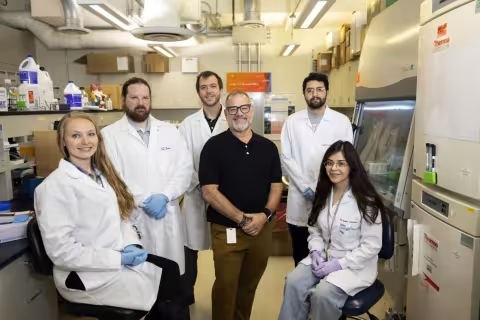
Tenenbaum’s lab produces tiny nano-scale RNA “switches” that are programmed to turn specific cell processes on and off. The two-part system works like a lock and key. It starts with synthesizing a piece of RNA in the lab that activates only when it meets a specific cellular target in a biological system (like a cancer cell, or a protein associated with dementia). When the lock and key come together, the engineered RNA will instruct the target cells to perform a certain function or express a particular trait.
Tenenbaum’s team can design an RNA switch for any cellular target for any tissue type. “All we need is an RNA tag within the target cell type, and we can design a nano switch to control the activity of that specific function in the cell,” Tenenbaum said.
Broad Market Appeal
The technology’s wide scope for adaptability means the pool of potential funders and commercial partners is also very broad. Since the company’s inception, Tenenbaum has worked closely with UAlbany's Office of Economic Development, Entrepreneurship, and Industry Partnerships to devise new ways to secure funding, secure intellectual property and build partnerships to support commercialization.
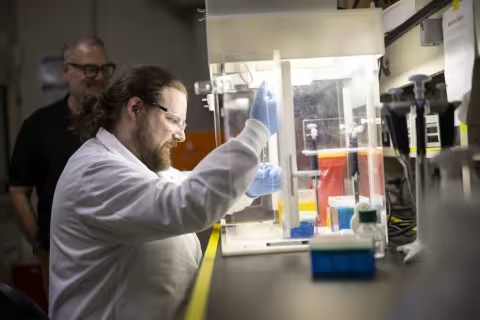
“I’ve always had an entrepreneurial bent, so in the earliest stages of developing this technology, I realized that it was something with broad commercial potential,” Tenenbaum said. “All scientific research is expensive, even more so if you’re looking to translate bench research to market-ready products. As sxRNA Technologies has grown, we’ve had to learn how to ‘sell’ our science to new types of potential funders — including those with the means to take what we’re developing in the lab and turn it into something that consumers — pharmaceutical companies, other academic institutions — can actually buy and use.”
This year, sxRNA Technologies won five grants from federal, state and industry sources, positioning the company for accelerated advancement. These awards include:
- With UAlbany collaborator Susan Sharfstein, professor of nanoscale science and engineering, sxRNA Technologies secured its second Small Business Technology Transfer (STTR) grant from the National Institutes of Health, providing $300,000 to continue developing its novel sxRNA-based biomanufacturing technology.
- French pharmaceutical giant Sanofi granted sxRNA Technologies a $150,000 Innovations in Data Exploration and Analytics (iDEA-TECH) Award, making it the first SUNY-affiliated recipient. With fewer than a dozen such grants awarded globally each year, this competitive seed-funding program will enable the company to test its sxRNA therapeutic in mice, and paves the way for future collaborations with Sanofi.
- New York State's Center for Advanced Technology in Nanoscience and Nanoengineering (CAT N2) awarded sxRNA Technologies $100,000 to continue its research on Alzheimer’s disease, the company’s original focus, with the aim to develop an sxRNA-based organoid product for studying the disease and testing therapeutics.
- The SUNY Research Foundation’s Technology Accelerator Fund (TAF) granted sxRNA $50,000 to strategically overlap with and support the Sanofi award, accelerating progress towards developing a commercially viable therapeutic product.
- At SUNY’s Startup Summer School Demo Day (S4), sxRNA Technologies earned $25,000 by winning the SUNY Research Foundation S4 pitch competition. They also won the New York BIO Mini-Pitch event held in late July, which positioned them well for the S4 win.
Three Product Lines, Endless Applications
As Tenenbaum's team explores new and creative ways to apply the sxRNA platform, three distinct product lines — all based on the same core technology — are already deep in development.
Organoid Innovation
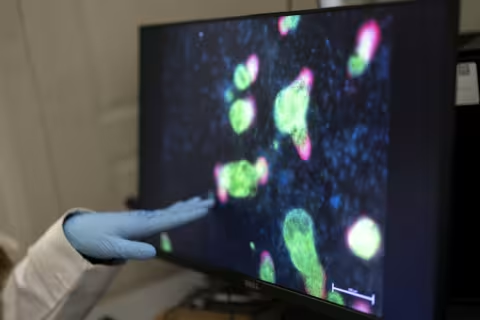
The first product line addresses a major challenge in biomedical research. Organoids — miniature lab-grown organs used for drug testing and disease research — currently require researchers to destroy up to 20% of their samples during quality control testing. sxRNA's real-time monitoring technology eliminates this waste by allowing researchers to track organoid development without destroying samples.
“Our technology has the ability to light up in living cells in real time, so we can track specific developmental markers,” Tenenbaum said. “This allows researchers to monitor any organoid type — brain, heart, liver or others — by adding sxRNA cocktails that light up in different colors when specific markers are present. This essentially works like a check engine light. You can see what’s wrong, if anything, without taking the car apart.”
UAlbany’s Tia Swenty, a doctoral student in the Tenenbaum Lab who participated in the Research and Innovators Startup Exchange program, is leading innovation in this line of research. Learn more about Swenty and her work in this Q&A.
Not only does this method reduce waste and save money, it also means that organoids can be monitored individually. Instead of testing a representative sample to generalize quality across the batch, with this system, each organoid can be monitored to ensure that it is meeting optimal developmental criteria.
Biomanufacturing
The second product line tackles inefficiencies in pharmaceutical production. Over 50% of modern drugs are made through biomanufacturing — using living cells to produce complex proteins too difficult to synthesize chemically. The process currently requires months-long cloning procedures and produces limited yields.
The sxRNA platform can reduce cloning time from months to less than two weeks while selecting for “super-producer” cells that generate higher protein yields. “A 5% increase in production translates to millions of dollars for a pharmaceutical manufacturer,” Tenenbaum said. “If we can help bump up yield, even by this seemingly modest margin, that's a lot of money.”
Precision Therapeutics
The most ambitious product line could revolutionize the way we treat disease. Unlike some mRNA therapies (and other conventional drugs) that circulate in the body and can cause off-target side effects, sxRNA can be engineered to activate only in specific cell types.
“The precision of our technology could enable groundbreaking therapeutics,” Tenenbaum said. “Imagine solving major medical challenges, like killing cancer cells without causing systemic harm. We could program our RNAs to target senescent cells associated with Alzheimer's disease. We could create better vaccines with fewer side effects. We could advance gene therapy for genetic diseases like cystic fibrosis — all while leaving healthy tissue untouched.”
Bench to Bedside
Tenenbaum's commitment to translating lab research into real-world impact started when he was a graduate student at Tulane University, where he was first exposed to a startup-centered research ecosystem.
“The popularity of the bench-to-market pipeline came about in 1980 thanks to the Bayh-Dole Act, which mandates that taxpayer-funded research should benefit society,” Tenenbaum said. “Because public funds support public university research, it is our duty to ensure that our work serves the people who make it possible.”
This philosophy drives the company's approach. “It's not just about asking neat questions; everything we are working to advance are things that can help people,” Tenenbaum said. “As we move toward larger funding rounds and pursuing new partnerships with major pharmaceutical companies, our ultimate goal remains the same: developing technologies to improve human health, and someday, save lives.”