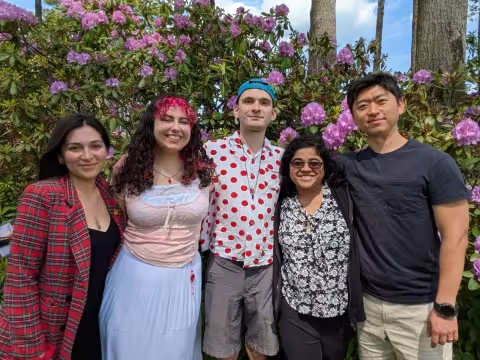
Trainee Insights - Best Summer Ever: My Experience at The RNA Institute

By Vanessa Gentile, Undergraduate Researcher at the RNA Institute, from SUNY New Paltz
I remember talking to one of my friends about research. I explained that I loved doing research in school, how I was struggling to find summer jobs, and that I wished there was a way for me to do research during the summer. I recall her exact response:
“Dude, you should try an REU. That’s what I did this past summer.”
At the time, I had no idea what an REU was. But once I attended an information session at my school, I found myself feverishly researching all these different programs in biology and chemistry. One caught my eye: the Research Experiences for Undergraduates (REU) at the RNA Institute at UAlbany. I wanted to join this program because of my love for molecular biology and genetics, which spawned in high school and only strengthened through my first few years of college. I expressed my enjoyment in researching stem cells, which ended up with me being paired with the Lee Lab.
In the Lee lab, we look at stem cell maintenance in the germline of the model organism Caenorhabditis elegans (C. elegans). Within the germline, we investigate how cells communicate through Notch signaling, and how specific target genes responsible for stem cell renewal are regulated through Notch signaling. The two target genes we focus on are sygl-1 and lst-1. sygl-1 is more well-known, but my project took a leap of faith into the road (or gene) less traveled, lst-1. Despite the uncertainty of the effectiveness of my procedures, I was lucky enough to produce strong, perhaps even publishable data.
Throughout the program, I obtained a lot of knowledge and experience with new topics and techniques. I learned about the Notch signaling pathway, as well as how to properly care for C. elegans in a lab. I was also introduced to the procedure of single-molecule RNA FISH (smFISH), a fluorescent microscopy technique. Because RNA is crucial to visualizing genes, we must take special care to not damage the RNA, creating an RNase-free environment. I also learned to navigate MATLAB which, in my opinion, is much scarier than smFISH.
Of course, I got lots of help along the way through my Principal Investigator Dr. ChangHwan Lee and senior lab members. Their help was the most valuable part of the entire program. From advice on interpreting data, graduate school, and careers, to simple day-to-day tasks, the support was the main reason I thrived. I’m a big question-asker, and I love to triple check that I got everything right before doing it myself. Being helpful isn’t always what you say,-it’s also having patience.
I am writing this during my final days in the program. Looking back at the past ten weeks, I can’t help but feel grateful. I’m grateful for all the valuable lessons I’ve learned, all the amazing people I met, and the certainty I now feel about my future. Though I’ll miss Albany, I know it has only prepared me for greater things. Because of that, I will always hold this REU very close to my heart.