





Shine Bright Like a Nanoparticle: Chemistry Senior Talks Rapid Pathogen Detection

By Erin Frick
ALBANY, N.Y. (April 22, 2026) — University at Albany senior and chemistry major Emmett Hanson has spent the past several years developing innovative techniques for fluorescent biosensing in the lab of Chemistry Professor Mehmet Yigit at the RNA Institute. His work on rapid pathogen detection — which he'll be presenting next week at Showcase Day — has resulted in two peer-reviewed publications and landed him a PhD position at Stanford.
Originally from Big Flats, New York, Hanson joined UAlbany as a freshman in the Honors College. After briefly exploring business, a course in general chemistry shifted his interest towards STEM and ultimately biochemistry research.
By working closely with graduate students and logging serious time at the lab bench, Hanson unlocked an opportunity to pursue his own project focused on biosensing to detect foodborne pathogens. As he prepares for graduate school, he hopes to continue advancing biosensing technologies while exploring deeper questions in synthetic biology.
We sat down with Hanson to learn more about his path, what he’s been working on in the Yigit Lab, and his advice for undergrads interested in research.
What brought you to UAlbany?
I'm from Upstate New York and I knew I wanted to attend a large university. I'm a big fan of SUNY schools, especially because they're so cost-effective. When I applied to UAlbany, I was offered a place at the Honors College and a scholarship. I visited during the accepted student day and everything just felt right. My parents also went to UAlbany, so it was a natural fit.

Why did you decide to study chemistry?
I initially tried business but quickly realized that wasn't for me. Then I took a general chemistry course with Dr. Paul Toscano, and the way he lectured really spoke to me. I liked that he used a chalkboard and his teaching style made everything click. I enjoyed biology in high school and at that point, I was considering becoming a doctor, so pursuing a STEM major and joining a research lab felt like good steps toward a pre-med path.
How did you get your start in research?
I cold-emailed Dr. Mehmet Yigit about joining his lab. He responded right away, gave me an interview and offered me a tour of his lab. From the beginning, he treated me with a lot of respect. I joined his lab early in the first semester of sophomore year. I started by working directly with a PhD student who was an excellent teacher. After showing up consistently and asking lots of questions, Dr. Yigit gave me my own project. My first project didn't work, but the second one did, and that turned into a paper, and then a follow-up paper.
What are you studying?
Our lab is working to develop quick, cheap and easy methods to detect foodborne pathogens, which make people sick and cause massive food waste. In particular, my project focused on Escherichia coli, Campylobacter and Listeria monocytogenes.
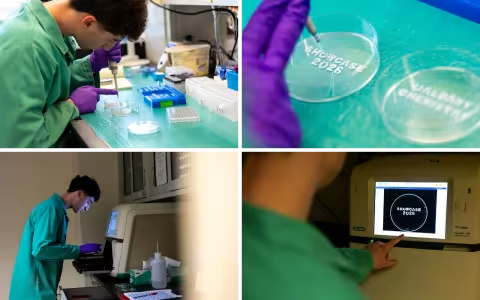
We use the “CRISPR-Cas” gene editing system, which is programmable, fast and relatively inexpensive. We combined this approach with silver nanoparticles that fluoresce to tell us whether a pathogen is present in a sample. Our test is paper-based and we use letter cut-outs (“E” for E. coli, “C” for campylobacter and “L” for listeria) to allow us to detect multiple pathogens at once.

How does it work?
First, we add fluorescent silver nanoparticles to a sample containing a pathogen genome, for example, E. Coli. We found that when the “Cas” enzyme detects a target pathogen, it destroys the silver nanoparticles, causing their fluorescence to disappear. We then developed a technique to reverse the signal, making it more intuitive — when E. coli is present, only the "E" cutout on our paper substrate remains visible. All of this requires a device called a fluorescent gel reader (a standard tool in many labs) which converts electron activity in the nanoparticles to a wavelength we can see as light, or fluorescence.
Our first paper was published in Small, and a follow-up paper recently appeared in ACS Sensors.
Why is this important?
By using inexpensive reporters, paper substrates and letters that glow to indicate pathogen presence, our pathogen detection system is cheap, quick and easy to interpret. Plus, it could be used to test for multiple pathogens at once. Someday, we’d like to see this type of technology become commercially available to make real improvements in food safety and public health. Being able to identify tainted foods faster also has important economic benefits.
What do you enjoy about working in a research lab?
The best thing is getting to work with grad students and postdocs from different backgrounds who bring different expertise and ways of thinking. I've worked with people from chemistry, nanotechnology and biology backgrounds. Dr. Yigit gave me a desk in the lab, so I could do my homework there and whenever someone was doing something interesting, I could take a break and watch, ask questions. You don't get one-on-one time with experts like this very often, so I really took advantage of it. I also love the hands-on work — the pipetting, trying to visualize what's happening using different imaging techniques, and working with cool machines like the negative 80-degree cryogenic freezer.

What advice would you give other undergraduate students interested in research?
You might think that getting your foot in the door of a lab will be hard since, as an undergrad, you have no research experience on your resume. And it is intimidating at first, but remember that no one expects you to know anything when you start. Everything is an opportunity because you're there to learn. It’s important to do your research on the lab and read up on what they're doing. But really, it's about showing enthusiasm for science; no one's looking at your GPA. Professors want to see that you're enthusiastic, willing to learn and think the science is cool. Once you're in a lab, ask good questions and show genuine interest. The whole point of undergraduate research is learning—there's no expectation for you to produce data immediately.
Learn more about Emmett’s research at Showcase Day, where he’ll be presenting his work alongside nearly 300 other students affiliated with UAlbany’s Chemistry and Biology Departments, the RNA Institute, and the College of Integrated Health Sciences. Catch the poster symposium April 30th from 9:30 a.m. to 12:30 p.m. in the Broadview Arena. (Emmett is on from 11 a.m. - 12:30 p.m.) All are welcome to attend this and all other Showcase Day events. Registration is free.