Sustainable Design Lab

About the Sustainable Design Lab

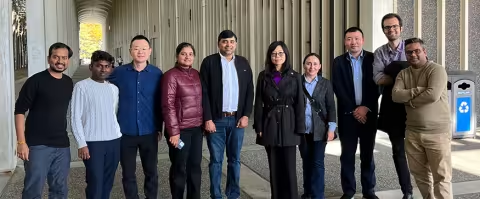
A group of ten researchers, including Dr. Yann Liang, stand and pose, smiling for a photo.


Welcome to Dr. Yanna Liang’s Sustainable Design Lab!

We focus on solving pressing environmental, social and health problems through sustainable approaches. Sustainability is the guiding principle for each of the process designs we use to tackle different challenges and applications.

Contact the Sustainable Design Lab
Yanna Liang
ETEC 024

1220 Washington Ave
Albany, NY 12226
United States

Research

Sustainable Design at UAlbany - Dr. Yanna Liang
Ongoing Funded Project 1: ERASE-PFAS: Stabilization of Per- and Polyfluorinated Substances in Sewage Sludge Intended for Land-application

In the U.S., various processes used for treating wastewater at wastewater treatment plants generate hundreds of million tons of sludge per year. Through certain kinds of pretreatment, the sludge is turned into biosolids that can be applied to agricultural lands.

Biosolids land-application has been practiced for decades and is generally considered a good approach for both biosolids disposal and soil quality maintenance.

In recent years, however, per- and polyfluorinated substances (PFAS) have been detected in sludge and biosolids. In this case, if biosolids are land-applied, PFAS may enter the ecosystem and food chain through uptaking by plant species.

To prevent this uptake and potentially negative impacts of PFAS to the environment and human health, we aim to identify suitable sorbents that can bind to PFAS and make their uptake by plants impossible.

Success in this project will lead to a sustainable approach for handling biosolids. This will allow biosolids to be land-applied continuously, benefit agriculture and eliminate a potential waste stream from the environment.

Besides technical contributions to society, this project will provide opportunities to train the next generation of engineers and scientists through education, training and outreach activities designed for students at different levels and ongoing discussions with a wide range of stakeholders.


Ongoing Funded Project 2: Assessing Plant Uptake of Per- and Polyfluoroalkyl Substances (PFAS) in Soil Exposed to These Emerging Contaminants

The overarching goals of this project are to assess the potential of perennial grasses planted through the Conservation Reserve Program (CRP) to be used as a form of phytoextraction to remediate farm fields contaminated with PFAS, to evaluate the risks of doing so and to propose management actions to prevent the further spread of PFAS on program-enrolled fields.

Ongoing Funded Project 3: Phytoremediation for Shallow Sources of Per- and Polyfluoroalkyl Substances (PFAS) Impacting Groundwater

Concerns regarding PFAS in the environment have grown dramatically in recent years. The Department of Defense (DoD) has used large quantities of aqueous film forming foam (AFFF) products containing PFAS for firefighter training activities and in response to fire emergencies.

Significant concentrations of PFAS have be found in shallow soils associated with past AFFF use at DoD facilities and these soils may serve as long-term sources to groundwater.

The primary objective of this project is to demonstrate phytoremediation approaches for managing shallow soils impacted by PFAS to significantly reduce source loading to groundwater.

The benefit of phytoremediation approaches for extracting PFAS (e.g., phytoextraction) from soils at low cost will also be demonstrated.

In addition to demonstrating phytoremediation approaches for reducing downward migration through unsaturated vadose zone soils, this project will also investigate uptake of PFAS by representative wetland plant species.

Ongoing Funded Project 4: Practical Management of PFAS Contaminated Agricultural Soil Using an Innovative Platform Integrating Experimental Research and Machine Learning Approaches, EPA, 2024-2028

This project aims to test the overarching hypothesis that proper engineering control will allow continued and beneficial use of biosolids on agricultural soil and that this practice can sustain marketable and PFAS-free products from such soil.

To achieve this goal, we seek to accomplish four specific objectives:

  1. Model the relationship between PFAS solid-water partition coefficient (Kd) and soil properties with or without powdered activated carbon (PAC).
  2. Understand the uptake of individual and total precursor PFAS by representative plants grown in biosolids-amended soil. The resulting data will be processed by machine learning (ML) to build models that can predict PFAS behavior in a given growth environment.
  3. Elucidate the binding mechanisms for and the stability of the bound residues formed between PFAS, soil and biosolids with or without PAC. New sorbents whose design is guided by the mechanisms will be tested thoroughly.
  4. Perform field trials to verify the accuracy of the developed models. Results from the field trials will confirm whether the established database and predictive tools are ready to be handed to potential users.
Ongoing Funded Project 5: Integrating Bioremediation and Phytoremediation for Efficient Treatment of AFFF-Contaminated Soil

To enhance plant uptake of perfluoroalkyl acid (PFAA) precursors and ensure AFFF-impacted soil can be cleaned up completely, we seek to integrate bioremediation and phytoremediation.

Bioremediation has been proven to be ineffective for degrading PFAAs due to their recalcitrant structures. The precursors, however, have more functional groups and weak chemical bonds that are amenable to biodegradation. Not surprisingly, bacterial degradation of several precursors has been reported.

Specifically, we aim to take advantage of the synergistic interactions between fungal strains and biochar for improved biodegradation of PFAA precursors.

Ongoing Funded Project 6: Understanding the Fate and Distribution of PFAS in Biosolids and Treated Effluent upon Application to Soil

The recycling of biosolids produced from publicly-owned Water Resource Recovery Facilities (WRRFs) is a common practice, due to the beneficial properties of the biosolids. Biosolids are known to improve soil quality by enhancing water retention, replenishing soil organic matter (SOM) and providing nutrients.

Aside from beneficial properties, biosolids can contain chemical and biological constituents that can cause harm to human health and the environment if not properly controlled.

To address these concerns, both federal standards (40 CFR Part 503) and New York State regulations (6 NYCRR Part 361) require control of these constituents.

In recent years, the presence of per- and polyfluorinated substances (PFAS) in environmental media has raised concerns related to potential human health impacts.

PFAS have been found in biosolids globally. This project seeks to provide scientific support for PFAS regulatory limits that will be applied to the recycling of biosolids in the state to provide protection of human health and environmental resources.

In addition to biosolids, the wastewater effluent from some WRRFs can be used for irrigation purposes, providing a benefit to the soil and conserving water resources. Effluent can contain low levels of PFAS compounds.

Thus, it is imperative to have sound scientific data that can support water quality guidance values for PFAS.

Ongoing Project 7: Micro and Nanoplastics (MNPs): Best-in-class Detection, Quantification and Removal

We seek to focus on four challenging questions that researchers commonly encounter:

  1. What are the accurate procedures for extracting and isolating MNPs from environmental matrices?
  2. What analytical instruments can detect and measure MNPs in water and what are the limitations of each?
  3. What materials are capable of adsorbing MNPs in water and what mechanisms help achieve this goal?
  4. How can adsorption studies advance from idealistic conditions focused on custom-synthesized MNPs to more realistic scenarios targeting degraded and eroded MNPs in the natural environment?

Publications

2026
2026
  • Ilango, A., Kharel, M., Zhang, W., Liang, Y. 2026. PFAS Uptake by Plants in Soils Amended with Biosolids Derived from Wastewater with Industrial Input. ACS Environmental Au.
  • Bitaraf, B., Pervez, M.N., Jiang, T., Ioanniti, M., Efstathiadis, H., Yigit, M., Liang, Y. 2026. Fast adsorption of short and long-chain PFAS from water by chemically modified sawdust. ES&T Water. 6, 873−883.
  • Pervez, M., Jiang, T., Ilango, A.K., Kumaran, Y., Zhang, Y., Zhang, W., Efstathiadis, H., Feldblyum, J.I., Yigit, M.V., Venkatesan, A.K., Liang, Y. 2026. Regenerable Graphene Nanoplatelet Adsorbents for Rapid and Trace-Level PFAS Removal from Water. ACS Omega. 11, 2, 2902–2916.
2025
2025
  • Pervez, M., Jiang, T., Li, B., Bitaraf, B., Ilango, A.K., Ioanniti, M.M. (Graduate student), Schaeffer, C., Efstathiadis, H., Yigit, MV., Liang, Y. 2025. Cationically Modified PVA-Based Electrospun Nanofiber Membrane for Adsorptive PFAS Removal from Water. ACS Applied Engineering Materials. 4 (1), 93-106.
  • Jiang, T., Pervez, M., Ilango, A.K., Liang, Y. 2025. Stabilizing Per- and Polyfluoroalkyl Substances (PFAS) through Amending an Adsorbent to Contaminated Soil Planted with Alfalfa. Science of the Total Environment, Volume 1000, 20 October 2025, 180430.
  • Pervez, M.N., Ilango, A., Jiang T., Talukder, M., Ehsan, M., Cai, Y., Liang, Y. 2025. PFAS in the textile industry: Sources, fate, detection, and pathways toward sustainable remediation and regulation. Chemical Engineering Journal. 522, 168183.
  • Ehsan, M., Pervez, M.N., Alam, S.M., Liang, Y., Vincenzo, V. 2025. PFAS in biotic and abiotic matrices in coastal and estuarine ecosystems: Temporal and seasonal distribution, discharge and environmental impacts. Journal of Environmental Quality. 54 (5), 893-912.
  • Qi, Y., Li, F., Zhang, C., Tang, X., Wang, C., Liang, Y., Sun, H., Xing, B. 2025. Enhancement of the Coadsorption of Per-and Polyfluoroalkyl Substances onto Fe-MOF Derivative in Surface Water through Strengthening Hydrophobic Interactions. ACS ES&T Engineering. 5 (6), 1405-1416.
  • Ilango, A., Mekkat, R., Jeyalakshmi, V., Pervez, N., Jiang, T., Chand, P., Kumaran, Y., Sukalingum, D., Soos, M., Liang, Y., 2025. Enhanced removal of PFAS in water using activated ZIF-8 carbons: high adsorption efficiency, repeatable regenerability and reusability. Chemical Engineering Journal. 507, 160192.
  • Qi, Y., Yang, Y., Yu, X., Wu, S., Wang, S., Yu, Q., Wang, C., Liang, Y., Sun, H. 2025. Unveiling the Contribution of Hydrogen Radicals to Per- and Polyfluoroalkyl Substances (PFASs) Defluorination: Applicability and Degradation Mechanisms. Environmental Science and Technology. 59 (3), 1875-1886.
  • Ehsana, M., Rizab, M., Pervez, N., Liang, Y. 2025. Source identification and distribution of per- and polyfluoroalkyl substances (PFAS) in the freshwater environment of USA. International Journal of Environmental Science and Technology. 22 (3), 2021-2046.
  • Jiang, T., Pervez, N., Ilango, A., Liang, Y. 2025. Enhanced Removal and Destruction of Per- and Polyfluoroalkyl Substances (PFAS) Mixtures by Coupling Magnetic Modified Clay and Photoreductive Degradation. Journal of Water Process Engineering. 69, 106733.
  • Zhang, W., Liang, Y., 2025. Impact of Four Surfactants on the Uptake of Per- and Polyfluoroalkyl Substances (PFAS) by Red Fescue Grass. International Journal of Phytoremediation. 27, 13-22.
2024
2024
  • Ilango, A., Zhang, W., Liang, Y. 2024. Uptake of per- and polyfluoroalkyl substances by Conservation Reserve Program’s seed mix in biosolids-amended soil. Environmental Pollution, Volume 363, Part 2, 15 December 2024, 125235.
  • Bian, Y., Leininger, A., Zhang, W., Liang, Y., Ren, Z.J. 2024. Co-valorization of food waste and CO2 to produce volatile fatty acids using liter-scale tubular microbial electrosynthesis cells. ACS ES&T Engineering. 4 (9), 2243-2251.
  • Pervez, N., Jiang, T., Mahato, J., Ilango, A., Kumaran, Y., Zuo, Y., Zhang, W., Efstathiadis, H., Feldblyum, J., Yigit, M., Liang, Y. 2024. Surface modification of graphene oxide for fast removal of per-and poly-fluoroalkyl substances (PFAS) mixtures from river water. ACS ES&T Water. 4, 7, 2968–2980.
  • Pervez, N., Jiang, T., Liang, Y. 2024. Structure and mechanism of nanoengineered membranes toward per-and polyfluoroalkyl substances (PFAS) removal from water: A critical review. Journal of Water Process Engineering, 63, 105471.
  • Jiang, T., Pervez, N., Ilango, A., Ravi, Y., Zhang, W., Feldblyum, J., Yigit, M., Efstathiadis, H., Liang, Y. 2024. Magnetic Surfactant-Modified Clay for Enhanced Adsorption of Mixtures of Per- and Polyfluoroalkyl Substances (PFAS) in Snowmelt: Improving Practical Applicability and Efficiency. Journal of Hazardous Materials. 471, 134390.
  • Qi, Y., Yang, Y., Cui, S., Tang, X., Zhang, P., Wang, C., Liang, Y., Sun, H., Ma, C., Xing, B. 2024. Novel Defluorination Pathways of Perfluoroether Compounds (GenX): α-Fe2O3 Nanoparticle Layer Retains Higher Concentrations of Effective Hydrated Electrons. Environmental Science and Technology. 58, 12, 5567–5577.
  • Ilango, A., Arathala, P., Musah, R., Liang, Y. 2024. Experimental and Density Functional Theory Investigation of Surface-Modified Biopolymer for Improved Adsorption of Mixtures of Per- and Polyfluoroalkyl Substances in Water. Water Research, 255, 121458.
  • Sun, S., Sui, X., Yu, H., Zheng, Y., Zhu, X., Wu, X., Li, Y., Lin, Q., Zhang, Y., Ye, W., Liang, Y. 2024. High tribocatalytic performance of FeOOH nanorods for degrading organic dyes and antibiotics. Small Methods. 8 (12), 2301784.
  • Nason, S., Thomas, S., Stanley, C., Silliboy, R., Blumenthal, M., Zhang, W., Liang, Y., Jones, J., Zuverza-Mena, N., White, J., Haynes, C., Vasiliou, V., Berger, B. 2024. A Comprehensive Trial on PFAS Remediation: Hemp Phytoextraction and PFAS Degradation in Harvested Plants. Environmental Science: Advances. 3, 304-313.
2023
2023
  • Ilango, A., Liang, Y. 2023. Surface Modifications of Biopolymers for Removal of Per- and Polyfluoroalkyl Substances from Water: Current Research and Perspectives. Water Research. 249, 120927.
  • Ilango, A., Jiang, T., Zhang, W., Pervez, N., Feldblyum, J., Efstathiadis, H., Liang. Y. 2023. Enhanced adsorption of mixtures of per- and polyfluoroalkyl substances in water by chemically modified activated carbon. ACS ES&T Water. 3, 11, 3708–3715.
  • Zhang, W.L., Liang, Y. 2023. The Wide Presence of Fluorinated Compounds in Common Chemical Products and the Environment: A Review. Environmental Science and Pollution Research. 30 (50), 108393-108410.
  • Jiang, T., Pervez, N., Liang. Y. 2023. Effective Stabilization of Per- and Polyfluoroalkyl Substances (PFAS) Precursors in Wastewater Treatment by Surfactant-Modified Clay. Chemosphere. 341, 140081.
  • Pervez, M.N., Jahid, M.A., Mishu, M.R., Talukder, E., Bounerba, A., Jiang, T., Liang, Y., Zhao, Y., Cai, Y., Naddo, V. 2023. Tuning the surface functionality of polyethylene glycol-modified graphene oxide/chitosan composite for efficient removal of dye. Scientific Reports. 13 (1), 13460.
  • Speer, D., Patel, T., Ho, B., Phillips, J., Zhu, T., Shangraw, J., Demirtas, M., Liang, Y., Tutej, A. 2023. Enhanced, Continuous, Liquid-liquid Extraction and In-situ Separation of Volatile Fatty Acids from Fermentation Broth. Separation and Purification Technology. 124810.
  • Ilango, A., Jiang, T., Zhang, W-L., Feldblyum, J., Efstathiadis, H, Liang, Y. 2023. Surface-modified biopolymers for removing mixtures of per- and polyfluoroalkyl substances from water: Screening and removal mechanisms. Environmental Pollution, 331, 121865.
  • Jiang, T., Shi, Q., Wei, Z., Shah, K., Efstathiadis H., Meng, X., Liang, Y. 2023. Leaching of Valuable Metals from Cathode Active Materials in Spent Lithium-Ion Batteries by Levulinic Acid and Biological Approaches. Heliyon. 9 (5).
  • Ehsana, M., Riza, M., Pervez, M., Khyume, M., Liang, Y., Naddeo, V. 2023. Environmental and health impacts of PFAS: Sources, distribution and sustainable management in North Carolina (USA). Science of the Total Environment. 878, 163123.
  • Zhang, W., Wellington, T. (Undergraduate student), Liang, Y. 2023. Effect of two sorbents on the distribution and transformation of N-ethyl perfluorooctane sulfonamido acetic acid (N-EtFOSAA) in soil-soybean systems. Environmental Pollution. 318, 120941.
  • Ravi, YK., Zhang, W., Liang, Y. 2023. Effect of Surfactant Assisted Ultrasonic Pretreatment on Production of Volatile Fatty Acids from Mixed Food Waste. Bioresource Technology. 368, 128340.
  • Jiang, T., Zhang, W., Ilango, A., Feldblyum, J., Wei, Z., Efstathiadis, H., Yigit, M., Liang, Y. 2023. Surfactant-Modified Clay for Adsorption of Mixtures of Per- and Polyfluoroalkyl Substances (PFAS) in Aqueous Solutions. ACS Advanced Engineering Materials. 1, 1, 394–407.
2022
2022
  • Zhang, W.L., Tran, N. (Undergraduate student), Liang, Y. 2022. Uptake of per- and polyfluoroalkyl substances (PFAS) by soybean across two generations. Journal of Hazardous Materials Advances. 8, 100170.
  • Govarthanan, M., Liang, Y., Kamala-Kannan, S., & Kim, W. 2022. Eco-friendly and sustainable green nano-technologies for the mitigation of emerging environmental pollutants. Chemosphere 287, 132234.
  • Jiang, T., Singh, S. (Graduate student), Dunn, K.A., and Liang, Y. 2022. Optimizing Leaching of Rare Earth Elements from Red Mud and Spent Fluorescent Lamp Phosphors Using Levulinic Acid. Sustainability. 14 (15), 9682.
  • Zhang, W.L., Liang, Y. 2022. Changing bioavailability of per- and polyfluoroalkyl substances (PFAS) to plant in biosolids amended soil through stabilization or mobilization. Environmental Pollution. 308, 119724.
  • Jiang, T., Zhang, W.L., Liang, Y. 2022. Uptake of Individual and Mixed Per- and Polyfluoroalkyl Substances (PFAS) by Soybean and Their Effects on Functional Genes Related to Nitrification, Denitrification, and Nitrogen Fixation. Science of the Total Environment. 838, 156640.
  • Zhang, W.L., Tao, J., Liang, Y. 2022. Stabilization of per- and polyfluoroalkyl substances (PFAS) in sewage sludge using different sorbents. Journal of Hazardous Materials Advances. 6, 100089.
  • Qi Y.W. (Graduate student), Cao, H.M. (Graduate student), Pan W.J. (Graduate student), Wang, C.P., Liang, Y. 2022. The role of dissolved organic matters during the per- and polyfluorinated substances (PFAS) adsorption, degradation and plant uptake: A review. Journal of Hazardous Materials. 436, 129139.
  • Zhang, W.L., Liang, Y. 2022. Performance of different sorbents toward stabilizing per- and polyfluoroalkyl substances (PFAS) in soil. Environmental Advances. Volume 8, 100217.
  • Cao, H.M. (Graduate student), Zhang, W.L., Wang C.P., Liang, Y. 2022. Photodegradation of F-53B in aqueous solutions through an UV/Iodide system. Chemosphere. 292, 133436.
  • Zhang, W.L., Liang, Y. 2022. Hydrothermal liquefaction of sewage sludge – effect of four reagents on relevant parameters related to biocrude and PFAS. Journal of Environmental Chemical Engineering. 10 (1), 107092.
  • Zhang, W.L., Zhang, Q., Liang, Y. 2022. Ineffectiveness of ultrasound at low frequency for treating per- and polyfluoroalkyl substances in sewage sludge. Chemosphere. 286, 131748.
2021
2021
  • Jiang, T., Geisler, M., Zhang, W., Liang. Y. 2021. Fluoroalkylether Compounds Affect Microbial Community Structures and Abundance of Nitrogen Cycle-Related Genes in Soil-Microbe-Plant Systems. Ecotoxicology and Environmental Safety. 228, 113033.
  • Liang, Y. 2021. A Critical Review of Challenges Faced by Converting Food Waste to Bioenergy Through Anaerobic Digestion and Hydrothermal Liquefaction. Waste and Biomass Valorization. 1-16.
  • Zhang, W.L., Liang, Y. 2021. Effects of Hydrothermal Treatments on PFAS in sewage sludge. Environmental Pollution. 285, 117276.
  • Zhang, W.L, Liang, Y. 2021. Interactions between Lemna minor (common duckweed) and PFAS intermediates: Perfluorooctanesulfonamide (PFOSA) and 6: 2 fluorotelomer sulfonate (6: 2 FTSA). Chemosphere, 276, 130165.
  • Zhang W.L., Cao, H.M. (Graduate student), Liang, Y. 2021. Degradation by Hydrothermal Liquefaction of Fluoroalkylether Compounds Accumulated in Cattails (Typha latifolia). Journal of Environmental Chemical Engineering. 9 (4), 105363.
  • Sharifan, H., Bagheri, M., Wang, D., Burken, J.G., Higgins, C.P., Liang Y., Liu, J., Schaefer, C.E., Blotevogel, J. 2021. Fate and transport of per- and polyfluoroalkyl substances (PFASs) in the vadose zone. Science of the Total Environment. 771, 145427.
  • Zhang W.L., Cao, H.M. (Graduate student), Liang, Y. 2021. Plant Uptake and Soil Fractionation of Five Ether-PFAS in Plant-Soil Systems. Science of the Total Environment. 771, 144805.
  • Zhang, D.Q., Zhang, W.L., Liang Y. 2021. Sorption of perfluoroalkylated substances (PFASs) onto granular activated carbon and biochar. Environmental Technology. 42 (12), 1798-1809.
  • Zhang, W.L., Cao. H.M. (Graduate student), Liang, Y. 2021. Optimization of thermal pretreatment of food waste for maximal solubilization. Journal of Environmental Engineering. 147 (4), 04021010.
2020
2020
  • Campobasso, M. (Undergraduate student), Peiravi, M. (Graduate student), Xia, C., Liang, Y., Liu, J. 2020. Effects of Combined Ag and ZnO Nanoparticles on Microbial Communities from Crab Orchard Creek, Illinois, USA. Journal of Environmental Engineering 146 (7), 04020067.
  • Lakhssassi, N., Baharlouei, A. (Graduate student), Meksem, J., Hamilton-Brehm, S., Lightfoot, D., Meksem, K., Liang, Y. 2020. EMS-Induced Mutagenesis of Clostridium carboxidivorans for Increased Atmospheric CO2 Reduction Efficiency and Solvent Production. Microorganisms, 8, 8: 1239.
  • Zhang D.Q., Zhang W.L., Liang, Y. 2020. Bacterial community in a freshwater pond responding to the presence of perfluorooctanoic acid (PFOA). Environmental Technology. 41 (27), 3646-3656.
  • Cao, H. (Graduate student), Zhang, W.L., Liang, Y. 2020. Sonochemical Degradation of Poly- and Perfluoroalkyl Substances - A review. Ultrasonics – Sonochemistry. 69, 105245.
  • Zhang, W.L., Cao, H. (Graduate student), Subramanya, S.M. (Graduate student), Savage, P., Liang, Y. 2020. Destruction of Perfluoroalkyl Acids Accumulated in Typha latifolia through Hydrothermal Liquefaction. ACS Sustainable Chemistry & Engineering. 8 (25), 9257-9262.
  • Zhang, W.L; Liang, Y. 2020. Removal of eight perfluoroalkyl acids from aqueous solutions by aeration and duckweed. Science of the Total Environment. 724, 138357.
  • Zhang, W.L., Efstathiadis, H., Li, L., Liang, Y. 2020. Environmental factors affecting degradation of perfluorooctanoic acid (PFOA) by In2O3 nanoparticles. Journal of Environmental Sciences. 93, 48-56.
  • Zhang, D.Q., Wang, M., He, Q., Niu, X., Liang Y. 2020. Distribution of perfluoroalkyl substances (PFASs) in aquatic plant-based systems: from soil adsorption and plant uptake to effects on microbial community. Environmental Pollution, 113575.

In the News

Team

Principal Investigator

Yanna Liang
Yanna Liang
Professor and Chair
College of Nanotechnology, Science, and Engineering; Department of Environmental & Sustainable Engineering

Research Team


Afroza Mst Khatun, MS student 

Afroza Mst Khatun.

Donald Ngozi, PhD student 

Donald Ngozi.

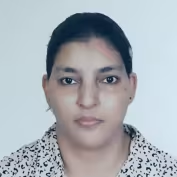
Mandeep Kaur, Research scientist

Mandeep Kaur.

Mzobanzi Moyo, MS student

Mzobanzi Moyo.

Behnia Bitaraf, PhD student

Behnia Bitaraf.

Sadia Mim, PhD Student

Sadia Mim.

Enamul Haque, PhD Student

Enamul Haque.

Tao Jiang, Research scientist

Tao Jiang.

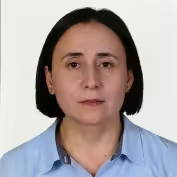
Oya Urucu, Visiting scholar

Oya Urucu.