


5 Qs with Kyle Schirmann, Assistant Professor of Management
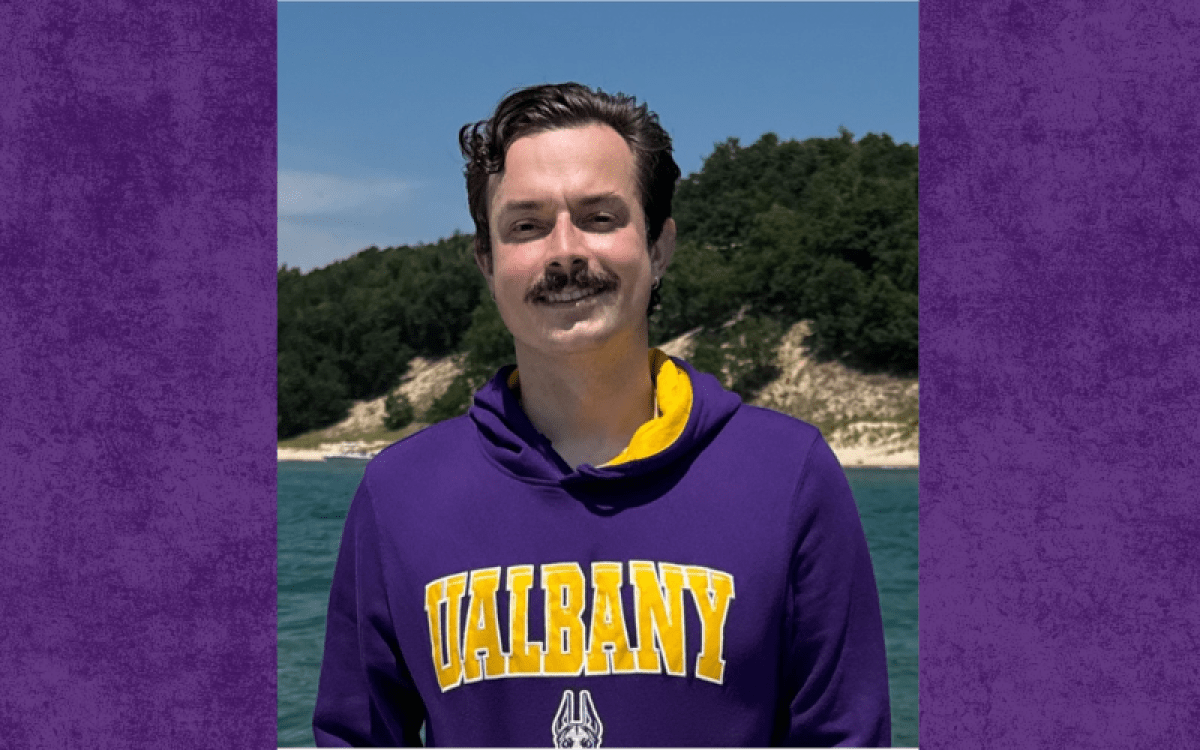
ALBANY, N.Y. (July 16, 2026) —After building a successful career in technology and corporate strategy, Kyle Schirmann is embarking on a new chapter at the University at Albany. This fall, he joins the Massry School of Business as Assistant Professor of Management. In his new role, Schirmann will combine his real-world industry experience with research to help students explore the complexities of the management industry. Read below to learn more about his professional background, passion for creativity and student-centered vision for his tenure at Massry.
Q: What are you most excited about in your new role as Assistant Professor of Management?
As a fresh PhD graduate, flippantly, I’m most excited to have a title that no longer includes the word “student”! More seriously, I’m excited to get to know the students, staff and faculty at the Massry School of Business, continue with my research program and teach the Strategic Management graduate course this coming semester.
I was on campus a few weeks ago for new employee orientation, which coincided with a Connection Day for incoming undergraduate students. It was such a joy to see that excitement and energy, even on a 96-degree summer day. I have a lot of respect for the SUNY mission in general and am thrilled to be part of it.
Q: Before entering academia, you worked as a senior software engineer and held strategy roles for various companies. How has your industry experience influenced the way you approach research and teaching?
I’m fortunate to have spent nearly a decade at two very different firms before starting my PhD. My time at those firms has helped me understand what’s important in real-world practice. When I’m thinking about theory, I’ll often relate it to my time in those roles, checking if the theory explains both the industry and the firm’s management styles. For example, when a new technology is introduced, I ask, "What’s really new about this? When might it be useful or harmful to adopt? What sorts of organizations are well-equipped to experiment and pivot, and which might have pre-existing commitments or investments that could make adoption difficult?" The same questions, when presented to my previous firms, might be answered differently by each team.
My industry experience also taught me that strategy is something everyone in an organization has a hand in, whether as an executive, a middle manager or an individual contributor. Strategy is such an incredibly fascinating world, full of potential and different ways of seeing the same thing. I try to bring that “broad church” view to my teaching.
Q: What can students expect from your classroom in terms of teaching style and the skills or perspectives you hope they’ll take away?
Every student learns differently, so I try to mix different approaches in my teaching—though I am a fan of the case method, and I try to keep my classes interactive. My goal is to teach a mix of theory and practice, creating a space where students can think critically about where, or where not, different theories are useful. There might be a single correct answer to a question like “Applying Framework X to the data we have, should Company Y acquire Company Z?” But there is rarely a single correct answer to “What should Company Y do?”
Economics tells us that if there were a perfect strategy for a company, it would be immediately copied by another firm. Some of the most successful companies began with strategies that, without the benefit of hindsight, “shouldn’t” have worked. I’m hoping that my students can combine that critical perspective with a bit of their own knowledge—perhaps a passion for a specific interest or industry—to succeed wherever their career takes them.
Q: Do you have any hobbies or interests that students might be surprised to learn about?
I’m not sure I need to repeat it anytime soon, but I did go skydiving near Saratoga Springs a few years ago! I’m overdue for another triathlon, even though I’m much more of a cyclist and swimmer than a runner.
While I don’t play any instruments, I’ve always been drawn to music in both my personal life and academic work. Much as I try to enjoy it on its own terms, somehow it also helps generate new research ideas. I’m a huge electronic music nerd; my master’s thesis looked at its history and aesthetics in India, and one of the most impactful classes I took in grad school was on Black sonic avant-gardes.
Q: Looking ahead, what are you most excited about building over the next few years?
I’m excited to finish some manuscripts I began during grad school and to start new collaborations with co-authors at the Massry School of Business and elsewhere. My research agenda is beginning to coalesce around “creativity” in its many forms, and I’m excited to integrate some of my research projects under that lens. Many of my colleagues in the Massry Management department were trained in psychology or organizational behavior, which I hope is generative in taking a fresh look at some of the research questions I’d like to answer.
As a newcomer to the Capital District, I’m also hoping to build connections with local private and public organizations, both for research and to better support my students and the community.