


5 Questions with School of Criminal Justice Senior Executive Director John McCluskey
By Indiana Nash
ALBANY, N.Y. (Nov. 6, 2025) — There’s something about the University at Albany’s School of Criminal Justice that has kept John McCluskey coming back.
McCluskey’s college education began at the school, where he earned his bachelor’s degree, followed by a master’s and PhD, and since earlier this year, he has served as the Senior Executive Director of the school.
“What’s clear, in retrospect, is that the School of Criminal Justice provides an environment that is hard to walk away from,” McCluskey said.
Throughout his career, his research has focused on body-worn cameras and their influence on policing and the criminal legal system. These overarching topics are joined by the common theme of procedural justice as a framework for evaluating police performance and the influence of body-worn cameras, and for assessing how school administrative responses to victimization reflect procedural justice principles.
We recently caught up with him about what brought him to the School of Criminal Justice and what has struck him about its legacy.
What drew you to the criminal justice field?
I initially pursued STEM courses when I started college at UAlbany (back then SUNY-Albany). After a semester or two, I realized that it wasn’t for me. My parents often noted that I might make a good lawyer. That suggestion led me to consider criminal justice as a gateway to law school. I applied to the criminal justice major at UAlbany and was accepted. It was a restricted major, so getting in should have felt like a real achievement. But, to be honest, I didn’t really understand what that meant. My desire to be a lawyer diminished rapidly as I started to understand what social science research and analysis really was as I gained more experience in classes.
What’s clear, in retrospect, is that the School of Criminal Justice provides an environment that is hard to walk away from. I’ve stayed with UAlbany and the field of criminal justice ever since. Now I’m back for more and hope that I can keep this door open to the curious at heart and open-minded folks that have contributed so much to the field, and as alumni, back to the school.
What made you want to attend the School of Criminal Justice as a PhD student?
After graduation, with an MA, I worked in a small factory, where I nearly lost a thumb in a milling machine. That incident sparked a conversation with my brother, who suggested I might be better suited for more college. Around that time, I was taking a law course with Professor Jim Acker, just for fun. He had written a note on a paper about applying to the PhD program, and I thought, “I’ll give it a shot.” I am still relatively certain that the scarce resources of the school could have been better spent on a more deserving student. But somehow, I slipped through the selection process.
Are there any particular professors or experiences you had there that you feel shaped your career?
I think that every professor and fellow student has had an impact in some way. But I will highlight three:
First, Joel Chadabe, who taught electronic music here. He predicted that tools like synthesizers and computers would eventually be mechanisms for overcoming barriers to creation. If you’ve ever seen GarageBand, you know what he was talking about in 1990. More importantly, working in one of his classes I realized that I had some affinity for using computers that was probably slightly above average, to the point where he allowed me into a computer music composition class, and the composition part was definitely my weak suit.
Second, I’d have to mention Jim Acker’s note on giving the PhD a try as a compelling nudge to my generally aimless 20-something self.
Third, the Project on Policing Neighborhoods, led by Rob Worden here at UAlbany, was a large-scale observation of police work in St. Petersburg, Florida and Indianapolis, Indiana. It was a great learning experience in the tradeoffs, limits and difficulties of managing original data collection. But it was one that also built long standing friendships with talented folks across the field. I was extremely lucky to work with fantastic senior personnel like Rob, but also with other PhD students who went on to address questions about police culture, the methodology of Systematic Social Observation, patterns of use of force, police supervision, police interactions with juveniles and more. That was immensely fun and provided a depth of learning.
As I think of the experiences I had as a student, it was the one (lasting more than two years) that set the course for the career that followed.
Since stepping into your role as Senior Executive Director, what has struck you about the School of Criminal Justice’s legacy?
The thing that has impressed me the most about the school is the consistency and the continuity of excellence committed to a field that has uncertain boundaries and an uncertain future. That commitment in 1968, and even before that, when it was in planning stages, represents 60 years of investment.
The goal has been to develop the best prepared and most curious set of professors and students to address problems of crime and crime control in the broadest sense possible. That early curiosity seems to be related to establishing the capacity for analytical and empirical foundation for our entire field. Early victimization research, the development of The Sourcebook of Criminal Justice Statistics and being able to see some of the materials that were debated and discussed at the highest levels has been a revelation. Those choices ultimately shaped the way we all think about our field, and that is something that will always exist here at UAlbany. It is the launching point into the future for criminal justice.
What’s something people might be surprised to learn about you?
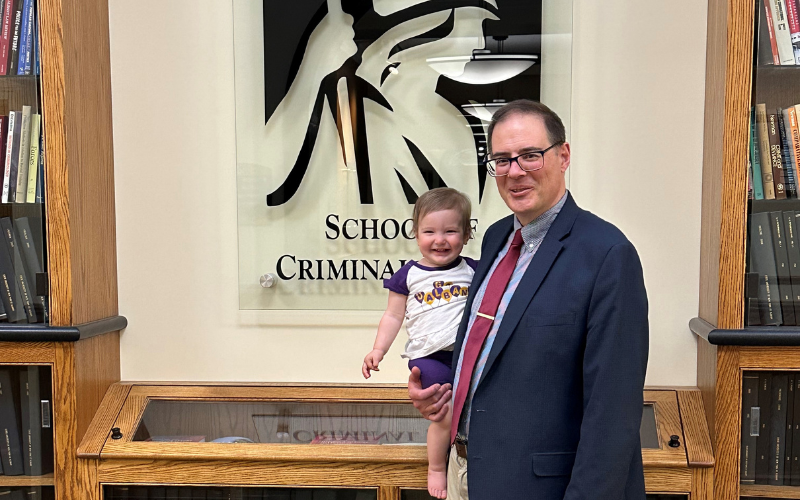
I am a grandfather! My wife Cynthia (who is also an SCJ PhD and we were married in Las Vegas – so I’m giving away a lot of interesting tidbits here!) and I have two daughters and the latest addition to our family is a granddaughter. Oddly enough, I thought her arrival would make me feel older, but I feel a lot younger whenever I am lucky enough to spend some time with her. She also makes me think about how we will leave our institutions for the next generation.