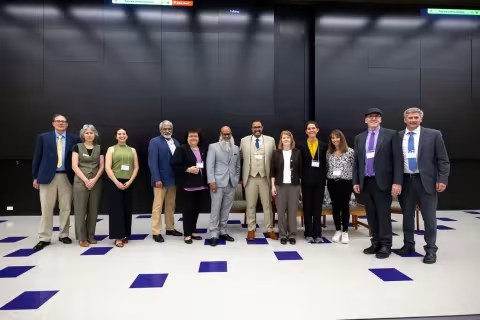


Steven Lopez and Attorney Discuss Central Park 5 Case with Local Students at UAlbany

By Indiana Nash
ALBANY, N.Y. (June 15, 2026) — Dozens of Capital Region high schoolers got an inside look at the high-profile Central Park 5 case, hearing from two people involved, including Steven Lopez and his attorney Eric Shapiro Renfroe, at the University of Albany last week.
In 1989, 15-year-old Lopez was named in three of the confessions provided to police by the “Central Park 5” — the group of five male teenagers who were wrongly accused of assaulting and raping a woman in New York City. To avoid the harsher conviction of rape, Lopez pleaded guilty to robbery, for which he served nearly four years in prison and was exonerated in 2022 by Manhattan District Attorney Alvin Bragg.
“I think what's really shocking to me as a lawyer is, there's no evidence against him,” Renfroe said. “If this case was tried today, there's absolutely nothing: there's no DNA [evidence], there's no witnesses.”
The event was organized by the Department of Biological Sciences and the School of Criminal Justice as part of the UAlbany in the High School program, which had UAlbany faculty work with forensics instructors at local school districts to teach students about the details of this case.
Those details came to life when students heard from Ryan Thurman, director of UAlbany’s Forensic Biology Program in the Department of Biological Sciences.
“One of our goals in offering this event was to afford local high school students an engaging, hands-on opportunity to ‘preview’ career options available to them if they were to pursue a degree in biology, forensic science or criminal justice,” said Thurman. “During their time on campus, in addition to hearing from Steven Lopez and Eric Shapiro Renfroe in a remarkable first-time public appearance, the students learned about degree options at UAlbany and toured our forensic biology labs.”
At the event, Thurman spoke about how confessions in the Central Park 5 case, which included incorrect details of the crime scene and bad forensic evidence, helped lead to several arrests.
Visting Assistant Professor Stephen Hogan, who previously worked as a legal advisor to the New York State Police Forensic Investigation Center, addressed how cognitive dissonance played a role in the wrongful convictions.
“It creates indecision. It creates psychological pain. As human beings we’re wired for seeking pleasure and avoiding pain. So a pre-existing belief, when it's confronted by something, creates pain, and as human beings, we try to avoid that pain,” Hogan said.
“It sounds sort of benign when we talk about it,” Hogan said, adding “[But] we have to understand the psychological contamination, and the way that can undermine our investigations.”
Renfroe discussed the challenges of Lopez’s case, and the difficult choice Lopez had to make when it came to whether or not to take the plea deal.
“My client, Mr. Lopez, had a choice to make . . . I can't imagine how someone that young can have to make that choice. As a lawyer, I can't imagine how I would have advised him to make that choice. I've got a young man where there's really no evidence against [him] but I think that if you go to trial, we're going to lose based on public pressure,” Renfroe said.
“Pain, anger, scared. Those were the feelings I had at that point,” Lopez said reflecting on that time period.
Renfroe also pointed to how deeply the experience impacted Lopez’s life.
“Meeting Steven, I can see and feel how it affected him and how this affected his family. Steve has a daughter who he's very proud of who recently graduated from college. He never told her about what he had been through, because even though he was innocent, how do you even tell your daughter that? What if she doesn't believe you? He only told her after he was exonerated,” Renfroe said, also noting the toll a criminal conviction can have on one’s career.
“It makes it very hard to get a job, very hard to have a normal life. I think that also probably shakes your trust in people in general, not just the system,” Renfroe said.
When asked what advice Lopez would give his teenage self, he said “Have a curfew. Live your own life. Be your own leader.”