


Next Stop for UAlbany Nanoscale Engineering PhD: Micron Technology

By Andrew McMains
ALBANY, N.Y. (June 1, 2026) — Rajas Mathkari brought nearly five years of industry experience to his pursuit of a PhD in nanoscale engineering at UAlbany’s College of Nanotechnology, Science, and Engineering.
In particular, as a focus improvement specialist at Goodyear South Asia, he was struck by how small things like nanometer-thin films can impact large structures.
That curiosity led him to CNSE’s Department of Nanoscale Science & Engineering, which offered the best of both worlds: a hands-on academic and research program that’s based inside an R&D complex that includes the likes of IBM and Applied Materials.
So, Mathkari’s academic journey was rooted in the professional world. Now, as the Class of 2026 graduate begins a role as a senior process integration engineer at Micron Technology, he explains what he learned from failure and how three mentors sharpened his thinking.
What led you to CNSE?
The opportunity to conduct cutting-edge research using industry-relevant tools in an environment that bridges the gap between laboratory research and semiconductor manufacturing was something I could not find elsewhere. CNSE provided me with the rare opportunity to pursue research that is not only scientifically meaningful but also directly relevant to the semiconductor industry. And that combination was exactly what I was looking for.
How would you describe your role at Micron?
It sits at the intersection of materials science, device physics and manufacturing. I am responsible for understanding how different process steps in the semiconductor industry — such as deposition, etching and patterning — interact with one another across the full device stack. Also, for ensuring that the integrated process produces devices that meet stringent performance and reliability specifications at scale. This requires both deep technical knowledge and the ability to think systematically across an entire process flow.
How did CNSE help get you there?
The fundamental concepts and problem-solving approach I developed during my PhD enabled me to quickly understand and adapt to complex industry processes and technologies. In fact, CNSE was instrumental in preparing me in ways that a traditional academic environment simply could not have. Working closely with the 300 mm wafer platform and the 200 mm academic fabrication facility, equipped with industry-standard tools, gave me hands-on experience with the exact processes and equipment used in high-volume semiconductor manufacturing.
How did your research prepare you?
It required me to simultaneously optimize multiple layers of a complex device stack, analyze failure modes across hundreds of devices and draw statistically meaningful conclusions, as I developed precisely the kind of systems-level thinking that process integration engineering demands. CNSE did not just teach me the science. It taught me how to think like an engineer in a fabrication environment.
Your most valuable experience as a graduate student?
Learning how to navigate failure. I learned to swim in the ocean with full problems. In research, the experiments that do not work teach you far more than the ones that do, and there were many days where the devices refused to behave, the data made no sense and the path forward was completely unclear. Learning to stay curious in those moments, to ask why something failed rather than being discouraged by the fact that it did was the most important skill I developed.
Who was your biggest mentor and what did you learn from that person?
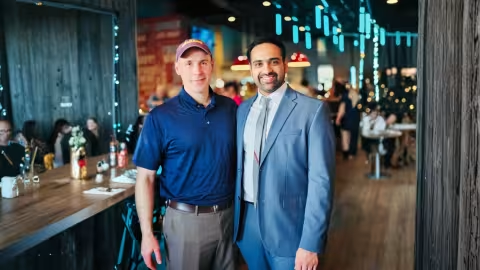
My PhD advisor, Nathaniel Cady. What made Professor Cady an exceptional mentor was not just his deep technical expertise, but his ability to challenge me to think independently while always being available when I needed guidance. He never simply gave me the answer. He asked the right questions and pushed me to find the answer myself, which is the kind of mentorship that builds a genuine researcher rather than just a technician.
What else did he teach you?
That great science is built on intellectual honesty. You have to question your own assumptions, report what the data actually shows — rather than what you hoped it would show — and find something meaningful in even the most unexpected results. I also learned the value of patience and persistence. Research rarely moves in a straight line and Professor Cady modeled the kind of calm, methodical determination that I now try to bring to every challenge I face in my professional life.
Other mentors?
Natalya Tokranova, who was always available whenever I needed support and continuously challenged me and pushed me to grow both technically and professionally. In addition, Karsten Beckmann was one of the first people from whom I gained significant technical knowledge. His guidance and knowledge transfer helped me navigate many aspects of my research journey and played an important role in my development as a researcher.
Your number one takeaway from CNSE?
That the gap between academic research and industrial manufacturing is much smaller than most people think, and that closing that gap entirely is what makes truly impactful science. CNSE sits right at that boundary. And being immersed in that environment for the duration of my PhD fundamentally changed the way I approach problems.
Anything else?
A mindset, the understanding that good research must be reproducible, statistically meaningful and relevant to real-world constraints. That is not something you learn from a textbook. It is something you learn by running hundreds of devices on a 300 mm wafer, by troubleshooting a process that works in the lab but fails at scale and by working alongside engineers and scientists who hold you to the highest professional standard every single day.
Where do you see yourself in five years?
Growing into a technical leadership role within the semiconductor industry — where I can contribute through my own technical work — and helping to develop the next generation of engineers and researchers. The semiconductor industry is at an extraordinarily exciting inflection point, with artificial intelligence, in-memory computing and advanced memory technologies reshaping what is possible, and I want to be at the forefront of that transformation. I am truly grateful to be part of this once-in-a-lifetime opportunity in semiconductors and Micron Technology has given me that chance.
Any other goals?
I hope to maintain strong ties with the research community through collaborations, publications and mentoring students who are now in the position I was in not too long ago. Ultimately, I want to look back and feel that the work I accomplished both at CNSE and beyond contributed meaningfully to the advancement of technology.