





Tracking Storms from Above: UAlbany Students Launch Weather Balloons in Puerto Rico

By Mike Nolan
ALBANY, N.Y. (May 14, 2026)— A team of University at Albany atmospheric science undergraduates recently traded Albany’s chilly start to spring for weather balloon launches in Puerto Rico’s tropical heat.
The trip was part of a new collaboration with the University of Puerto Rico Mayagüez aimed at improving our understanding of how thunderstorms form and intensify across the island.
Over five days in April, the UAlbany students joined UPR Mayagüez students and faculty to launch weather balloons from two locations, gaining hands-on field experience, while collecting atmospheric data for future research.
The group traveled to Puerto Rico with Brian Tang and Justin Minder, professors in the Department of Atmospheric and Environmental Sciences.
“One of the things I really like about atmospheric science is the fieldwork side of it, actually going out and collecting weather observations in real time,” Minder said. “We had some department funds that were able to support a small group of students traveling to Puerto Rico for this pilot project, which grew out of an idea first developed by UAlbany atmospheric science alumnus Rosimar Rios-Berrios, who now works at the National Center for Atmospheric Research and is leading this new research.”
“It offered an opportunity for our students to do real research, while also engaging in a cultural exchange with UPR Mayagüez students. We hope to see this idea grow into something bigger over time.”
Collecting Data with Weather Balloons
Weather balloons collect atmospheric data such as pressure, temperature, humidity and wind, helping improve forecast models. Each helium-filled balloon carries a radiosonde that transmits real-time readings to a ground station. Flights typically last about two hours, reaching altitudes of up to 115,000 feet and drifting as far as 125 miles from the launch site.
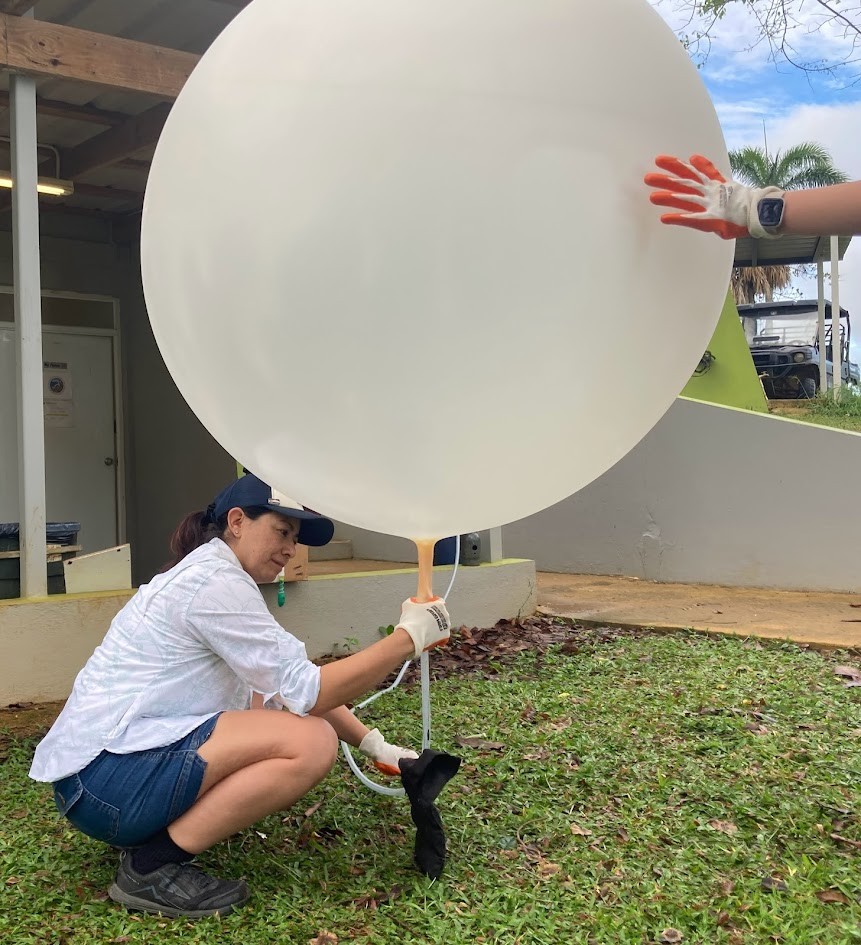
Through Minder and Tang’s AATM 480 course, students gain hands-on experience in field campaigns, including a requirement to participate in at least three balloon launches during the semester.
Four students were selected for the Puerto Rico trip through a competitive application process open to those currently enrolled in or who had previously taken the course.
“This was a once-in-a-lifetime opportunity to take the knowledge we’ve developed in the classroom and apply it in a real-world setting,” said Bernadette Leyba, a junior atmospheric science major and student assistant with UAlbany’s New York State Mesonet, who was selected for the trip. “Putting that learning into practice on this trip really helped everything start to connect and gave me a fuller understanding of the importance of fieldwork.”
Sophomore atmospheric science major Tyler Montgomery also participated in the project.
“Through our observations, we are trying to find any correlation between the sea breeze, upper air in the atmosphere and how thunderstorms develop across the island of Puerto Rico,” Montgomery said. “I do not think any of us expected to be doing work like this as undergraduate students. It was an incredible experience.”
A More Resilient Puerto Rico
Over the course of the trip, the student teams conducted roughly three balloon launches per day from sites in the northwest and western coastal regions of the island.
While Puerto Rico’s most severe weather threats come from tropical cyclones, thunderstorms can still be dangerous, bringing intense lightning and flash flooding, according to Minder.
“The island’s weather radar system is positioned on the eastern side near San Juan, resulting in an observational gap in the western region where thunderstorms tend to be more intense,” Minder said. “Our objective here is to improve understanding of how these thunderstorms develop across the island and the atmospheric conditions that drive their formation.”
In addition to the Puerto Rico campaign, all AATM 480 students participated in an international research effort this semester led by the Center for Western Weather and Water Extremes at UC San Diego’s Scripps Institution of Oceanography. The project, involving 16 universities across North America, focused on collecting data during active storm events to improve understanding of atmospheric rivers and other high-impact weather systems.
Data from the Puerto Rico launches will now be analyzed by students and researchers at UAlbany, the National Center for Atmospheric Research and the University of Puerto Rico Mayagüez.