





UAlbany Students Join International Project to Improve Atmospheric River Forecasting


By Mike Nolan
ALBANY, N.Y. (March 3, 2026) — On a cold February afternoon, a team of University at Albany students steadied a large white balloon against the wind and began a countdown. Moments later, the balloon lifted into the sky from the back of the ETEC parking lot, carrying a small instrument package high into the atmosphere.
The students, all from the Department of Atmospheric and Environmental Sciences, are participating this semester in the Coordinated University Sounding Program for Atmospheric River Reconnaissance, led by the Center for Western Weather and Water Extremes at UC San Diego’s Scripps Institution of Oceanography.
The program involves 16 universities across North America, including UAlbany. Student teams from each institution are launching weather balloons during active storm events to collect data that can help improve understanding of atmospheric rivers and other high-impact weather systems.
Atmospheric rivers — long, narrow, and concentrated regions of water vapor in the atmosphere — can bring beneficial rain and snow, but are also responsible for deadly flooding, mudslides, severe thunderstorms and even tornadoes. These storms, which frequently strike during the fall and winter months, cost an average of $1.1 billion in damage annually on the West Coast of the U.S.
“While atmospheric rivers have a greater impact on the West Coast, the data we are collecting here can help us better understand storm systems in our region that may carry this phenomenon with them,” said Brian Tang, a professor of Atmospheric and Environmental Sciences. “It’s an excellent opportunity for students to learn how to launch weather balloons, gather observations, and see firsthand how their work contributes to improving weather forecasts.”
Exploring the Atmosphere with Weather Balloons
Weather balloons collect a wide range of atmospheric data, including pressure, temperature, relative humidity, and wind speed and direction, which help improve forecast models.
During each flight, data is transmitted in real time to a ground computer through a small, expendable instrument package called a radiosonde, attached to a helium-filled balloon. Flights last about two hours, during which the balloon can drift up to 125 miles and reach altitudes of 115,000 feet.
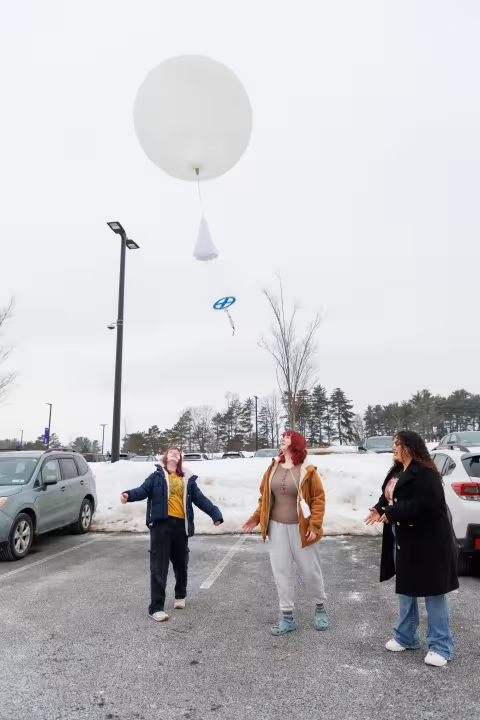
To support the atmospheric rivers study, the project has been brought into the classroom through AATM 480: Atmospheric Science Fieldwork. The one-credit experiential learning course provides UAlbany students with hands-on experience in atmospheric science field campaigns.
As part of the course, students are required to participate in at least three balloon launches during the semester.
"This is the third time we've offered our atmospheric science fieldwork course, with a focus on radiosonde observations,” said Justin Minder, a professor of Atmospheric & Environmental Sciences, who is co-teaching the course with Brian Tang. “It has been a great opportunity for our students to apply the theory and data analysis skills they have learned in the classroom to observations that they collect on their own, reinforcing and deepening their understanding."
Liz McDonald, a sophomore majoring in atmospheric science, is among the students enrolled this semester. She hopes to pursue a career in weather research, and possibly storm chasing, after graduation.
“I've always been interested in launching weather balloons and analyzing atmospheric data, so I thought the class would be interesting and it would also help me develop that skill more,” McDonald said. “It’s already been very valuable, not just learning how to launch these balloons, but also getting to see the data plotted in real time as it’s collected.”
Layla Miller and Emely Martinez-Pichardo are also participating in the launches.
“I find weather balloons fascinating,” said Miller, a sophomore in atmospheric science. “It’s exciting to be part of this class and know that we’re connected with students nationwide who are collecting atmospheric data for the same project.”
“I transferred last semester, so I didn’t expect this level of hands-on work,” said Martinez-Pichardo, a junior in atmospheric science. “Getting to do a field project like this and work with professors who have done this kind of research before has been a great experience.”
Large-Scale Weather Observations
The students are sharing the data in real time with the Center for Western Weather and Water Extremes and will analyze it later in the semester.
Nationwide, more than 150 undergraduate and graduate students are expected to participate in the project, collectively building a large-scale dataset of atmospheric observations that researchers will combine, analyze, and eventually publish. The weather balloon launches are part of a globally coordinated effort that includes collecting data with aircraft over the Pacific and Atlantic Oceans.
The weather balloon equipment is funded by the U.S. Army Corps of Engineers Forecast Informed Reservoir Operations award.
“This is a collaborative effort, bringing together hundreds of researchers and students from across the world,” Tang said. “All of the data collected will be combined and analyzed, contributing to research that could improve forecasting and deepen our understanding of high-impact weather.”
In April, Tang and Minder plan to take a select group of students to Puerto Rico to support a separate research project examining the island’s daily thunderstorm cycle.
The project, which will also rely on weather balloon data, is being led by scientists at the National Center for Atmospheric Research and the University of Puerto Rico at Mayagüez.
Photos by Zach Durocher