





Biology Research Meets Entrepreneurship Through ‘RISE’

ALBANY, N.Y. (April 29, 2026) — Manuela Montoya-Giraldo is a fourth-year PhD candidate at UAlbany, working under the mentorship of Associate Professor Cheryl Andam as part of the Molecular, Cellular, Developmental and Neural (MCDN) program in the Department of Biological Sciences. This spring, she began exploring how to translate laboratory research to commercially impactful technologies as part of the Research and Innovators Startup Exchange (RISE) program.
Montoya-Giraldo is from Colombia, where she previously earned a bachelor of science in microbiology and worked as a marine microbiology researcher at the Coastal and Marine Research Institute INVEMAR, where she studied how microorganisms living within sea sediments in the Caribbean and can yield novel natural compounds for potential future uses in areas such as drug discovery. Her interests in molecular biology, microbiology and bioinformatics led her to pursue a PhD at UAlbany.
Since beginning her doctoral studies in 2022, Montoya-Giraldo has published research in high-impact journals including Nature Communications, Communications Medicine and Microbial Genomics. She has also received honors including the American Society for Microbiology Future Leaders Mentorship Fellowship and UAlbany’s Academic Leadership Award.
Montoya-Giraldo was selected to participate in the Spring ’26 Research and Innovators Startup Exchange (RISE) program through the UAlbany Innovation Center. This research translation program brings together researchers, students and founders with diverse expertise to explore pathways for transforming scientific and technological discoveries into impactful real-world applications, including the development of startup companies and intellectual property licensing opportunities.
For the eight weeks of the program, Montoya-Giraldo joined a team that is developing a tool for autonomous, end-to-end monitoring and management of freshwater aquatic invasive plant species. Her role involved identifying market needs and working with researchers, stakeholders and potential customers to evaluate how the tool could address real environmental challenges. The RISE program concluded with “Demo Day” on April 27, where 11 teams presented their projects to stakeholders and community members.
We caught up with Montoya-Giraldo to learn more about her research and participation in the RISE program.
What is your research focus at UAlbany?
I have long been interested in how organisms interact within ecosystems. I am also very interested in studying microbes in relation to the organisms they live with.
Actinobacteria are a major source of antimicrobial and drug precursors (chemicals that could be used to make new medicines), and one of the most studied genera in this group is Streptomyces. These bacteria have been the source of many clinically relevant antibiotics used in medicine, agriculture and biotechnology.
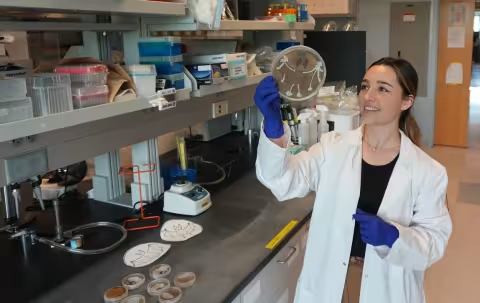
My research in the Andam Lab focuses on understanding Streptomyces diversity and its potential as a future drug. To do this, I’m using Streptomyces samples taken from the skin and fur of insectivorous bats. Ultimately, I’m aiming to uncover the genetic mechanisms that drive Streptomyces diversity and to gain a better understanding of how interactions among bats in cave environments influence the discovery of new antimicrobial compounds.
What inspired you to join the Andam Lab?
I previously worked on Actinobacteria from deep-sea sediments at INVEMAR in Colombia, where I developed a strong interest in Streptomyces species. I found it exciting that the Andam Lab was studying Streptomyces from bats. I first connected with the lab as a summer fellow in the 2021 Bioinformatics Research Program offered by UAlbany’s RNA Institute. I applied to the graduate program following that experience and joined the Andam Lab where I’m now conducting my thesis research.
Have any advice for students interested in pursuing research?
I would emphasize the importance of curiosity. I believe that taking time to ask questions and explore ideas can lead to meaningful discoveries. If you think you’re interested in pursuing research, always find time to be curious.
What drew you to the RISE program?
I first learned about RISE from Entrepreneurship and Innovation Program Director Kelly Reardon and I was drawn to the opportunity because it provides hands-on experience in developing scientific ideas into business concepts. I was particularly interested in exploring career paths beyond traditional academic and industry roles. I also wanted to become more comfortable with business terminology and concepts, and begin to build an interdisciplinary skillset that connects science and entrepreneurship.
Participating in RISE broadened my perspective of potential career options. I now see new opportunities to combine scientific research with free enterprise. I am particularly interested in someday applying this approach to conservation and ecosystem management, with a special eye to coral reefs.
I also appreciated the opportunity to explore cross-disciplinary collaboration. My RISE teammates included fellow UAlbany grad student Nishitha Pushpa Karan, who is currently pursuing a master’s degree in computer science, as well as Kate Blackwell and Carlos Montes Ariza, both PhD candidates from the ecology and evolution program at SUNY Stony Brook. This was an excellent opportunity to not only develop a broader professional network, but also to imagine ways to expand the impact of my own research on Streptomyces beyond the lab.
Through RISE, I gained hands-on experience with customer discovery, stakeholder engagement and business development. I am motivated to apply my training in new and impactful ways, and I believe these experiences will influence both my academic and professional direction moving forward.
What advice would you give students considering RISE?
I highly recommend reaching out to Entrepreneurship and Innovation Program Director Kelly Reardon or Assistant Director Economic Development, Entrepreneurship, and Industry Partnerships, Brett Orzechowski, and attending matchmaking events hosted by the UAlbany Innovation Center. I also suggest exploring different roles within the program — for example, you could join as a fellow, founder or team leader — to find the best fit. Keep in mind that this could be an opportunity to expand your understanding of translational possibilities in an area that you’re already working in, or try something totally brand new.