





Honors College Students and Faculty Explore the Spaces Between Disciplines
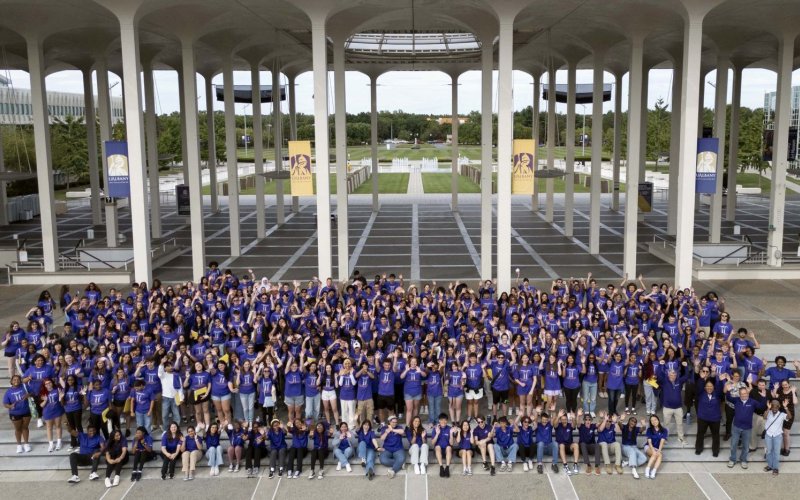
By Sophie Coker, Class of 2026
ALBANY, N.Y. (April 20, 2026) — At the University at Albany Honors College, higher education is being reimagined.
“Honors isn’t a major and it isn’t a minor,” said David Goldsmith, the director of the Honors College. “We exist as a partnership with the academic departments on campus.”
That’s why Goldsmith and the Honors College team have created new rules for bringing UAlbany experts together. Honors College classes are inherently designed to gather students with different perspectives and work beyond the confines of a single major. While a biology class may only attract biology students, a course with an honors designation serves as a home for interdisciplinary thought and a hub for new classifications of experts.
In addition to traditional academic subjects, the Honors College offers some exceedingly non-traditional courses that transcend disciplines and invite discussions across history, science and culture. These courses — on topics as varied as vampires, sea monsters, queer ecologies and Bad Bunny — are offered exclusively to honors students, referred to within the Honors College as Honorables.”
Goldsmith’s own class, Sea Monsters, examines concepts of monstrosity and nature's indifference to human expectations, discussing how preconceived notions affect how people study the world around them. Every Tuesday, he teaches a group of Honorables about marine biology and paleontology and explores not only cultural legends, but also the creatures that inspired them.
Honors classes are just as formative for faculty as they are for students. The value of an honors class, according to Goldsmith, comes from both professors and students taking intellectual risks together and coming to new understandings.
“When I try to get professors interested in teaching in honors, one thing I tell them is to think about why they became professors in the first place,” he said. “I ask them: What have you always wanted to teach, but maybe couldn’t fit into your department’s curriculum, or that might even be a little outside of your field?”
Students in the Honors College must earn a 3.25 GPA during their first semester, 3.30 GPA during their first year, and a 3.50 GPA each subsequent academic year. The College recently restructured its foundational course, TUNI 101, from large lecture halls to smaller sections capped at 25 students, putting an emphasis on individualized student support.
Next semester, Honors College students can look forward to classes like Medical Pseudoscience, Eugenics, Magic and Shopping & Consumption, among a full catalog of academic offerings.
Beyond serving as a place for students to “flex their interdisciplinary muscles,” as Goldsmith puts it, the Honors College also builds community. Students live together on State Quad and take frequent trips to apple orchards, movie theaters and museums, forming bonds outside of the classroom.
Goldsmith has one message to students: “You've got three to four years to be in college, so make the most of opportunities that you have while you have them. At the same time, never forget to stay curious and ask questions as you go.”