





UAlbany Course Sinks Its Teeth Into Vampire Lore
By Kamal Tomlin, Class of ’26
ALBANY, N.Y. (April 16, 2026) — Enrolling in classes for upcoming semesters can sometimes feel overwhelming. You might find yourself staring at course listings, scrolling through four-digit numbers in a desperate attempt to find engaging electives to offset your required courses and gen-eds.
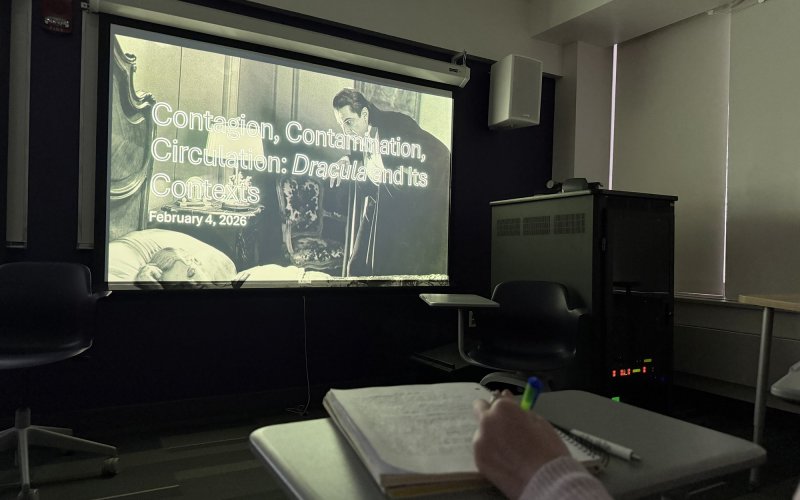
If you’re part of UAlbany’s Honors College, you might come across a course on something even more frightening than an 8 a.m. psych class — vampires.
The brainchild of UAlbany Honors College lecturer Kristen Loutensock, the course was created in the wake of Sinners, the Oscar-winning, homo sanguinis-centered pop culture phenomenon. It also boasts a syllabus as eclectic as its subject matter, requiring students to study 26 distinct pieces of bloodsucker-centric media, spanning both film and literature.
But learning about the living dead isn’t a hands-off activity. According to the syllabus, students enrolled in the course are expected to “create their own vampire fiction, experiment with ethnographic methods and practice creative techniques to craft their own vampire criticism.”
Alongside the books and films introduced in the course, students engage with theoretical readings spanning folklore studies, health humanities and gender studies to help facilitate real-world comparisons. By asking students to, as the syllabus puts it, “consider the connections between blood and contagion in vampire fiction connected to epidemics ranging from the plague to HIV,” the course offers a new way to think about how these characters relate to the real world — and what their presence in media says about society, including how we understand issues like health.
“I've had a long-term interest in vampires because of health humanities, because of the connections between vampires and histories of disease, disorders, and disability,” Loutensock said. “But Sinners gave us an even newer way to think about it.”
For students, the eclectic course serves as a novel way to discuss and dissect a wide array of topics, both contemporary and historical.
“I think it really opens up different conversations we can have,” said Eva DeMarco, a freshman majoring in English and public policy. “Because even though the course is about vampires, we can talk about the history of how stories were vehicles for disease, propaganda, fear of outsiders and things like that. I feel like it's important to be able to analyze and look deeper past the vampire aspect of it.”
As Loutensock puts it, “Classes that are interdisciplinary let us think about bigger questions. And I think for this class, we keep coming back to the bigger question of why there are so many versions of the vampire. Why do people keep coming back to it? And why is it still as relevant as it is today?”