





UAlbany Launches New Bachelor’s Programs in Mechanical Engineering

By Bethany Bump
ALBANY, N.Y. (April 1, 2026) — The University at Albany is launching two new undergraduate programs in mechanical engineering that will prepare graduates for in-demand careers designing innovative solutions to society’s most complex and pressing problems.
The College of Nanotechnology, Science, and Engineering (CNSE) at UAlbany received approval from the New York State Education Department to establish a new Bachelor of Science program in Mechanical and Design Engineering and a new Bachelor of Science program in Mechanical and Mechatronic Engineering.

The programs, which are accepting applications for the fall, will be housed in the college’s new Department of Mechanical & Mechatronic Engineering, to be chaired by Oliver Myers, who is currently serving as professor of mechanical engineering at Clemson University and special assistant to the dean for student success.
"We are excited to add these programs to our academic offerings in CNSE — the first new undergraduate programs since 2017," said CNSE Dean Michele J. Grimm. “Mechanical engineering is one of the most sought-after majors within engineering as it can be applied to almost every real-world activity or enterprise we can imagine. At UAlbany, we provide additional specialization within our programs so students can choose to add to their knowledge related to mechatronics — also known as robotics — or become more experienced in designing systems or products that can address broad challenges that society is facing. These additions will provide UAlbany graduates with skills and experiences that are important to industry in the Capital Region and nationally."
"These new programs reflect UAlbany’s commitment to providing students with access to high-demand, high-impact fields of study," said UAlbany Provost Carol Kim. "These degrees will position our graduates to succeed in critical industries, from advanced manufacturing to robotics and emerging technologies, and provide them with the knowledge and experience needed to design solutions that make a meaningful difference in the world and their communities."
The programs combine a solid foundation in engineering principles with hands-on learning opportunities. Students begin with a common curriculum and by their junior year select a preferred focus in mechatronics or design. Those interested in designing products or systems with medical applications can pursue a specialized concentration in biomechanics. During their senior year, students complete a two-semester capstone design course, applying what they have learned toward solving real-world engineering problems.
The new programs are unique for their emphasis on designing solutions for societal needs. A foundational course, IEGR 100 Design for Society, will teach students the importance of understanding the user population for devices and systems they are designing and how diversity of lived experience and background might affect a user’s needs.
Graduates will be prepared to enter the workforce with expertise that goes beyond a traditional mechanical engineering degree and can pursue careers across a wide spectrum of modern engineering fields, including manufacturing, product design, automation, robotics, medical devices, consumer products, aerospace, automotive, energy systems, control systems, embedded systems and sustainable systems.
BS in Mechanical and Design Engineering
Students in the Mechanical and Design Engineering program will acquire a deep understanding of core mechanical engineering concepts — including mechanical design, solid mechanics, fluid mechanics, thermodynamics and manufacturing — alongside specialized training in design principles and methods.
The program’s focus on design and innovation will provide students with the analytical tools and experience needed to conceptualize, prototype and refine designs for real-world applications. By integrating engineering fundamentals with design thinking, students will learn to create systems and products that are functional, sustainable and responsive to user needs across a variety of industries.
This unique combination will allow graduates to excel in traditional mechanical engineering roles such as product development, materials engineering and structural analysis, as well as in roles that emphasize innovative solutions for consumer products, medical devices, sustainable systems and more.
BS in Mechanical and Mechatronic Engineering
The Mechanical and Mechatronic Engineering program will provide a foundation in both mechanical engineering and mechatronics — an interdisciplinary field that blends mechanical engineering, electronics, computer science and control systems to create intelligent, automated machines.
The curriculum will cover topics ranging from mechanical design, fluid mechanics and kinematics to robotics, automation, control systems and smart materials. The biomechanics concentration in this program is available for students interested in the application of robotics to solve challenges related to physiology, medicine or assistive technologies.
Graduates will be prepared to enter traditional mechanical engineering fields, including energy systems, manufacturing and product design, as well as the rapidly expanding areas of automation, robotics, control systems and embedded systems. The program’s interdisciplinary nature will equip graduates with the ability to respond to an evolving technological landscape in industries such as semiconductors, automotive, aerospace, robotics and energy.
Workforce Need
Many of the major challenges of the 21st century — such as sustainability, public health, quality of life, and resilience to pandemics, terrorism and natural disasters — will require engineering solutions. Mechanical engineering will play a critical role in addressing these issues, making it a highly relevant and in-demand field.
The new programs at UAlbany are expected to help meet this demand.
While enrollment projections for mechanical engineering programs are strong — mechanical engineering is the most widely enrolled engineering degree in the U.S.— there remains a substantial workforce gap. The U.S. Bureau of Labor Statistics estimates approximately 19,200 mechanical engineering job openings each year nationwide, a number likely to increase due to recent federal investments in semiconductor manufacturing and R&D and the Bipartisan Infrastructure Law.
National employment in the field is projected to grow by more than 5 percent over the next seven years, with growth exceeding 10 percent in New York and even higher in the Capital Region. The expansion of semiconductor manufacturing in New York is a key factor, creating demand for engineers in areas such as facility design, manufacturing processes and maintenance.
The combination of high demand, strong job growth and competitive salaries — the current median salary for a mechanical engineer is approximately $99,510 — makes the field an attractive one for prospective students and underscores the importance of expanding educational opportunities in the field.
Community College Partnerships
To help attract a diverse student population, UAlbany has established transfer pathways and concurrent admission agreements with Hudson Valley Community College (HVCC) and Mohawk Valley Community College. These partnerships will allow students who earn an Associate of Science in Engineering Science to seamlessly transition into UAlbany’s mechanical engineering programs.
As part of this collaboration, HVCC will play a key role in supporting the programs during their early years by providing laboratory space while UAlbany completes renovations to teaching laboratories on its Downtown Campus. Through this partnership, UAlbany students will have access and transportation to well-equipped laboratories in areas such as materials science, mechanics of materials and fluid mechanics, with potential use of robotics and manufacturing labs as well.
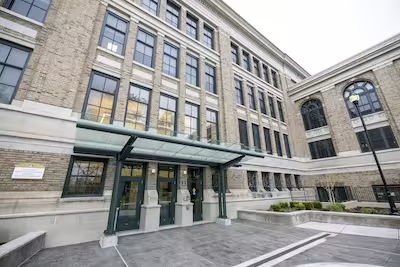
UAlbany acquired the former Albany High School building as part of its Downtown Campus in 2013 and has been transforming it and nearby buildings into a hub for CNSE. While much of the renovation is complete, dedicated laboratory facilities for the new mechanical engineering programs are still under development.
Together, the new mechanical engineering programs complement CNSE’s existing suite of programs in Computer Science, Electrical & Computer Engineering, Environmental & Sustainable Engineering and Nanoscale Science & Engineering.