

Celebrating Early Career Researchers Across the Life Sciences

By Erin Frick
ALBANY, N.Y. (Oct. 30, 2025) — Promising research being led by University at Albany trainees was on full display during the 16th annual Life Sciences Research Symposium held earlier this month. With nearly 200 attendees, the D’Ambra auditorium was standing room only, as students and faculty across three colleges came together in celebration of science, with a spotlight on student accomplishments.
The day-long symposium highlighted research by students and postdocs from the College of Arts and Sciences, the College of Integrated Health Sciences and the College of Nanotechnology, Science, and Engineering.
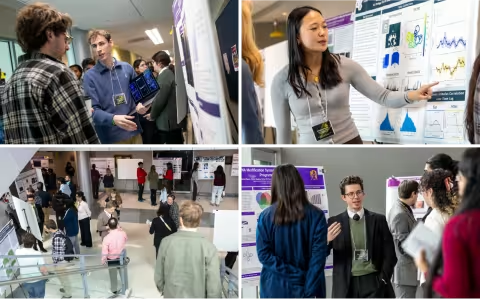
Twelve students presented their research in verbal “podium presentations” and 86 more shared their work via posters.
The day was interspersed with networking opportunities as well as keynote talks from scientists working at the fore of the field, including Nobel Laureate Professor Victor Ambros of UMass Chan Medical School.
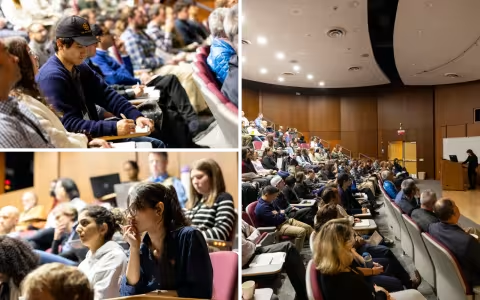
“This annual event brings together scholars, researchers and trainees to highlight cutting-edge research and demonstrate the tools, skills and approaches that move research in the life sciences forward," said Professor Jeanette Altarriba, dean of College of Arts and Sciences. “The key to this particular venue is the focus on interdisciplinarity and the ways in which bringing leading scientists in the field together can forge new ties and new networks that address problems and issues that no single domain can solve independently. For students and trainees, this event affords them the opportunity to make connections that could lead to further training and indeed jobs and careers in the life sciences.”
Professor Melinda Larsen, biology department chair, explained that the event began as a collaboration between the chemistry and biology departments to highlight student and postdoc research and promote collaborations between those departments. Over the years, it has grown to include not only several UAlbany colleges, but also other labs across the Capital District, including Albany Medical College and the NYS Department of Health’s Wadsworth Laboratory.
“This symposium provides our trainees — postdoctoral scholars, graduate students and undergraduates — with a fantastic opportunity to network, build new collaborative relationships and be inspired to pursue further discoveries in the life sciences,” said Cheryl Andam, associate professor of biological sciences and scientific director of the Life Sciences Research Initiative.
“Research projects showcased in the symposium were wide-ranging. They looked at systems scaling from microbes up to humans and other animals, biological processes from the cellular to organismal level, many kinds of human diseases, fundamental and translational research, and technological innovation. Now in its 16th year, this event is a testament to the rapidly growing and successful community of life scientists on campus at UAlbany."
Giving Voice to Science
The Life Sciences Research Symposium gives young researchers the opportunity to gain experience communicating their research. We caught up with several of the student presenters to learn about their work at UAlbany.
Tia Swenty
Tia Swenty is a third-year nanobioscience PhD student working in the Tenenbaum Lab at the College of Nanotechnology, Science, and Engineering.
“Today I presented our cell-targeting technology called sxRNA, which we use to make specific cells turn bright green using a fluorescent protein,” said Swenty. “We do this by targeting small RNAs called microRNAs produced by the cells. We are using sxRNA to study how old, sick and ‘misbehaving’ cells affect healthy cells in a diseased environment.
“There are not many other labs working in this type of field, which makes our technology very unique. I also like how it can be used in many different applications and I can be creative in my research.”
Hannah Talbot
Hannah Talbot is a second-year biology PhD student working with Arun Chandrasekaran at the College of Nanotechnology, Science, and Engineering.
“My lab works in DNA nanotechnology, where we use synthetic DNA like building blocks to construct different structures,” said Talbot. “My project focuses on improving the assembly process to better equip DNA nanostructures for use in the body, such as in drug delivery applications. We do this using a compound called choline dihydrogen phosphate, which has been found to deactivate enzymes. When we construct a DNA nanostructure in this compound, the nanostructure is able to withstand degradation by enzymes for longer, making it better equipped for use in the body.
“One of my favorite things about my field is how variable it is. DNA is so flexible and customizable that it can be used to make many different shapes, which allows it to be used in all sorts of applications. This allows me to work on many different topics. I have always enjoyed learning new things, and this gives me many opportunities to do so.”
Elianna T. Cruz Gonzalez
Elianna T. Cruz Gonzalez is a second-year biology master's student, co-mentored by Associate Professor Cara Pager and Associate Professor Morgan Sammons.
“I am trying to understand how our bodies combat infections caused by the Zika virus, which is transmitted by mosquitoes and can cause developmental malformations in fetuses,” said Cruz Gonzalez. “We focus on an antiviral gene called 'ATF3' and how it helps defend our cells from the effects of the virus. The hope is to better understand how our bodies normally stop viral infections, so we can develop even better treatments or vaccines.
“What I've enjoyed most about my research is sitting down to analyze all the data and finding connections to form conclusions and new hypotheses to test.”
Caroline Pritchard
Caroline Pritchard is a second-year PhD student in the Shorrock and Berglund Labs, affiliated with the Department of Biological Sciences and the RNA Institute.
“Today I shared my outreach project, which will eventually be implemented at the MiSci Museum in Schenectady, which involves developing an interactive exhibit on RNA exploration as a way to bridge biology and art using AI to empower science storytelling,” said Pritchard. “In this interactive exhibit, children will build nucleotide sequences with RNA code blocks and see them translated into proteins instantly folded into 3D structures on a screen. This will help them learn that small changes in code can affect big changes in structure and function.
“I think my research is very cool, and the best part of this project is that it increases accessibility of ‘RNA’ as a household term and ‘AI’ as a tangible tool. My hope is that with this dual approach, everyone else can find the 'cool' in it, too.”
Dylan Ehrbar
Dylan Ehrbar is a fifth-year PhD student in the Molecular, Cellular, Developmental and Neural program working in the Begley Lab.
“All living things use DNA ‘codes,’ called codons, to make proteins, but some codons are used more often than others,” said Ehrbar. “We discovered that these codon preferences aren’t random; instead, the whole human genome is grouped into distinct ‘codon programs’ related to their biological functions. Understanding these programs could open new ways to alter gene expression, design more effective gene therapies, and even treat diseases where codon usage becomes disrupted, like in cancer or Alzheimer’s.
“I love that I can research the aging process and the different diseases associated with it. The chance to alter gene expression on such a basic, mechanistic level gives us a chance to change something that’s usually seen as an immutable fact of life.”
Celebrating the Art of Science
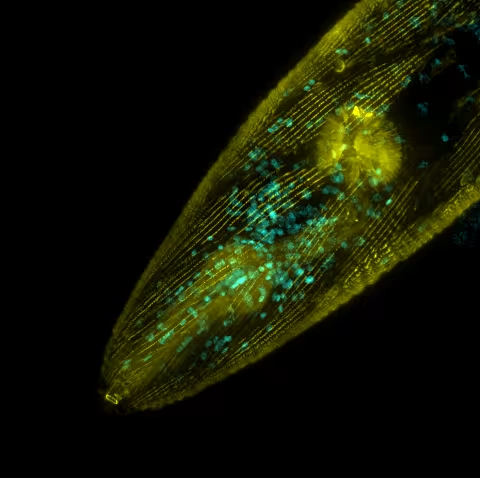
For the first time this year, the symposium included a life science image competition. The inaugural winner was Michelle Urman, a sixth-year PhD student in UAlbany's Molecular, Cellular, Developmental and Neural Biology program working with Assistant Professor of Biological Sciences ChangHwan Lee.
Urman explained that her image (at right) features the head of a roundworm, Caenorhabditis elegans (C. Elegans), which she captured using a staining method wherein a fluorescent yellow chemical binds to proteins in muscle fibers. This makes it possible to see the worm's mouth, pharynx and the striated muscles of its head. Using a second type of stain that binds to DNA, Urman was able to visualize the cell nuclei, seen as the bright cyan dots scattered throughout.
“In our research, we use staining as a way to look at tissue architecture, specifically the cytoskeleton that serves as the scaffolding to maintain tissue shape and structure,” said Urman. “We don't usually look at the head, but out of curiosity, I imaged it for fun, and it came out much prettier than I expected.”
Recognizing Greatness
At the end of the symposium, prizes were awarded for the best podium presentations and posters.
Podium presentation winners included:
- Tia Swenty, College of Nanotechnology, Science, and Engineering
- Hannah Talbot, Department of Biological Sciences and College of Nanotechnology, Science, and Engineering
- Noah LeFever, Department of Biological Sciences
Poster presentation winners included:
- Undergraduate: Antionette Mastrangelo, College of Nanotechnology, Science, and Engineering
- Graduate students:
- Safi Eddine Khiati, Department of Biological Sciences
- Nikki Dolphin, Department of Biological Sciences
- Jiayue Hong, Albany Medical College
- Shubhajit Singha, Department of Chemistry
- Postdoctoral researcher: Rico Amato, Department of Biological Sciences