


This CEO Has a Knowledge for Thirst

By Paul Miller, MA ‘21
Albany, NY (May 23, 2025) — Norman E. Snyder '83 is a man who knows his drinks — and he should. As a leader with more than twenty-five years of experience in the beverage industry, Snyder has brought to market all manner of libations from craft brews to caffeinated waters to highly sought-after soft drinks. Currently, Snyder is CEO of Reed's Inc., makers of the favorite all-natural ginger beer in America and Virgil's — the company's line of handcrafted sodas.
We caught up with Snyder, a former accounting major, during his visit to campus and met with him in his Norwalk, Connecticut headquarters for wide-ranging conversations that included public vs private companies, super-tasters, and JAWS.
Note: This interview has been edited and condensed for length and clarity.
Massry School of Business: So, there's a book called A History of the World in Six Glasses that tells the story of humanity's development — from the Stone Age to the 21st century — through the lens of beer, wine, spirits, coffee, tea and cola. What are your thoughts on beverage as a cultural influencer?
Norman E. Snyder: Well, I think you could kind of put food and beverages in the same category. I think it's huge. It ties families together, ties cultures together. It creates memories, so I think it's very impactful. When I travel abroad, the first thing I want to know is what are they eating and what are they drinking to understand [the place] culturally. Trying to understand what people eat and drink when they come together, I think it's a pretty neat thing.
Consumers, today, seem to be focused on health and wellness. Is that true in the beverage space? And how is Reed's positioned to meet this demand?
Sugar has become a big focal point. High fructose corn syrup is still the number one sweetener in most carbonated beverages. That's become sort of the carcinogen of this generation. Consumers are looking for "better-for-you." It was really accelerated during the period of COVID. Now what's emerging are these lower calorie, very low sugar drinks and they're on fire! So, we're coming out with lower calorie ginger-based, gut-health and energy "functional" beverages that we believe will resonate with the younger consumer.
I have children in their early twenties and when their friends come over, I'm always looking in their coolers to see what they're drinking. In my generation, that cooler is full of beer. With this generation, there's one beer and all these RTD (Ready-to-Drink) cocktails and flavored malt beverages. We have a ready-to-drink Mule and a ready-to-drink flavored hard ginger ale which are becoming very popular today. It's an introduction to a new generation of consumers to our products.
How do you decide what flavors or products to introduce?
We’ll come up with a concept, put a positioning statement behind it [and] the brand attributes we want. Then we’ll start working on artwork. We work with our flavor house, send them the product brief. They’re in St. Louis. We'll fly out and spend two days and we'll try their first prototypes.
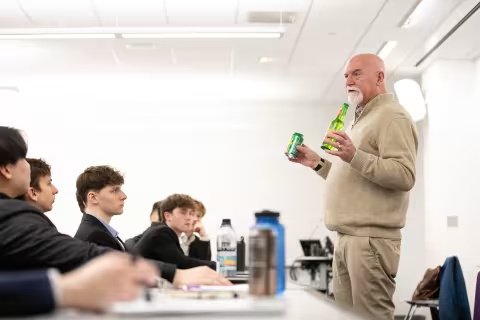
So, you, personally, go out there and taste?
Yeah. Back in my brewery days, I developed a proper way to taste products. Now, some people are really gifted. They’re called super-tasters. We had a young woman in here and she could pick up things that no one could pick up. That’s a gift. When you taste things, you’re not tasting for what you like. You’re tasting for deficiencies.
Then we’ll develop the product. Do we have the right ingredients? What does it cost? We have certain margin targets that if we can’t hit [them], we’re not going to do it. Once we’re done with the liquid, we can fill in the ingredients panel and all the compliance stuff. We have a monthly innovation meeting for all of our new products. So marketing is involved, operation is involved, sales is involved. So, it’s quite a process.
Is it hard for Reed's, which is not a large company, to be nimble like this?
That’s the benefit of being a small company like us. We can be nimble. We can make decisions very quickly and execute. Plant-based food and beverages are really popular. We were at that party before it was popular, but we don't get credit for it. Most, if not all, of our products are non-GMO. We’re the only ginger beer, with a nationwide presence, that uses real ginger. Incredible! We use organic ginger sourced from Peru ... which has some of the best ginger in the world.
If you just look at our ingredient panel: pineapple juice, lemon juice, lime juice, cane sugar and, of course, ginger. Nobody else puts this stuff in their product and I get so frustrated that I want to go to the top of the world with a megaphone and say, “We have the best ginger ale in the world! Drink it.”
A study of CEOs revealed that the most effective executives realize that a wrong decision is better than no decision at all. How do you handle making critical decisions when you may not have complete information?
I believe in collaboration, so I try to get as much input from people. I don’t think that I’m always right. When you get people involved [with a project], they have a vested interest in its success, and it helps your chances tremendously. I always tell people here, “If you have a problem and you tell us, it becomes our problem and then we’re all trying to solve it. But if you keep it to yourself, it becomes your problem. And if you ‘f-it up,’ you’re done. So, why would you hide it, right? So, I think try to get as many people involved and get various inputs. But I think sometimes it just comes down to it feels like the right thing to do. It's intuition.
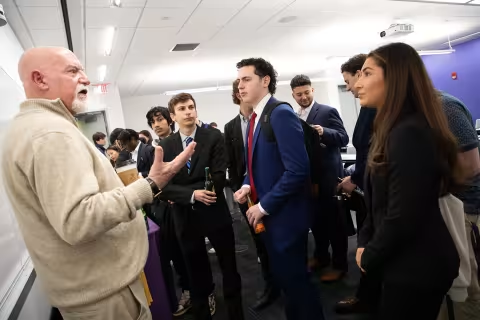
You’ve been CEO at both private and publicly held companies. How do you adjust your mindset to lead in those different environments?
Both companies keep score differently. Public, you have to really think in quarter increments, trends, and key milestones, and that’s how you plan things — which sometimes isn’t always the best for the company. I do quarterly press conferences and you're talking to investors, bankers, board members. It consumes a lot more of your time. You sit down and you look at what the [stock market] analysts have [written] after you talk to them. I think it’s probably harder and becomes, sometimes, a bit of a distraction. You’re not sharing your results with the world when you’re private and your goals are set differently. ... and there seems to be a little more patience. But that's kind of the challenge. It's a great experience. I'm glad I've had the chance to do it.
As Reed's continues to grow, what are the key considerations that you take into account when exploring new markets or distribution channels.
We put quality at the top. However, profitability is also a strong consideration. We just don’t have the ability to invest in something if it’s a drag on us. And then where does it lead us, in terms of growth and other opportunities? A lot of big companies will get in this stuff and they don’t care if they’re profitable. It’s about market share and dominance. We can’t afford those missteps, so after quality, it's really profit-driven.
Alright, we understand that you're a fan of movies. If you could retroactively do a product placement of Reed's, what movie or scene would you want to see it in?
Boy, that's a great question! (Snyder pauses to think) You know what scene comes to mind? In JAWS, when [the main characters] are on Quint's boat ... and the three characters don't trust each other, but they need each other. And that bottle of rum that he breaks out kinda breaks down the barriers ... they start drinking his rum and they're showing their scars. How about drinking rum with Reed's Ginger Beer? Make a Dark and Stormy! (laughs) I think that would be a neat scene.
I love that! So, one question about the entrepreneurial mindset: When you get to the end of your career, whenever that is, do you think you'll be able to turn off that mindset or does that get channeled into something new?
I think two things. When I get there, what I'll do is be a board member of a few companies to try to stay involved. So, you're not doing the day-to-day grind, but you still have to think about solutions and strategy. So that's part of it, but it definitely gets channeled into other things. I play the guitar. I've been studying music theory which I find fascinating! I would love to learn a little bit more about woodworking. I could do that for hours. The thing with being entrepreneurs is it's very difficult to have a shut-off ... but I think I can re-direct that because there are so many things that I want to do."