





Why Attending Conferences is Essential for Graduate Students
I am Dwi Puspita Sari, a Ph.D. candidate in Information Science at the College of Emergency Preparedness, Homeland Security and Cybersecurity at the University at Albany. My primary specialization is Information, Government, and Democratic Society and my secondary specialization is Data Analytics. My research interest includes broad digital government topics, particularly open data and open government. Since starting my doctoral study, I have attended both local and international conferences to present my research nine times at six different conferences.
Attending and presenting my research at academic conferences is an essential part of my professional development as a PhD student. Throughout my doctoral journey, I have had the privilege of participating in several presentation formats, including full-paper article presentations, ongoing research project posters, and dissertation progress updates for doctoral consortiums. Personally, I believe that these experiences have given me advantages that have contributed to my academic and professional growth tremendously. Here’s how:
- Constructive feedback: I consider this to be an important consideration that motivates me to present my research at a conference. Furthermore, interacting with scholars and professionals in my area of interest allows me to improve my research. I can integrate the recommendations to broaden my literature and consider the practical applications of my study. For example, after presenting my dissertation progress at the HICSS-58 in Big Island, Hawaii, on January 6th, 2025, I received constructive feedback from mentors that guided me in expanding my study into a more comprehensive article, which I intend to expand it and develop for submission to peer-reviewed conference proceeding or journals.
- Networking: I can engage with conference participants with similar research interests when attending conferences. I connected with people from a wide range of sectors at the conferences, such as researchers, academics, practitioners, and professionals. I can get the opportunity for future collaboration (in the short and long term), such as collaborative publication and research activities. I usually take the opportunity to introduce myself and connect with other attendees during the networking sessions. This connection has the potential to go beyond the conference. For instance, I was invited to serve as a reviewer for the paper submission at the conference the following year, which I attended and presented.
- Keep track of the latest research: I can stay informed on the latest research trends in my field, which can help me identify novel research avenues so that I can refine my current research in a way that will be more meaningful and contribute to the academic field. During the conference, I love attending workshop sessions focusing on current and innovative research. Attending workshop sessions at the conference can assist me in investigating topics that are pertinent and beneficial to my academic pursuits outside of my immediate research focus through conferences, which also facilitate engagement with interdisciplinary approaches. Finally, it also can allow me to get practical knowledge and hands-on experience that I am able to apply to my future work.
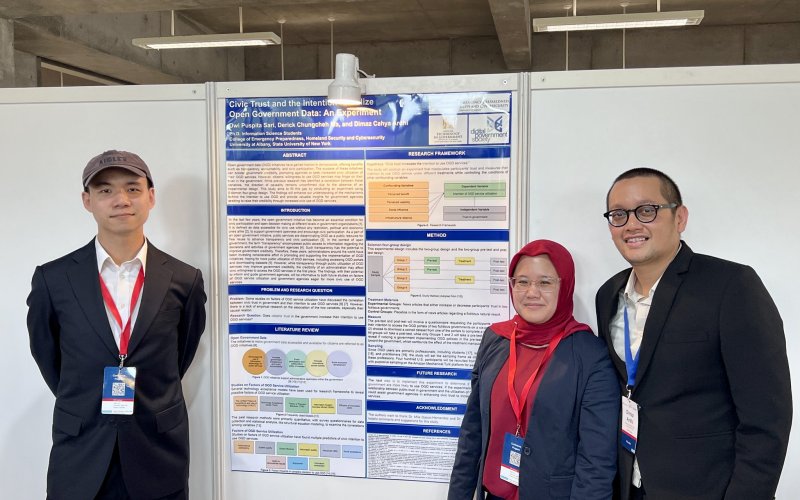
- Gain cultural and geographic exposure: these experiences allowed me to explore a variety of locations and obtain knowledge about various cultures. A sometimes-forgotten advantage of participating in international conferences is the chance to travel and engage myself in many cultures and places. For example, I had the opportunity to travel to two distinct countries to present my research in 2024. In June, I and two other classmates presented our poster “Civic Trust and the Intention to Utilize Open Government Data: An Experiment” at the 25th Annual International Conference on Digital Government Research (dg.o) in Taiwan, and in September 2024, I traveled to Leuven, Belgium, to present my work with other two classmates “Assessing Open Government Data Quality using Machine Learning: The Case of Satu Data Indonesia” at the IFIP eGOV 2024 conference. Ultimately, the opportunity to travel and engage with new individuals not only improved my academic career but also expanded my doctoral experience beyond conventional learning.
I believe my participation also contributes to the University at Albany by being able to represent the University within the global academic community. Finally, attending and presenting at academic conferences is essential to my development as a doctoral student. By continuing to participate in these conferences, I am positioning myself for continued growth, not only as a scholar but also as an active contributor to my field of study.