





Four Faculty Members Win SUNY-IBM AI Research Grants

ALBANY, N.Y. (Oct. 31, 2024) — Four University at Albany faculty members have received grants from the SUNY-IBM AI Research Alliance for their work to advance the efficiency and trustworthiness of artificial intelligence systems.
Chancellor John B. King Jr. announced the 2024 grants on Monday, and UAlbany was one of two SUNY Research Centers to receive four grants this year out of a total of 14 projects funded systemwide.
“UAlbany researchers are developing more powerful and efficient AI hardware and models without losing sight of critical questions about their trustworthiness and the ethics of their use,” said UAlbany Vice President for Research and Economic Development Thenkurussi (Kesh) Kesavadas. “This is exactly the kind of innovative interdisciplinary work we envisioned when UAlbany launched its AI Plus initiative, and these collaborations highlight how our researchers are working thoughtfully with industry to advance our understanding of artificial intelligence and its deployment for the public good.”
The projects funded at UAlbany were:
Resistive Random Access Memory (RRAM) for AI Applications
Nathaniel Cady, Department of Nanoscale Science & Engineering

Professor Cady’s research group is collaborating with IBM on the development and benchmarking of a new kind of memory device that can be used to make artificial intelligence computing more efficient and consume less power, especially during training. These new devices are known as resistive random access memory (RRAM), also known as memristors. The project focuses on improving the materials and chip processing steps, while integrating these devices with more conventional computer chip fabrication approaches.
Trustworthy-AI from a User Perspective
Jason D'Cruz, Department of Philosophy

Associate Professor D’Cruz leads a research group composed of ethicists, engineers and cognitive psychologists from UAlbany and IBM to explore interpersonal relations with AI chatbots. The linguistic fluency of bots powered by large language models (LLMs) encourages humans to relate to them as if they were individuals with the ability to feel and morally understand the world. For example, today’s chatbots will frequently apologize for their errors, appearing to take responsibility for them. Deploying both empirical and philosophical methods, D’Cruz and his colleagues are creating a framework to guide design of these technologies in ways that mitigate the risks of anthropomorphism and complement and enrich human relational capacities.
Strengthening Hybrid Bonding Through Understanding of Orbital Exchange
Kathleen Dunn, Department of Nanoscale Science & Engineering

Professor Dunn’s research group is investigating how to make the most of the limited real estate on high-performance chips used in demanding applications such as AI. Instead of making chips wider, the industry is exploring making them taller — something known as three-dimensional integration (3DI). Hybrid bonding is the process by which two wafers (or a chip and a wafer) can be processed separately then bonded face-to-face to provide more functionality in the same footprint. Using wafers supplied by IBM, the research group will assess the impact of pre-and post-bond treatments by mapping the electronic structure of atoms at and around the bonds, providing information critical to achieving hybrid bonding for AI chips.
Quantization and Compression of Large AI Models
Penghang Yin, Department of Mathematics & Statistics (co-PI Zi Yang)
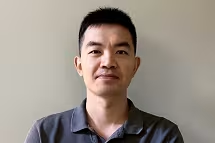
Assistant Professor Yin’s group is studying the substantial memory and computational demands that make it difficult to efficiently deploy the large AI models that are revolutionizing digital tasks like summarization, programming and content generation. They are working to develop two optimization techniques to reduce the model size and memory usage of pre-trained AI models, using only a small fraction of the original training data for calibration. The first technique, called quantization, reduces the precision of model parameters from 32-bit floating-point to ultra low-bit integer representations. The second technique, called pruning, identifies and removes less important parameters to streamline the model. They also are focusing on creating tensor-compressed training algorithms for efficient fine-tuning on specific downstream tasks, balancing model complexity and performance.
Integrating AI across disciplines
The announcement of the SUNY-IBM AI Research Alliance grants comes three weeks after King and Gov. Kathy Hochul joined President Havidán Rodríguez on campus to unveil UAlbany’s state-of-the-art new AI supercomputer. The new AI system is a central pillar of UAlbany’s ambitious AI Plus initiative to integrate AI across its academic and research portfolios.
The SUNY-IBM AI Research Alliance is led by a Scientific Advisory Council of distinguished faculty members and research leaders from SUNY and IBM who provide strategic direction and guidance. Research projects are jointly envisioned and conducted by SUNY faculty and IBM researchers, and the first grants were awarded in 2020.
Separately, in 2023 UAlbany and IBM collaborated to found the Center for Emerging Artificial Intelligence Systems to fund research projects of mutual interest, including those that make use of the prototype IBM Artificial Intelligence Unit computing cluster installed at UAlbany earlier this year. UAlbany was the first university in the world to receive the new IBM AIU chips.
Through SUNY, UAlbany also is a partner in Gov. Kathy Hochul’s $400 million public-private Empire AI Consortium, which was launched earlier this year to bring universities and industry leaders together to ensure New York remains a leader in AI R&D as well as the responsible deployment of the technology.