




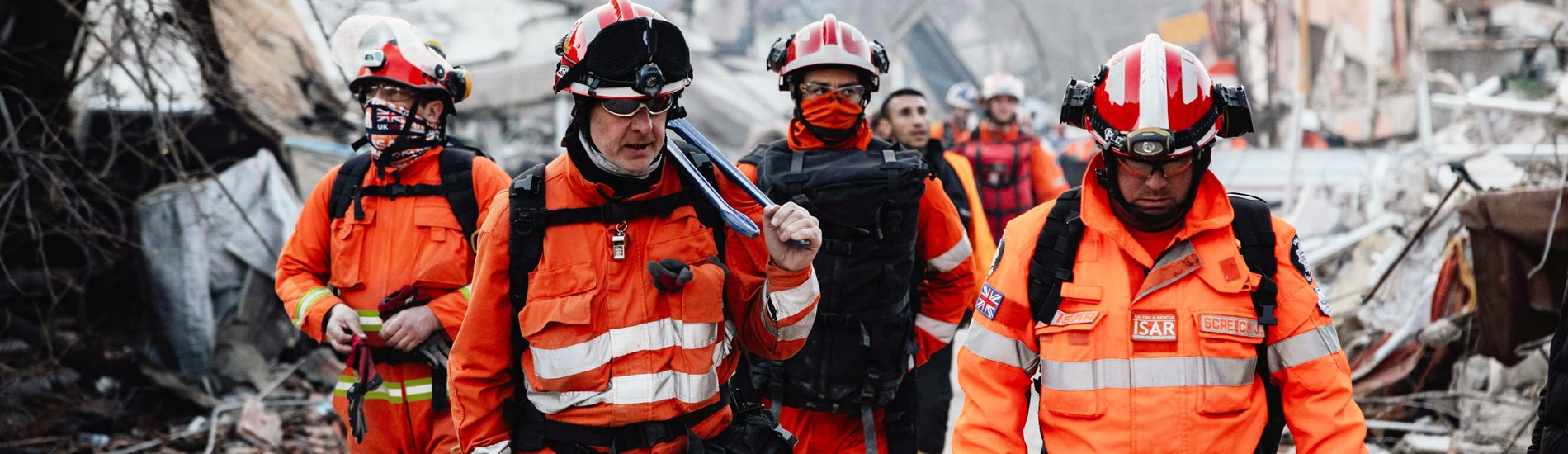
In today's world, where crises and disasters are becoming increasingly frequent, the need for mental health and psychosocial support (MHPSS) has never been greater. While evidence-based mental health services exist for disaster settings, numerous barriers hinder their scalability and effectiveness. Human capital limitations, cultural complexities and linguistic barriers complicate the delivery of these services. The displacement of affected populations exacerbates accessibility and consistency challenges, leaving many without the mental health support they critically need.
This innovative project aims to bridge the gap between global mental health care needs and capacity by leveraging artificial intelligence (AI) and information and communications technology (ICT). By combining evidence-based interventions with cutting-edge technology, we seek to provide timely, culturally sensitive and localized mental health support to both humanitarian workers and displaced populations, transforming the landscape of crisis response and mental health care delivery.
Increasing Disasters
Natural disasters and complex emergencies are on the rise globally, leading to more displaced persons and increased mental health need.
Limited Resources
There is a significant gap between the global need for mental health care and the available capacity to provide it, especially in crisis-affected areas.
Cultural Complexities
Cultural and linguistic barriers often hinder the effective delivery of mental health support, particularly in diverse and displaced populations.
Human Capital Shortage
There is a critical shortage of trained mental health professionals, especially in regions most affected by crises and disasters.
Evidence-Based Interventions
Integrating proven techniques like Psychological First Aid (PFA), Mental Health and Psychosocial Support (MHPSS), and Cognitive-Behavioral Group Therapy (CBGT) into AI-driven platforms.
AI/ICT Enhanced Platform
Leveraging artificial intelligence and information and communications technology to create accessible, scalable mental health support systems.
Culturally and Locally Adaptive Delivery
Developing AI algorithms capable of adapting interventions to local languages and cultural contexts, ensuring relevance and effectiveness.
Timely Intervention
Creating systems that can provide immediate support during crises, reducing the impact of traumatic events on mental health.
AI/ICT Stress Management Apps
Develop intelligent applications that provide personalized stress management techniques, mood tracking and coping strategies for first responders and humanitarian workers. These apps will use AI to adapt to individual needs and work patterns, offering real-time support during high-stress situations.
AI-Powered Training Platform
Create an advanced training app that uses AI to deliver personalized learning experiences for humanitarian workforce. This platform will offer interactive modules on PFA and MHPSS techniques, adapting to each learner's pace and style while providing simulations of real-world scenarios using gaming/AR/VR platforms.
This app can also be used to train local community members.
Multilingual AI Toolkit
Implement natural language processing to provide the PFA/MHPSS Toolkit in multiple languages, ensuring that local humanitarian workers can access critical resources in their native language, enhancing understanding and application of mental health support techniques.
AI Crisis Counseling Agents
Develop AI-powered chatbots and virtual agents capable of providing immediate, culturally sensitive crisis counseling in local languages. These agents will be available 24/7, offering a first line of support for those in distress.
Virtual Group Therapy
Create an AI-facilitated platform for synchronous and asynchronous virtual group therapy sessions. This system will match individuals with similar experiences and provide translated, culturally appropriate guidance.
Peer Support Network
Establish an AI-moderated social media platform that connects displaced individuals for peer support. The system will use advanced algorithms to create safe, supportive spaces while monitoring for potential risks.
Dr. Eric Stern, Project Lead, University at Albany, SUNY
Ms. Tianning Huang, Strategic Oversight, University at Albany, SUNY
Ms. Elizabeth Gray, Strategic Advisor, University at Albany, SUNY
Dr. Amy Nitza, Executive Director of the Institute for Disaster Mental Health, SUNY New Paltz
Dr. Rukhsana Ahmed, University at Albany, SUNY
Dr. Lindsey Disney, University at Albany, SUNY
Dr. Salvador Dura-Bernal, Interim Co-Director of the Global Center for AI in Mental Health, SUNY Downstate Health Sciences University
Dr. Andrea Norcini-Pala, SUNY Downstate Health Sciences University
Dr. Anahita Bassir Nia, Assistant Director for Training and Education, at the Clinical Neuroscience Research Unit, Connecticut Mental Health Hospital, Yale School of Medicine
Dr. Lindy Newlove Eriksson, Swedish Defence University
Mr. Matt Gray, Lead Liaison, Consultant for the Global Center for AI in Mental Health, University at Albany, SUNY
Dr. Xin Li, University at Albany, SUNY
Dr. Sukumaran Nair, Vice Provost for Research and Chief Innovation Officer, Southern Methodist University
Dr. Abdulhamit Subasi, University at Albany, SUNY
Mr. Jacob Biju, Health Innovation Exchange
Team Rubicon is a veteran-led humanitarian organization serving global communities before, during, and after disasters and crises. Their vision is to support humanity and build resiliency for vulnerable communities across the world.

HEART 9/11 is a team of first responders - FDNY, NYPD, PAPD and the NYC Building Trades - that bonded in the aftermath of September 11, 2001. Together, they build resiliency and provide hope for individuals, families and communities that have been affected by natural and man-made disasters.

Center for Evangelization, Spirituality and Mental Health (CESSA)
The Center for Evangelization, Spirituality and Mental Health (CESSA), located in Haiti, focuses on the integration of spirituality in the treatment of trauma. The center offers psychological assistance services to traumatized children and vulnerable adolescents. This is a place for psychological assessments, a space for the protection of minors, a home for the growth of vulnerable people, wishing to cultivate a unified life and grow in humanity.
Health Innovation Exchange (HIEx)
HIEx is a multilayered international platform that supports innovation ecosystems for climate resilience and improved access to healthcare.

Southern Methodist University (SMU)
SMU is a private research university with a legacy of scholarly impact, creating knowledge and leaders through research and graduate education.
Yale is a private Ivy League research university that has been dedicated to expanding and sharing knowledge, inspiring innovation, and preserving cultural and scientific information for future generations. This university engages with people and institutions across the globe in the quest to promote cultural understanding, improve the human condition, delve more deeply into the secrets of the universe, and train the next generation of world leaders.

Södertörn University is a young university, with a strong focus on multidisciplinarity. They offer education and conduct research in the humanities, social sciences, technology and natural sciences, often with a multidisciplinary and intercultural profile, and collaborate with the surrounding community for sustainable societal development.
Our reach is global, as demonstrated through our partnerships with international humanitarian aid organizations like Team Rubicon. But our work is local, aimed at delivering and developing mental health resources with community organizations that empower local leaders to direct the dissemination of aid.
That’s why we’ve developed relationships with partners like CESSA, whose work is dedicated to the continued growth and recovery of the Haitian people following the earthquake of 2010. And why we’re also working with Heart911, whose efforts to encourage healing in the aftermath of tragedies like 9/11 and Sandy Hook is devoted to supporting crisis responders in the context of their own communities.
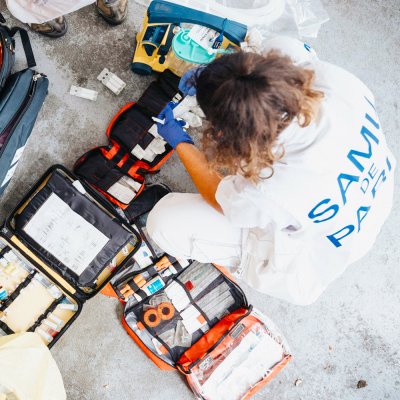
We are actively seeking partnerships with disaster relief organizations, humanitarian aid groups and local partners to expand the reach and impact of our AI/ICT-empowered mental health support initiatives. By collaborating with us, you can play a crucial role in training communities and enhancing the capacity to respond to mental health needs during crises.
Please contact Dr. Eric Stern at [email protected] to get involved or learn more about this project.