





Young Scientists Present Original Research at Science Symposium

ALBANY, N.Y. (March 3, 2026) — When Kahela Michel first experimented with science in fifth grade, it involved a lightbulb, a balloon and a kit her mother, Judith Michel, brought home.
“That sparked my fascination,” said Michel, now a student at Elmont Memorial High School.
Years later, that early curiosity led her to the University at Albany, where she joined 51 other student researchers selected from across New York State to present original investigations at the 2026 UAlbany in the High School Science Research Invitational Symposium.
Hosted through the University’s UAlbany in the High School (UHS) program, the symposium brought together students from 39 schools statewide, with 33 schools featuring presenters.
About 400 students attended the daylong event, which included formal presentations, networking opportunities and an evening awards ceremony.
A bridge to college-level research
The symposium represents the culmination of a three-year Science Research in the High School experience. Students are nominated by their teachers and must be enrolled in UHS science research coursework for college credit. From hundreds of participants statewide, 52 were selected to present before professional judging panels across five categories: Animal and Plant Sciences; Biomedical and Health Sciences and Bioinformatics; Earth and Environmental Sciences; Human Behavior and Social Sciences; and Physical Sciences.
UAlbany Provost and Senior Vice President for Academic Affairs Carol H. Kim, who delivered opening remarks, emphasized the importance of giving students access to authentic research experiences early in their academic careers.
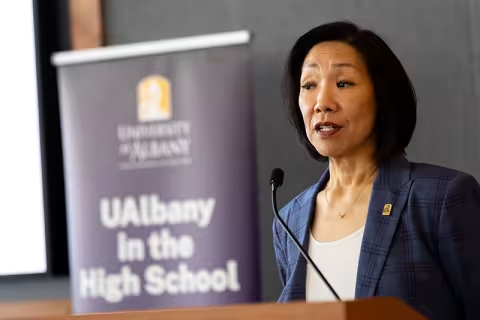
“The work these students are presenting reflects the highest ideals of scholarship — curiosity, rigor and a willingness to ask complex questions,” Kim said. “It is inspiring to see students at this stage of their education working with such depth and purpose to address some of the world’s most pressing problems.”
“For decades, the UAlbany in the High School Science Research Program has provided students with the opportunity to conduct meaningful, original scientific investigations, and our invitational offers an important venue to showcase their findings,” added Angelo Piccirillo, Science Research in the High School Program coordinator and liaison and co-director of the symposium. “As we look to the future, we envision this symposium becoming the premier event where New York’s most promising young scientists come together — united by the shared understanding that they will lead the next generation of innovation.”
Established in 1983 within the College of Arts and Sciences, UAlbany in the High School allows qualified students to earn University credit while still in high school. Originally focused on advanced foreign language coursework in the Capital Region, the program has expanded to include more than 30 subject areas and now serves schools throughout New York State.
For participants, the invitational provides an opportunity to present sustained, college-level research in a professional setting: defending methodology, fielding questions and refining communication skills that will serve them well in higher education and beyond.
From curiosity to climate science
For Michel, that experience was both challenging and transformative.
Her research examines how coral skeletons can serve as long-term records of ocean temperature change. Working with mentors at Columbia University’s Lamont-Doherty Earth Observatory, she analyzed coral cores from American Samoa to evaluate chemical indicators that may provide more reliable historical climate data.
Her interest in environmental science first took shape through an investigation into microplastics at her school. As she connected with research mentors and learned more about coral reef systems, she began to see how fragile marine environments are and how closely they are tied to global climate patterns.
To explain the broader relevance of her work, Michel pointed to Winter Storm Hernando, which brought 19.7 inches of snow to Central Park (the ninth-largest snowstorm in New York City history since record-keeping began in 1869) along with hurricane-force wind gusts that shut down much of the region. While the storm was predicted, the severity still caught many people by surprise, she said.
Studying coral records provides scientists with a longer historical lens into climate behavior within major climate zones such as the South Pacific Convergence Zone, with implications that extend globally.
“By analyzing past climate patterns preserved in coral, we can better understand how systems respond to stress,” Michel said. “That helps improve how we model and prepare for future climate-related events.”
Presenting that work before professional judges pushed her outside her comfort zone.
“At first I was terrified,” she said. “But now that I’ve finished, I’m really grateful for the feedback.”
The experience strengthened her confidence and public speaking skills, preparation she sees as essential as she explores college options, medical school and the possibility of studying neuroscience at UAlbany.
For Michel and her fellow students, the symposium was not only a showcase of original research but an early step into the world of academic discovery — one that began, in her case, with a simple experiment kit and a spark of curiosity.