





UAlbany Summer: From bioinformatics to hands-on lab work
By Erin Frick
ALBANY, N.Y. (Aug. 5, 2026) — When Yasvi Sonani arrived at the University at Albany from Gujarat, India, she planned to major in economics — inspired by her older sister, who holds two UAlbany degrees in the field. However, a strong existing interest in biology and a conversation with her academic advisor quickly set Sonani on a different course.
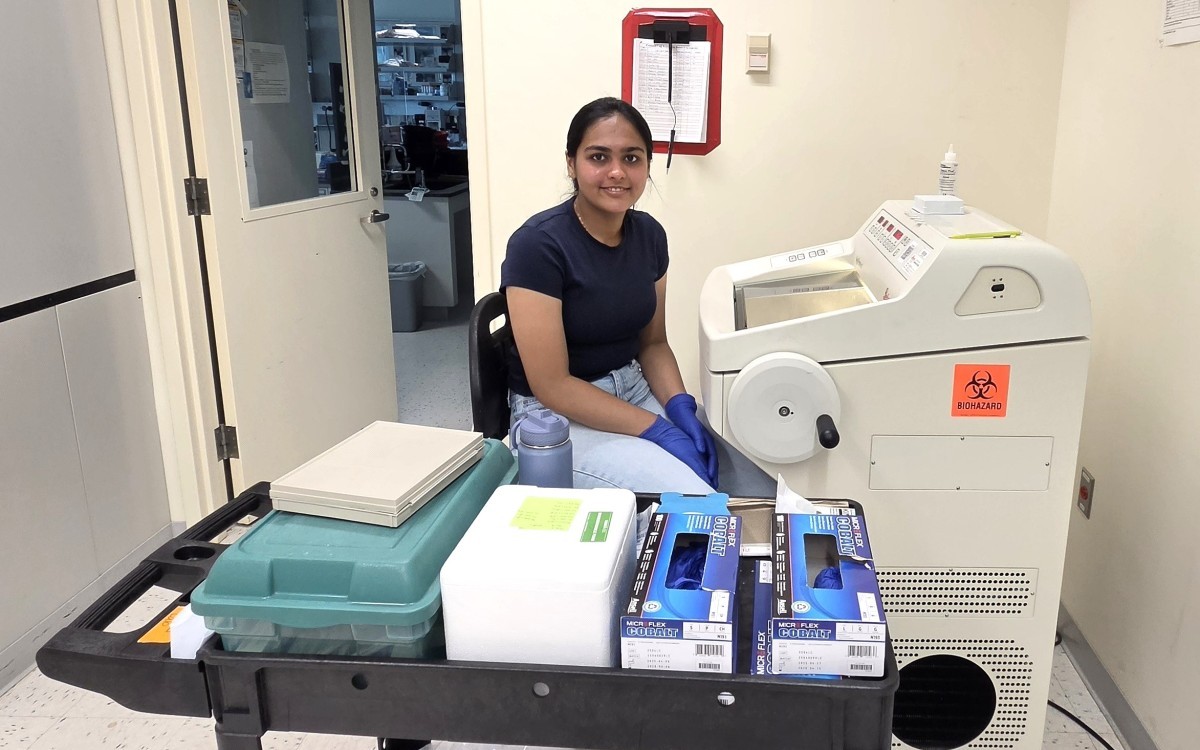
After taking one introductory biology class, Sonani made the decision to chart a new path — one that has since led her into two research labs at UAlbany's RNA Institute, as well as the New York State Department of Health.
Sonani’s research journey began last summer with the RNA Institute's Summer Bioinformatics Program, a virtual training program that teaches students to analyze RNA sequencing data. Her independent project compared gene expression and splicing patterns between experimental and control cell samples.
“The Bioinformatics Program was my first real exposure to research,” Sonani said. “I learned transcriptomic data analysis and data visualization techniques in the context of rare disease research using next-generation RNA sequencing. Through these analyses, I gained valuable knowledge and had an incredible learning experience.”
The program inspired Sonani to reach out to a faculty member to ask about additional opportunities — a conversation that led her to the Research Experience for Undergraduates in RNA (REU in RNA) program, a hands-on summer program at the RNA Institute supported in part by funding from the National Science Foundation. Students in the program spend 10 weeks working alongside faculty mentors to advance research projects in RNA science. The program concludes with a public research symposium where participants have the opportunity to share their findings with senior scientists, local policymakers and the broader community.

Working with RNA Institute Research Scientist Mackenzie Davenport, Sonani's project focused on myotonic dystrophy type 1 (DM1) — a severe neuromuscular disorder and the most common cause of adult-onset muscular dystrophy. The question at the center of the project was why a certain mouse model of myotonic dystrophy type 1 does not develop the skeletal muscle abnormalities seen in human patients with the disease, despite carrying the same genetic mutation.
As part of this work, Sonani's team crossed the mouse with another DM model to test whether aging and combined genetic defects could induce the muscle symptoms that were otherwise absent. Sonani analyzed muscle structure, size and disease state, as well as particular structures inside muscle cells.
“Understanding why this mouse model doesn't develop the same muscle problems as people with DM1 could help researchers build better models for studying the disease in human patients,” Sonani said. “Better research models allow scientists to test potential treatments more effectively and improve our understanding of how the disease progresses. This research contributes to the long-term effort to develop better therapies for people living with DM1.”
Data that drives public health
This summer, Sonani also undertook a position as a student assistant at the New York State Department of Health — an opportunity made possible by UAlbany's longstanding partnership with the Department, which gives students firsthand experience working in one of the most preeminent public health research centers in the country. Sonani's current work supports the Research on Prostate Cancer in African American Men (RESPOND) case study. Her responsibilities include updating and managing databases, processing survey information and contacting patients to complete missing data.
“My work helps ensure that researchers have accurate and complete data,” Sonani said. “Reliable data is important for public health research as it supports better studies and helps inform decisions that can improve healthcare and public health programs.”
Sonani will continue her new appointment at the NYS Department of Health through graduation.