





Showcase 2026: UAlbany Student Develops App to Help You Avoid Pollution Hot Spots
By Bethany Bump
ALBANY, N.Y. (April 21, 2026) — UAlbany PhD student Md. Reazul Islam developed an app that uses artificial intelligence and a network of smart devices to monitor, predict and map pollution levels, alerting users in real time to areas with hazardous air quality that could damage their health and suggesting alternate routes.
"Urban air pollution is a major threat to sustainable cities and public health, and major sources include industrial vehicle emissions and poor waste management," said Islam, who is in the first year of his PhD program in computer science.
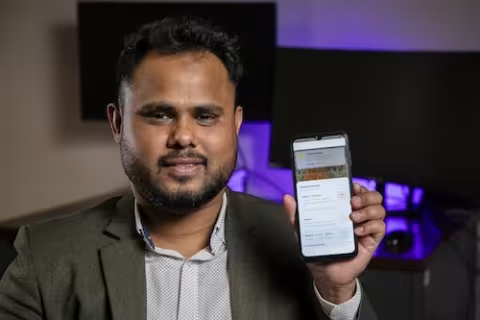
The app comes with a built-in intelligent waste management system that can also alert garbage collectors to bins that are nearly full, helping them optimize collection routes and prevent environmental and public health hazards before they occur.
"I wanted to work on a real-life problem," said Islam, who is presenting his research at Showcase Day on April 30. "Many people are concerned about health and air quality is a big thing for our health."
Exposure to pollutants has been linked to numerous health concerns, including respiratory and heart issues and cognitive impairments, and is particularly dangerous for sensitive groups such as children, the elderly, pregnant people and individuals with underlying health conditions. Islam’s app aims to help users reduce exposure by providing real-time alerts about air quality, while delivering actionable insights to urban planners and other officials that can help them reduce pollution over both the long and short term.
How it works
The app relies on the Artificial Intelligence of Things (AIoT) — the fusion of AI technologies with Internet of Things (IoT) devices. Such devices, like a wearable health tracker or Ring camera, are integrated with the Internet and edge AI, enabling real-time data collection, analysis, and autonomous response.
Islam developed and deployed IoT sensors across an urban area, collecting data to train his machine learning models. These sensors measure key pollutants such as fine particulate matter, carbon monoxide, sulfur dioxide, and ozone, along with environmental factors including humidity, temperature, wind speed, and direction.
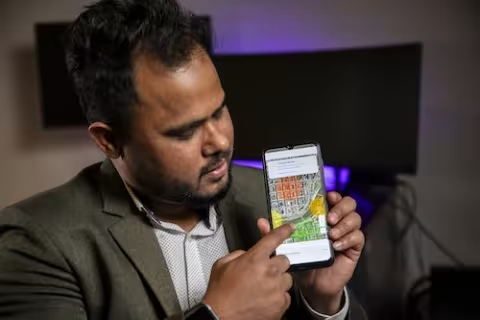
The machine learning algorithms analyze the data and use it to predict and map pollution levels and calculate an Air Quality Index (AQI), sorting areas into six categories based off their AQI: good, moderate, unhealthy for sensitive groups, unhealthy, very unhealthy, and hazardous.
“Suppose I want to go downtown from UAlbany,” Islam said. “Before traveling, I can select a destination and the app will generate multiple routes along with the AQI of these routes, so I can easily identify paths that go through a highly polluted area and select an alternate route to avoid them.”
Another feature uses a combination of AI and IoT sensors to monitor the fill level of garbage bins, identifying bins at risk of overflow. Overflowing garbage bins contribute to pollution and disease by attracting pests, releasing greenhouse gases into the atmosphere, and leaching toxins into the ground and water.
Existing air quality monitoring systems often lack predictive capabilities, are not user-friendly, and fail to integrate with smart waste management systems, said Islam. His goal was to develop an application with built-in prediction features and an integrated intelligent waste management system.
“We need intelligent pollution prediction instead of reactive monitoring,” he said.
Islam, who came to UAlbany last fall from Bangladesh, said he chose the University because his research interests aligned with work Associate Professor Ming-Ching Chang has been doing in the Computer Vision and Machine Learning (CVML) Lab at UAlbany.
Back in Bangladesh, Islam received national and international awards for his research and innovation in the area of computer science. Two collaborators — Khondokar Oliullah of Comilla University and Nusrat Jahan Trisna of American International University–Bangladesh — contributed to the survey and environmental data collection for his latest project.
Next Steps
Chang, who co-directs the CVML Lab at UAlbany and serves as Islam’s research advisor, said the app demonstrate the feasibility of combining agentic AI — or AI that can act autonomously to achieve complex, multi-step goals — with IoT devices.
“This project is like a proof of concept,” he said. “We imagine that in the future, the more powerful analysis agents can run on these devices to provide more accurate predictions and more sophisticated, customized inference in different scenarios.”
Islam has submitted his research for publication and is planning to present it at UAlbany’s fourth annual Showcase Day celebration of student research, scholarship and creative activity.
Further research on the project could involve the use of satellites to collect even more advanced weather and climate data, as well as Graph Neural Networks, a type of deep learning model that can perform even more complicated analysis, he said.
Ultimately, the goal is to deploy the project at a much larger scale and provide data that can be used to improve urban air quality and enable evidence-based smart city planning, Islam said.
“Every day we are trying to improve our model so that we can have a positive impact on the environment and also on people,” he said.