





Commencement: MFA Student’s Journey from Iran to Albany

ALBANY, N.Y. (May 14, 2025) — The flight from Iran to the United States covers more than 6,000 miles. It crosses an ocean and three continents. For Hoora Mirabzadeh, a graduate student at UAlbany, the journey also meant separation from her culture, her language and her family when she first came to the U.S. in August, 2023.
Mirabzadeh is one of approximately 5,000 students set to earn their degrees this weekend as the University celebrates its 181st Commencement.
“From the beginning, migration held a different meaning for me. I migrated in search of myself in a new world and to grow artistically in a freer space, without fear or control,” said Mirabzadeh, who is completing her master’s degree in fine arts. “But this journey didn’t unfold as I had imagined, like many other things.”
Mirabzadeh’s UAlbany story began with the joy accompanied by news of her acceptance into the program in April of 2023. This was followed completing the necessary paperwork for her and her daughter, Hanna, to make her dream of traveling to the U.S. a reality. But then came the complications.
“My daughter and I both received our visas; mine was issued, but hers was not. The embassy stopped responding. Time was running out as classes were about to begin,” explains Mirabzadeh. “Flight tickets had become increasingly expensive, and I had a 6-year-old child caught in limbo while my dream stood in front of me, waiting.”
Her daughter’s visa was issued at the last minute, but Mirabzadeh couldn’t wait as delaying her arrival could have risked her U.S. entry.
“So, I came alone. For the first time after 10 years of marriage and 6 years of motherhood, I was separated from both my husband and my daughter. My dream began with sorrow, tears and bitterness,” said Mirabzadeh.
Channeling these emotions into her creative work, she documented every moment of her journey to share with her family.
“Where I was, what I was doing and those moments became the first spark of conscious self-documentation,” said Mirabzadeh. “This led me to make ‘The Weight of Miles,’ a large photo collage of screenshots taken with my cell phone from the moment I received my visa and left Iran until now.”
Mirabzadeh’s work is currently part of the 2025 Master of Fine Arts Thesis Exhibition on display now at the University Art Museum through May 18.
The culmination of the two-year, 60-credit hour program of intensive training and study in traditional and contemporary fine art practices, the MFA exhibit features the work of Mirabzadeh and her fellow MFA candidates Angelyn Chandler, Ally DeRusso, Sara Griffith, Avery Hartranft, Chad Lubertowicz, Richard Soto, Ruan Strydom, Kim Tateo and Christian Henry Wechgelaer.
The MFA exhibition is supported by the Office of the President, Office of the Provost, The University at Albany Foundation, the College of Arts and Sciences, the UAlbany Alumni Association, and the Ann C. Mataraso Endowment Fund in honor of Professor Emeritus Mark Greenwold.
“Graduate school in studio art is a pressure-cooker for anyone, in that artists are expected to squeeze a decade or so of development into just two short but super-intense years, but it has been particularly challenging for Hoora," said Professor of Studio Art, Photography and Related Media Daniel Goodwin, the chair of the Department of Art & Art History at UAlbany. "She has somehow overcome a cascade of setbacks that would have shut most of us down with incredible aplomb. In the process, she’s developed a new set of skills that will surely serve her well in her career as an artist — particularly in these challenging times."
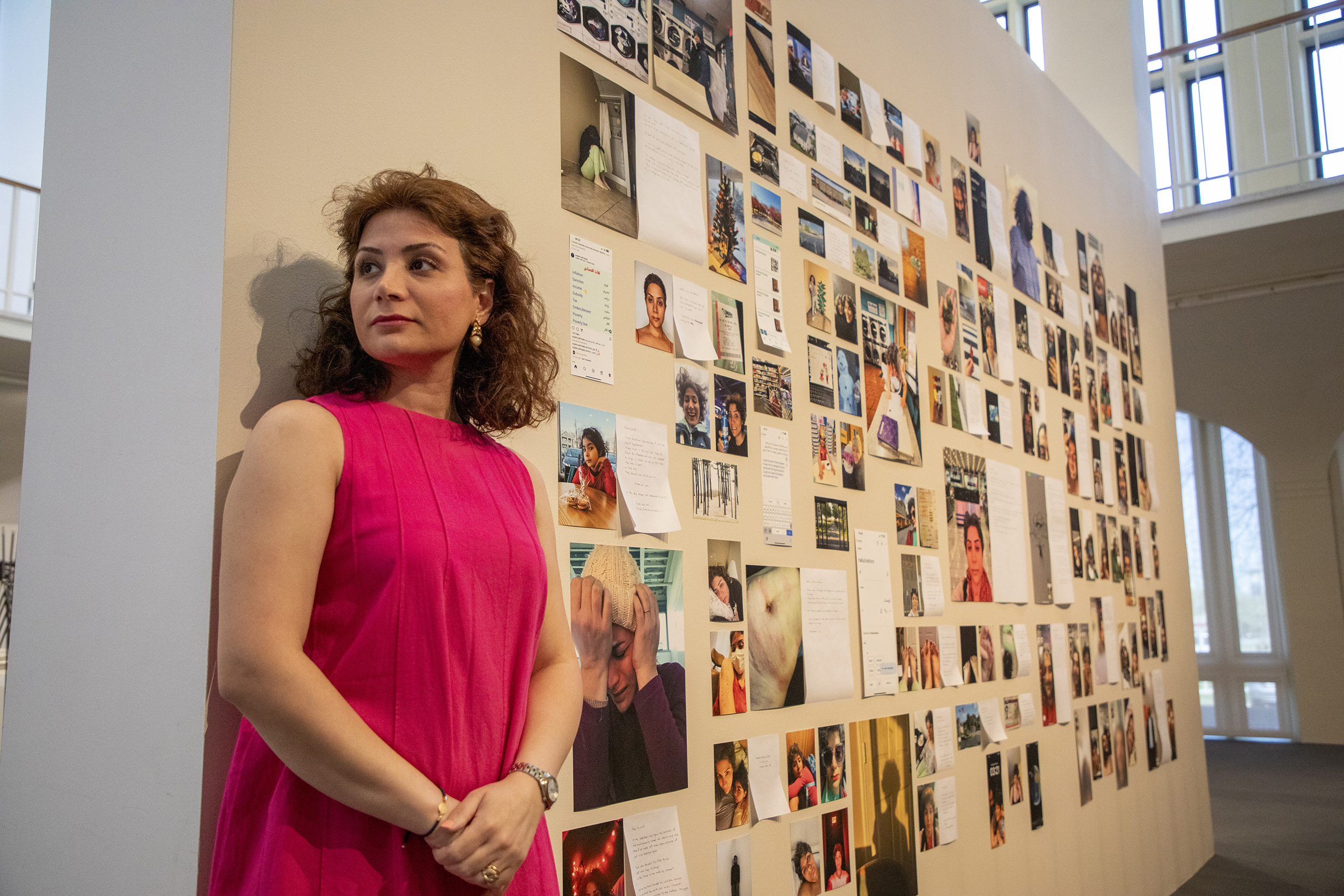
In Mirabzadeh’s case, her experience has featured both joy and sorrow, often intertwined in her work as in her life.
“Two weeks after I arrived, I returned to bring my daughter to Albany and life felt brighter. I enrolled her in school. She was in the first grade, and she loved her school,” explained Mirabzadeh. “But being without my husband was incredibly difficult. Many nights, we stayed up talking until morning and crying from longing. It only takes a few sentences to say this now, but those seconds felt endless at the time.”
Mirabzadeh’s family also faced financial uncertainty to add to the stress.
“With escalating political tension between Iran and the U.S., the value of the Iranian currency kept dropping. My husband, working hard to support us, came under more pressure,” said Mirabzadeh. “With a low teaching stipend and a school-aged child, life grew more difficult by the day. But still, the pain of separation and loneliness remained my greatest sorrow.”
Unfortunately for Mirabzadeh, those tensions also prevented her husband, Reza, from joining her and their daughter in Albany, as the family found out his application for a visa had been rejected on Valentine’s Day in 2024.
“That day was one of the hardest moments of my life — emotionally, mentally, and physically. His visa was denied at 1:20 a.m. U.S. time,” said Mirabzadeh. “My husband and I cried on the phone, separated by the world, and he just told me, ‘Hoora, forgive me that I couldn’t change it,’ and I cried more at hearing the sound of a man who broke his back under this pressure.”
Explaining the news to her young daughter, who had been so hopeful to be reunited with her dad, was even more difficult.
The experience once again served as inspiration for her next project, “I am Good, Thank you,” an idea and execution born from the most painful moment of her life.
“I’ve always coped with hardship by developing and transforming pain into art, which has been my path to healing,” explained Mirabzadeh, who remains grateful for the support of her professors who understood her and classmates who stood beside her.
Then her husband’s second visa application was denied, once again due to political circumstances, and this time the pain turned into deep anger at the injustice. That became the seed for “My Body Hurts”, a work born out of emotional and physical strain.
During those months, another transformation was unfolding, something Mirabzadeh didn’t notice at first: Her daughter was beginning to forget how to speak Farsi. As a single mother, her daughter spent nine hours a day at school, and gradually began to struggle to communicate with her father in their shared native language.
Caught between two languages, Mirabzadeh tried to bridge the growing gap, but day by day, she felt more and more lost in translation. This complex and painful experience ultimately gave rise to “From Here to You,” a collection of intimate, bilingual letters to her husband that trace the invisible distance between love, language and longing.
"I realized that migration is the greatest and most difficult displacement in the world; it pulls you out by the roots, and rootlessness is unbearable," she says. "I learned that life is full of lessons, and if you don’t learn them, they return often in more painful ways. I discovered that we grow in the heart of darkness and pressure right where everything seems to fall apart, there’s a space to rebuild ourselves.
“In hardship, we come face to face with parts of ourselves we never knew existed: a quiet strength, an inner voice, a courage that rises from pain. It’s as if pain is a silent but profound teacher, and if you listen closely, it can show you the path to your own rebirth."