


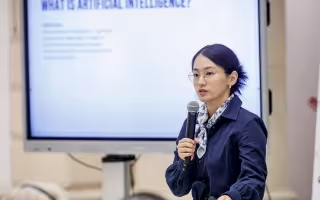
5 Questions with CTG UAlbany Researcher Seulki Lee-Geiller
Center for Technology in Government researcher Seulki Lee-Geiller studies how digital technologies and artificial intelligence are reshaping democracy and the relationship between people and government. Lee-Geiller offers insight into her research at CTG UAlbany.
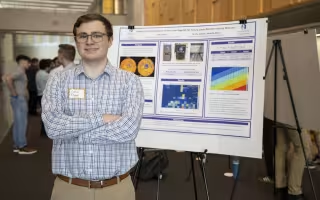
UAlbany Summer: Student Research Helps Scout Landing Sites in Race to Return to the Moon
UAlbany sophomore Collin Flynn spent his summer studying the electrical properties of moon soil in support of ongoing efforts to get humans back to the moon, thanks to a 10-week research opportunity provided through the College of Nanotechnology, Science, and Engineering's Summer Undergraduate Research Program.
UAlbany Summer: Pursuing a Future in Biomedical Research
As a high school student in Brooklyn, UAlbany Senior Winnie Ou knew she was fascinated by science and human health. This past summer, Ou took another step toward that goal in the lab of Professor of Nanoscale Science and Engineering Yubing Xie as part of UAlbany's Summer Undergraduate Research Program (SURP).
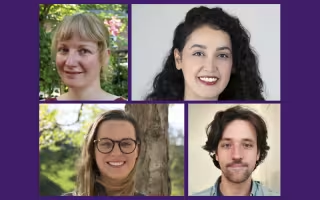
New UAlbany Faculty to Explore AI, Quantum Tech and the Human Brain
The endowment of the Neuromorphic Quantum Computing Constellation will fund four Simons Empire Faculty Fellows — two focused on neuroscience and one each in mathematics and computer hardware engineering. They will study how to combine the enormous power of quantum computing with the unparalleled adaptability and energy-efficiency of the human brain.
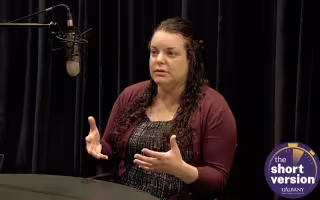
The Short Version podcast resumes this week
The podcast produced by UAlbany's Office of Communications and Marketing begins its third season this week and will publish every Wednesday through early December.
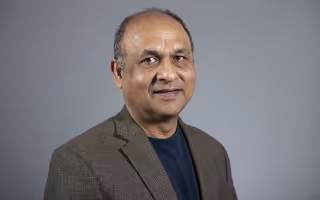
5 Questions with Vivek Jain: Unlocking the Mysteries of Neutrinos
UAlbany physicist Vivek Jain is part of DUNE, an international experiment studying neutrinos. He works on the project’s Near Detector, which will measure particles before they travel 800 miles through the Earth to South Dakota.
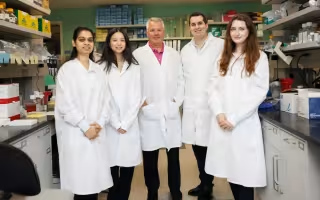
$7.3M in New Research Grants Mark ‘RNA Day’ at UAlbany
Researchers at UAlbany’s RNA Institute are helping lead $7.3 million in new federally funded grants that will explore the toxic effects of woodsmoke on firefighters and how DNA damage that accumulates over time contributes to cancer and other aging-related diseases.