


Redirecting the Response: Schenectady Police Lieutenant Merges Police Work and Public Health

ALBANY, N.Y. (May 12, 2026) — As he completes his Master of Public Health at the University at Albany, Lieutenant Ryan Macherone is changing police work through harm reduction initiatives that connect people to care rather than arresting them or pursuing charges through the criminal justice system.
As a police officer for almost two decades, Macherone has seen firsthand how issues like addiction, homelessness and poor mental health impact the community. As lieutenant of neighborhood engagement for the Schenectady Police Department since 2019, his role includes overseeing the department’s public relations and media relations. He also manages the harm reduction programming, the area that led him to public health.
“For years in policing, you hear statements like ‘overdoses have increased’ or ‘more people are struggling with housing insecurity,’” Macherone said. “Now, because of my public health training, I immediately start asking why. What factors have changed? What’s driving it?”
Choosing a career path
After graduating from SUNY Oneonta with a degree in political science in 2001, Macherone considered several different fields, including law, aviation and dentistry. Inspired in part by his father, who also worked in law enforcement, Ryan decided to join the profession at age 29.
While he initially enjoyed patrol work in Schenectady, he soon found that his strengths lie in building partnerships and developing programs that help people before situations escalate.
“As I rose through the ranks, I realized there were other ways to make a positive impact in the community,” he said. “Now, a lot of what I do is about directing people away from the criminal justice system and into services that are more appropriate. It’s a win-win.”
Enhancing harm reduction programs
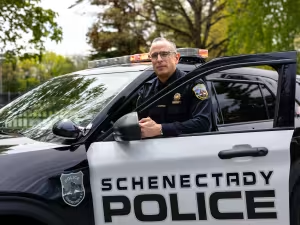
As a police officer for Schenectady, Macherone has formed close working relationships with local public health and behavioral health professionals passionate about improving community well-being.
“I’ve been fortunate to work with people who truly care about making the community a better place,” he said. “They’ve taught me so much about running successful, harm-reduction-based programs.”
In 2019, Macherone helped launch “Schenectady Cares,” a program designed to connect individuals experiencing substance use disorders with support services. The program allows people to walk into the police station and seek help without fear of investigation or arrest. Through partnerships with local service providers, participants can access resources ranging from safe syringes and naloxone to assistance navigating inpatient treatment programs. Schenectady Cares also plays a key role in the city’s overdose data collection and public health messaging, helping officials track trends and respond quickly to emerging issues.
The program has already shown promising results. For example, in 2024, the city experienced a 40 percent decline in overdose events.
“It’s incredibly rewarding to see those outcomes,” Macherone said. “But the most important part is connecting people with the services they need.”
Pursuing a public health degree
Macherone’s work with harm reduction brought him into contact with UAlbany’s Tomoko Udo, professor at the College of Integrated Health Sciences, who at the time was leading an evaluation of the Schenectady Cares program and continues to spearhead harm reduction initiative evaluations across the Capital Region.
“I remember talking with Dr. Udo about wanting to go to graduate school for something,” Macherone said. “She said, ‘What about public health?’ The rest is history.”
In 2020, Macherone began his public health studies online at UAlbany. He started with a Graduate Certificate in Public Health Fundamentals and Principles and continued on to the Master of Public Health in Public Health Practice.
With graduation now on the horizon, Macherone says the experience has strengthened his ability to evaluate and improve the programs he helps lead.
“The MPH program wasn’t easy,” he said. “But it’s given me confidence in my decision-making and a more evaluative eye when looking at our programs.”
Udo notes that it was exciting to watch him bring what he was learning in the classroom directly into his work in Schenectady County.
“Since I’ve met him, Lieutenant Macherone has always brought a high level of care to how he approaches community programming,” Udo said. “And now, he’s able to assess and track implementation and outcomes more effectively to further showcase the benefit of merging public health and police work.”
“Before, I might say, ‘I think this program is working,’” Macherone said. “Now I have the tools to measure process and outcomes and really understand the impact.”
Interning to enhance impact
Macherone is currently interning with the Police Assisted Addiction and Recovery Initiative (PAARI), a national organization that supports deflection and diversion programs connecting individuals with treatment and recovery services.
As part of the internship, he is helping develop a comprehensive training program for police officers and public health professionals on topics ranging from the science of addiction to the value of deflection-based approaches. He is also designing a pretest and posttest evaluation to measure how the training influences participants’ attitudes and understanding.
Looking ahead
Graduating with his Master of Public Health later this week, Macherone hopes to continue expanding deflection-based programs both in Schenectady and beyond.
“I believe that shifting issues like homelessness, substance use disorders and mental health challenges toward public health services will create more meaningful pathways for people who need help,” he said. Police will still play a role, he added— often as the first point of contact. “But they can also become conduits to care.”
For Macherone, completing the MPH program has also brought a sense of belonging within the public health community.
“There were times early on when I felt like I was sitting at tables with public health professionals as a police officer who happened to have a few good ideas,” he said. “Now I feel like I belong there not only as a police officer, but as a public health professional too.”
“Lieutenant Ryan Macherone is a great advocate for a public health approach,” said Udo. “I’d love to see more of this integrated into policing across our local communities.”