


Immune Response to Lyme Disease: Research at the New York State Department of Health’s Wadsworth Center

ALBANY, N.Y. (May 28, 2026) — "Going to school" for MS in Biomedical Sciences student Rebecca Landry doesn't involve a classroom. Instead, she heads to the Wadsworth Center of the New York State Department of Health, where she collects mouse skin biopsy samples and prepares them for experiments and analysis. Her work is critical to addressing one of the most pressing public health problems New Yorkers face — Lyme disease.
Spread by the blacklegged tick, Lyme disease is caused by the bacterium Borrelia burgdorferi and can lead to fever, rash, facial paralysis, irregular heartbeat, arthritis and other symptoms. In New York State, Lyme disease increased from 3,006 reported cases in 2021 to 22,173 reported cases in 2023. This made New York the state with the most Lyme disease cases in the country, based on the Center for Disease Control and Prevention’s surveillance dashboard.
“While Lyme disease is readily treatable with antibiotics when diagnosed early, too often a tick bite can go unnoticed and the disease can progress to the point of clinical illness, sometimes with persistent symptoms. Reducing the incidence of Borrelia burgdorferi infection in the first place is critical,” explains Nicholas Mantis, professor in the Department of Biomedical Sciences at UAlbany’s College of Integrated Health Sciences and chief of the Laboratory of Microbial Pathogenesis and Immunology in the Division of Infectious Diseases at the Wadsworth Center.
Landry works within the Mantis lab alongside six other UAlbany students and nine full-time research scientists and laboratory technicians. They employ methods in molecular biology, cell biology, immunology and structural biology to investigate how antibodies function to protect vulnerable tissues in the body from infections, along with how to apply this information to the development of more effective vaccines.
“Working closely with the Wadsworth Center for my Master of Science ensures that the work I am doing creates a lasting impact and prepares me for a career working in biomedical research outside of a strictly academic setting,” Landry explains, citing UAlbany’s partnership with the New York State Department of Health as a key reason for enrolling in her academic program.
Ariana Nobles works alongside Landry in the Wadsworth Center three to four times a week, also earning her Master's in Biomedical Sciences and focusing on Lyme disease research. Both she and Landry look at skin biopsies collected from non-infected, infected, and vaccinated mice using various techniques, including fluorescent microscopy, which uses special dyes that make specific parts of cells appear to glow under the microscope so that researchers can better assess immune response.
“I think this is the most interesting part of my project — discovering just how many aspects are involved in an immune response and how they contribute to the clearance of infectious agents in the body,” Nobles says, noting that she and Landry also analyze data from previous experiments and read the most up-to-date academic discoveries in their field in an effort to implement new ideas into their workflow. They bring what they learn to the scientists around them in the lab, while simultaneously learning from their mentors.
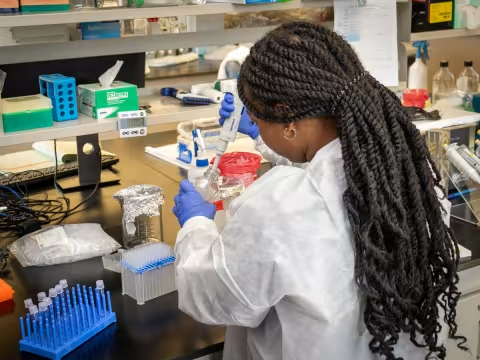
“Within the Mantis lab, we all come from different scientific backgrounds, so it’s great to be able to run ideas by each other and have other people you can rely on for help and support,” says Gianna Mirabile, a PhD student in the lab.
Mirabile is studying an antibody called F945, which was isolated from a patient with Lyme disease. Part of the F945 antibody is similar to fragments found in AL Amyloidosis. AL amyloidosis is a rare disease where antibody fragments aggregate and cause organ failure and death.
“Essentially, I’m investigating how F945 interacts with the bacteria that causes Lyme disease and whether it could aggregate similar to what is observed in AL Amyloidosis,” Mirabile explains.
For this work, Mirabile takes mutated forms of F945 and inserts them into the bacteria cells and human cells to see what happens when the antibodies come into contact with them. This requires her to be in the lab five days a week, and sometimes on the weekends if cells or bacteria need additional care throughout the research process.
“Studying the immunology of the most common vector-borne disease in the United States is extremely rewarding,” Mirabile says. “It not only affects people around the world, but right in our own backyards— and helping our local community is particularly important to me.”
As Lyme disease continues to impact the health of New Yorkers, research at the Mantis lab becomes increasingly vital. Atieh Shemshadian, an international PhD student from Iran, echoes this sentiment.
“Our research is pioneering a potentially groundbreaking approach to prevent Lyme disease transmission before it even reaches humans,” Shemshadian explains. “Unlike traditional vaccines that trigger immune responses after infection occurs, we're investigating a strategy that blocks the Lyme-causing bacteria right at the source—within the tick itself.”
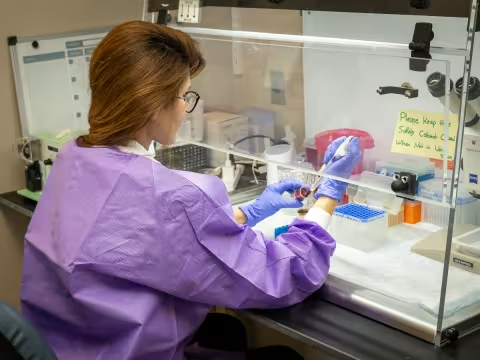
Shemshadian works directly with tick nymphs, juvenile ticks that are smaller than poppy seeds. One of her duties includes setting up and monitoring artificial tick feeding chambers, which mimic how a tick would feed in the wild. This allows Shemshadian and her fellow researchers to study infection transmission and more.
“They’re incredibly tiny, making every research aspect labor-intensive and demanding,” Shemshadian, who is in the lab every weekday and most weekends, explains. “We need to spend significant time and concentration to execute our procedures appropriately.”
Working in this controlled environment, the scientists at the Mantis Lab can trace specifically what happens during the transmission process, enabling them to examine which antibodies targeting specific proteins work the best at preventing the transmission of Lyme disease, and why they might be more effective than others.
“This work matters because it represents a paradigm shift in Lyme disease prevention—stopping infection at its earliest stage rather than fighting it after transmission to humans has already occurred,” Shemshadian says.