


UAlbany Environmental Engineering Student Seeks Cleaner Drinking Water + Pine Barrens Preservation

ALBANY, N.Y. (Oct. 5, 2026) — As Shyrill Mariano pursues a PhD in environmental and sustainable engineering at UAlbany’s College of Nanotechnology, Science, and Engineering, she’s gaining funding as she hones her skills as a researcher.
This year alone, Mariano earned an $18,000 Catskill Research Fellowship from the Catskill Science Collaborative and a $25,000 Graduate Research Innovation Award from the U.S. Department of the Interior. Each was the maximum allotment.
The fellowship funds a study of a spike in phosphorus in the West Branch Delaware River. In particular, Mariano and Associate Professor Rixiang Huang are examining erosion along the banks of the river and how that may hasten the flow of phosphorus into the river, which is part of the larger New York City watershed that supplies drinking water to more than 9 million residents.
The award supports research into how prescribed fires in the Albany Pine Bush Preserve impact nutrients in the soil and the growth of vegetation there. Based on the results, researchers will create scientific recommendations to guide future prescribed fires in pine barrens, a unique ecosystem that covers about 2 million acres in the East and Midwest.
Both projects exemplify science that serves society — a core mission of CNSE, home of the Department of Environmental & Sustainable Engineering. It also happens to be Mariano’s mission. Here are five things that define her as a student, researcher and future PhD.
Mariano brings many disciplines to her work. Her bachelor’s in geology and master’s in marine science helps her see the big picture in her current work. “I am able to appreciate how the molecular-level interactions I am studying now can influence a more complex system, such as the plant-soil system or an entire watershed,” she said.
Research brought her to CNSE. “It was not a program per se that I looked for but rather research that aligned with my skills and interests,” Mariano said. “It is also a Research-1 University, which meant I’d be immersed in an environment with high research activity that I felt would benefit my goal of becoming an independent researcher.”
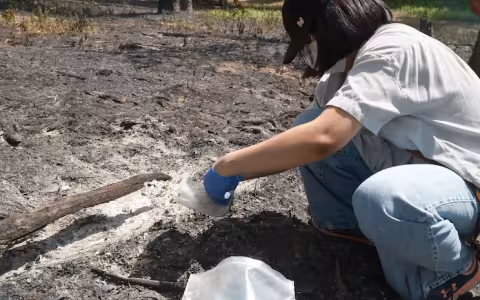
She’s a self-starter who sweats the details. Huang, her faculty advisor, describes Mariano as a fast learner who is professional, responsible and willing to tackle additional responsibilities, be it managing instruments or training undergrads. “She is becoming a relatively independent researcher and shows the potential to be a good scholar,” Huang said. “She sets a great example for what I expect of our PhD students.”
She yearns to teach. “Ever since I was a kid, I knew I’ve always wanted to be somewhere I could teach,” Mariano said. “Getting into university and meeting dedicated and inspiring educators have just strengthened this goal even more and my long-term goal has evolved to become a university professor.”
Her future lies in nature. When asked where she sees herself in five years, Mariano said, “Hopefully still out in the field, wearing protective gear, collecting soil or water samples. I hope to continue this path where I incorporate what we gather out in nature, investigate it in the lab and uncover these fundamental connections that can help us better understand how our ecosystems respond to disturbances.”