


Instructor for Next Engineers at UAlbany Brings Industry + Teaching Experience

ALBANY, N.Y. (Sept. 9, 2026) — George Reluzco draws on two careers when teaching high school students for GE Aerospace Foundation’s Next Engineers in the New York Capital Region.
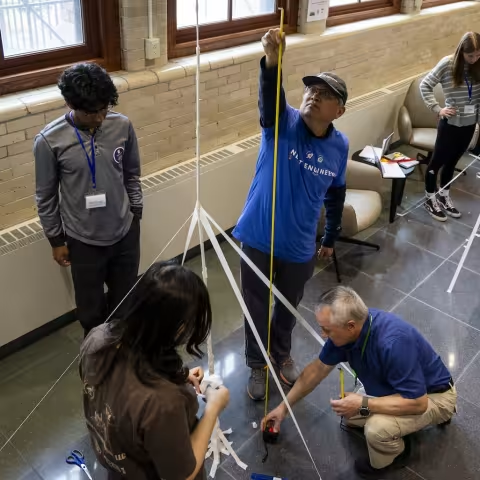
One was as a mechanical design engineer at GE, the other as a high school engineering and technology teacher. Both help him engage teenagers through a combination of slides, videos, informational sheets and hands-on challenges like building a tower out of just seven pieces of paper and masking tape.
Reluzco is an instructor for Engineering Academy, the high-school component of Next Engineers, which the College of Nanotechnology, Science, and Engineering at the University at Albany delivers in partnership with NY Creates. The other piece is Engineering Discovery, where the Museum of Innovation and Science brings engineering activities into local middle schools.
Collectively, the partners in the next four years will inspire some 4,000 students to pursue engineering education and careers. In an interview, Reluzco explains how his two careers prepared him for this challenge.
What first sparked your interest in Next Engineers?
I was particularly drawn to the program’s pragmatic, hands-on curriculum. The focus on frequent engineering challenges with students working together in small teams to solve open-ended problems is appealing.
What stands out to you about the first group in Engineering Academy?
They’re highly motivated and eager to learn about engineering. I’m pleasantly surprised to see their level of motivation while completing the engineering challenges. I see some very clever designs and solutions to the challenges we presented.
Early on, you asked them to establish standards of behavior for the whole group, including how to manage smart phones. What were you trying to instill?
Getting students to buy into the culture of learning that we all want in our classroom is important to address on the first day. Some of the methods I like to use include treating high school students like young adults and letting them develop and demonstrate their ability to be responsible and exercise self-control. Also, give them a sense of ownership of the classroom environment.
What are the keys to connecting with teenagers?
Engage them with ideas or concepts they have not seen before or fully understood. And to maintain that engagement, get them involved in hands-on activities where they can interact with other students. Yes, it’s important to discuss the underlying engineering concepts of a design challenge. However, the time students spend in their seats listening to the instructor needs to be balanced with hands-on time to design, build and test prototypes.
How would you describe your delivery?
Enthusiastic, animated and genuinely interested in the topics we discuss. For this type of program, where students are giving their own time to attend an event outside of school, I think it’s important to make it relevant to their lives. We want students to be able to see themselves in the role of an engineer or technician and to develop confidence in their ability to succeed in their career path.
For how long were you a high school teacher?
I taught high school technology and engineering classes at Mohonasen High School for 23 years. I covered topics such as computer-aided design, robotics, aerospace engineering, nanotechnology and machining. I also coached a FIRST robotics team for more than 10 years.
What did you love about it?
It was very rewarding to learn about topics that were new to me and share my curiosity and knowledge with students on a daily basis. Also, it was a pleasure to help students grow their understanding and skills and help them develop a career plan. One of the most satisfying parts of teaching is reconnecting with former students after they have launched their careers. I like to think I may have played a small part in guiding them along their path to success.
Before teaching, you were an engineer at GE.
Yes, I was a mechanical design engineer for 16 years on a variety of products including gatling guns, tank ammunition and rotating components for large steam and gas turbines. I was part of a larger team that designed, built and tested new products. My focus as an engineer was always design and testing.
How did that help you in the classroom?
It gave me a much better understanding of the processes and functions of an engineering team. One of the main themes of Next Engineers is the engineering design process, which I can speak to with many years of practice. My distinct career path as an engineer also has given me a deep appreciation for the career options available to engineers and technicians. I’m happy to help students explore their options when selecting a career and college.