





UAlbany Summer: Student Research Helps Scout Landing Sites in Race to Return to the Moon

By Bethany Bump
ALBANY, N.Y. (Aug. 28, 2026) — In the race to return humans to the moon, figuring out where to land is no small step.
That’s because this time around, more than half a century since humans last stepped foot on the moon, the players are no longer competing for flags or firsts. Instead, they’re looking to set up a permanent lunar base that can support everything from science and exploration to resource mining to a proving ground for sending astronauts to Mars and other areas of deep space.
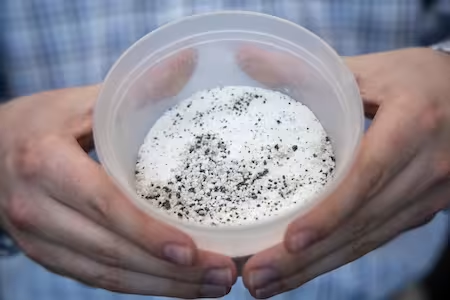
Collin Flynn, a UAlbany sophomore majoring in Electrical and Computer Engineering, is one of many people contributing to this 21st century space race. Working with Mustafa Aksoy, associate professor of Electrical and Computer Engineering in UAlbany’s College of Nanotechnology, Science, and Engineering (CNSE), he spent his summer characterizing the electrical properties of moon soil in support of NASA’s Artemis missions to return humans to the moon as early as 2028.
"We're getting data on how the soil reacts when we shoot microwaves at it and that allows us to figure out what materials are in the soil,” Flynn said. “Through these measurements, we can figure out how stable a surface is for building, as well as what resources are available. Do we have water so we can make oxygen, so we can drink, so we can breathe?"
It’s not easy to get ahold of actual soil from the moon, though. So Flynn worked with something known as lunar regolith simulants, which are Earth-made materials designed to mimic the chemical, mineral and physical properties of real moon soil collected during NASA’s Apollo missions in the 1960s and ‘70s.
His research was made possible thanks to CNSE’s Summer Undergraduate Research Program, which provides undergraduates from UAlbany and beyond with 10 weeks of structured, hands-on research experience in STEM fields ranging from semiconductors and microelectronics, artificial intelligence, biotechnology and bioengineering to quantum science, climate, sustainability, chemistry and more. The program saw a record number of applicants this year and expanded its reach to 57 students, up from 37 last summer.
“I want to go to grad school, and I knew this program would be a great way to get into a lab and build hands-on experience,” Flynn said.
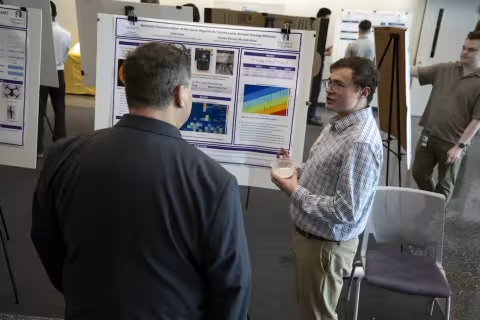
Microwaving Moon Soil
Flynn spent his summer shooting microwaves at moon soil in UAlbany’s Microwave Remote Sensing Laboratory.
Using an advanced microwave network analyzer and temperature-controlled chamber, his aim was to measure the soil’s permittivity — or how it responds to electromagnetic energy. Because every material responds to this energy differently, researchers can use permittivity to infer which materials are on the moon as well as beneath its surface. By measuring how known materials respond to microwaves, they can also calibrate how unknown materials are later identified remotely. This leads to improved subsurface mapping, resource identification and site selection for when astronauts return to the moon.
The simulants used in Flynn’s study mimic materials found on the moon such as silicon, titanium and aluminum.
“There’s the NASA aspect — they want to go there for research,” he said. “But there’s also a commercial aspect. These materials are very valuable. Silicon can be used for chips, and titanium is a very strong metal that can be used in a lot of different applications.”
South Pole Exploration
The soil was blasted with microwaves across a range of frequencies and temperatures. Due to its lack of atmosphere, the moon’s surface swings from about minus 400 degrees Fahrenheit to 250 degrees Fahrenheit, with the most extreme cold found in the permanently shadowed craters near the South Pole. This area is of particular interest to NASA because its deep ancient craters contain trapped water ice that could be converted into drinking water, oxygen and rocket fuel.
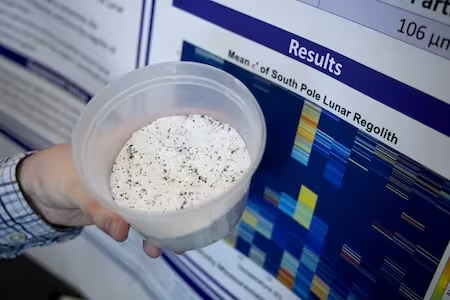
"Nobody has ever been there, so we don't really know what it's like except for satellites," Flynn said.
The project is currently self-funded within Aksoy’s lab, and builds on an earlier two-year grant from NASA that supported its theoretical foundation, Aksoy said.
“The goal in the future is to apply for bigger grants from NASA, or collaborate with growing commercial space industry,” he said.
For Flynn, a Ballston Spa High School graduate who caught the engineering bug through an Early College in the High School program, the project helped sharpen his research skills. His long-term goal is to work as a computer engineer building hardware such as embedded systems and integrated circuits.
“I want to be making the things you see making a difference in the world,” he said.