





CTG UAlbany, CDTA Explore AI Tools for Bus Shelter Maintenance

ALBANY, N.Y. (June 2, 2026) — For Capital District Transportation Authority (CDTA), keeping track of conditions at hundreds of bus shelters across the Capital Region poses a constant logistical challenge.
Now, researchers and students at the University at Albany’s Center for Technology in Government (CTG UAlbany) are helping CDTA address that challenge using mobile sensors and artificial intelligence.
Through an ongoing partnership, CTG UAlbany has adapted its Community Asset Tracker platform to identify maintenance conditions at bus shelters using AI-enabled camera sensors mounted on CDTA buses.
From detection to decision making
The pilot project focuses on detecting issues such as graffiti, broken glass, garbage, snow and ice accumulation and overflowing trash bins while developing dashboard tools that can help CDTA staff prioritize maintenance decisions.
“The Community Asset Tracker was originally developed to help local governments monitor public infrastructure and community conditions in real time,” said Derek Werthmuller, director of technology innovation and services at CTG UAlbany. “Building on our earlier work with the city of Schenectady, this partnership with CDTA allows us to explore how AI-generated data can support operational decision making in a public transit environment.”
The work also provides UAlbany students with opportunities to apply classroom learning to real-world technology challenges facing local governments and public organizations.
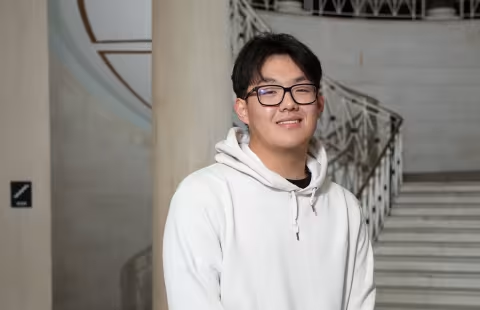
Kelvin Cai, a rising senior from Brooklyn double majoring in computer science and digital forensics, has worked on the Community Asset Tracker project since his first year at UAlbany. As a research assistant with CTG UAlbany, Cai helped in the data preparation phase, the AI model training processes, and the software development supporting the CDTA project.
“The CDTA bus shelter project is a project by CTG at UAlbany to help the CDTA optimize the management of their bus shelters by using a computer vision model to automate the identification of key assets such as trash, snow, graffiti and other conditions,” Cai said. “This aims to help CDTA identify specific shelters that require cleanup and create more efficient routes for staff.”
Cai said his experience working with CTG has helped broaden his understanding of how AI can support organizations and communities beyond consumer-facing technologies.
“Most people are familiar with AI as a chatbot, but CTG uses AI to solve practical real-world problems,” Cai said.
Cai said UAlbany stood out because it offered an affordable pathway to earning his degree while allowing him to pursue his interest in technology. He began as a computer science major before adding digital forensics as a second major after discovering an interest in the intersection between technology and investigative problem solving.
He also credits UAlbany’s Educational Opportunity Program with helping him transition into college life and build momentum early in his academic career.
“I truly believe my success was a result of the momentum EOP gave me when I first started at UAlbany,” Cai said.
This summer, Cai will continue his work in cybersecurity and technology through a FedRAMP and cloud security internship with Motorola Solutions while continuing his position with CTG UAlbany.
Research in service of communities
“This partnership with CTG UAlbany reflects CDTA’s commitment to leveraging innovation to improve our operations and the customer experience,” said Christopher Desany, Chief Operating Officer at CDTA. “It is especially meaningful to me, having worked with CTG while completing my master’s degree studies in computer science many years ago, to see how their capabilities have evolved to support real-world applications like this. By using AI and timely data collection, we can more proactively identify maintenance needs, deploy our resources more efficiently, and ensure that our bus shelters remain safe, clean and welcoming. We’re also proud to support opportunities for students to apply emerging technologies to real-world challenges in our community.”
For J. Ramon Gil-Garcia, director of CTG UAlbany and professor in UAlbany’s Rockefeller College of Public Affairs and Policy, the CDTA partnership demonstrates how applied research projects can connect new technologies with real operational needs in the public sector.
“Artificial intelligence is creating new opportunities for governments and public organizations to improve services and respond to community needs,” Gil-Garcia said. “CTG UAlbany works alongside partners like CDTA to explore how those technologies can be applied in practical ways that support better decision making, create public value and provide students with opportunities to work on real-world challenges facing communities and organizations.”
Future work could include expanding sensors to additional buses, refining the dashboard system and continuing to improve the AI model using additional real-world imagery collected across the CDTA service area.