





Grads at a Glance: Passion for Tiny Materials Leaves Big Impact
By Bethany Bump
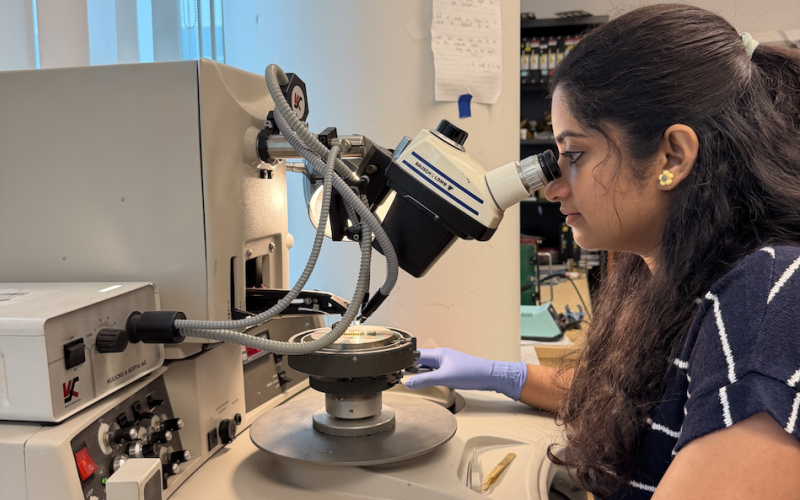
ALBANY, N.Y. (May 14, 2026) — The contrast between impact and scale is a big reason Soumya Kollipara was drawn to nanoscience, a field devoted to the study of very tiny things.
“Once I started learning how much you could change about the world by playing with stuff at the nanoscale, I was hooked,” she said.
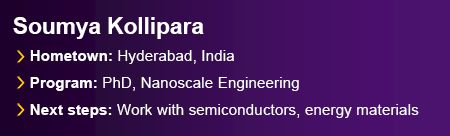
Kollipara will graduate later this year from UAlbany’s College of Nanotechnology, Science, and Engineering (CNSE) with a PhD in Nanoscale Engineering — a journey that began six years ago when she left her hometown of Hyderabad, India with a master’s degree in nanotechnology, drawn by UAlbany’s global renown in nanotechnology and semiconductors.
“I read about CNSE and how the University and the semiconductor industry basically live under the same roof here. That blew my mind — the idea that you could be doing your PhD research a few steps away from real fab tools and industry partners was exactly the kind of place I wanted to be,” she said.
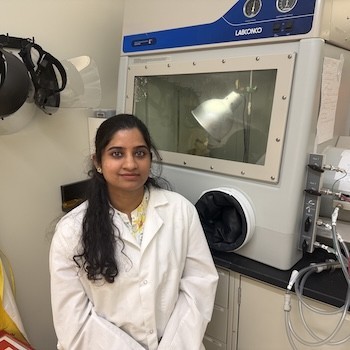
Her first project when she arrived in Albany, working under Professor James Lloyd, involved reliability testing of radio-frequency microelectromechanical systems (MEMS) switches. She would go on to intern for NY Creates, owner of the Albany NanoTech Complex that houses CNSE’s Nanoscale Science & Engineering department, as well as semiconductor industry partners Xallent and Applied Materials, also housed there.
Kollipara’s research was advised by Professor Harry Efstathiadis and focuses on solid-state batteries, a next-generation energy storage solution that “sits at the sweet spot between cool science and real impact,” she said.
“Better, safer batteries mean cleaner energy, longer-lasting devices, and a more sustainable future and the fact that the tiny material choices I’m making in lab could eventually show up in something people actually use is a pretty amazing motivator,” she said. “Plus, working at the nanoscale never really gets old.”
After UAlbany, Kollipara plans to continue working in semiconductors and energy materials — whether that will be more battery work, semiconductor process development or something in between, she hopes to continue research in areas with real-world impact.
“Looking back, UAlbany has shaped me in ways I never would’ve guessed when I first landed here from Hyderabad,” she said. “More than anything, this is where I really became independent. Moving across the world for grad school taught me how to figure things out on my own, both in lab and in life, and to trust my own judgment.”