


Moot Court Program Returns to UAlbany with April Tournament

By Indiana Nash
ALBANY, N.Y. (April 16, 2026) — Twenty-three School of Criminal Justice students have been grappling with tough and timely legal questions this semester as they gear up for the undergraduate Moot Court Tournament.
Set for Friday, April 24, and Saturday, April 25, it marks the return of the moot court program, which has been dormant since the pandemic and previously ran in partnership with Albany Law School.
Moot court is a simulated oral argument before the United States Supreme Court, with two teams arguing a hypothetical case, and judges pressing each with tough questions about their legal arguments. The case featured in this year’s tournament involves topical Fourth Amendment issues around privacy and Eighth Amendment issues around the virtual life sentencing of juveniles who commit serious crimes.
Competing can be nerve wracking for students, considering it's often their first time presenting oral arguments. There is a benefit to facing that challenge, according to Visiting Assistant Professor Stephen Hogan, who is leading the program.
“We expect them to be a bit intimidated. That is part of the experiential learning process. We want them to be nervous, breathe and push through it.” Hogan said.
That was the experience of attorney and School of Criminal Justice alum Steven DeBraccio ’10.
“I have argued at every appellant department in this state,” DeBraccio said. “I still get those butterflies when I walk up to the podium, just as I did when I was 19 and I did this competition.”
He competed in 2009, when the program was led by Professor James Acker, and returned to judge the competition and others in the Northeast from 2010 to 2019.
“It was really a wonderful experience, particularly given the fact that that's what I do for a living now. I'm an appellate attorney, so basically I give oral arguments to judges. I use a lot of those skills today,” DeBraccio said. “I learned a lot about being interactive, being flexible, gently guiding the judge toward the argument, and essentially letting the argument go where they take it.”
The tournament rounds out the moot court class Hogan is teaching, along with doctoral teaching assistant Nidhi Panicker. The spring tournament is just the first step in a wider plan to expand the program. In the fall, Hogan plans to lead a travel team of UAlbany students to compete in bigger competitions and eventually work with Albany Law School to organize a local tournament. The partnership would build on a former tradition known as the “Theodore T. Jones, Jr. Undergraduate Students of Color Moot Court Competition," which began in 2016.
Throughout the class, Hogan and Panicker have noticed students gaining not only intellectual skills but also self-confidence.
“I think that is one of the things I'm so excited to see in the competition, it's the joy of seeing the change in them. And moot court definitely does that,” Panicker said.
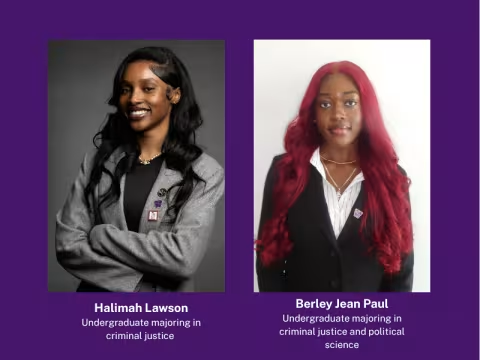
One such student is Berley Jean Paul, a sophomore and double major in criminal justice and political science, with a concentration in American politics.
“As an introvert, I actively seek out opportunities that will force me out of my comfort zone, help me improve my public speaking and advocacy skills, and provide me with the ability to effectively work on a team,” said Jean Paul, who aims to become an attorney. “This course seemed like a great way to strengthen my legal analysis, debate and oral advocacy skills, which are necessary to master in my pursuit of attending law school.”
She has spent hours reading and memorizing the assigned case, and studying the corresponding precedent cases aligned with the position she has been tasked with. She has also leaned into watching examples of moot court arguments on YouTube.
That kind of dedication is what made DeBraccio want to return to judge the competition this year.
“I know how hard the students work all semester, and I want to match their level of preparation to do my very best to make sure that the most deserving students and best arguments win,” DeBraccio said.
Halimah Lawson, a senior criminal justice major who will also be competing in the tournament, was looking for something to push her out of her comfort zone.
“I’ve learned the importance of a strong oral argument and knowing the details inside and out. The class has helped me think strategically, anticipate questions, and present arguments clearly, which has been invaluable,” Lawson said.
In the lead up to the tournament, she has pored over the case materials, read the book “How to Please the Court,” and written a case brief.
“I feel confident but also a little nervous. The judges can ask questions at any time, and there’s a lot to remember, but I know that preparation is key,” Lawson said.
DeBraccio’s advice for students preparing for the competition:
- Review the cases carefully, try to link cases together — what makes them similar, what makes them different.
- The best arguments are not spontaneous, not quotes from the cases per se, but rather organic thought from the attorneys.
- Listen carefully to your adversary's arguments and, if you're the respondent, respond to their arguments. There's something to be said for actually addressing the point that the attorney stated.
The finals are set to run from 2-3:30 p.m. on Saturday, April 25 at the Husted Hall Amphitheater and are open to anyone who would like to attend. Event details are available on the University calendar.