

Caring for the Community: 5Q with Clinical Psychology PhD Student Vanessa Aryee

By Erin Frick
ALBANY, N.Y. (Jan. 26, 2026) — University at Albany’s Vanessa Aryee, a second-year PhD student studying clinical psychology, is among the team of student clinicians serving local community members at UAlbany’s Psychological Services Center.
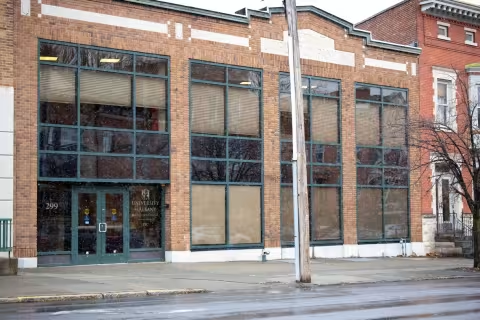
With offices located in Downtown Albany, the Center is a community-based training and research clinic that provides affordable psychological care to children, adolescents and adults in the Capital Region. Offering psychotherapy, counseling and assessment services, its mission is twofold: to deliver high-quality, evidence-based mental health care while serving as a rigorous training ground for doctoral students in UAlbany’s clinical and counseling psychology programs.
Note: If you are a current student in need of counseling, please contact Counseling & Psychological Services (CAPS). The Psychological Services Center does not provide direct services to UAlbany students.
After starting her academic career on the pre-med track, Aryee shifted to psychology when she noticed a need for more research on mental health and mental health stigma in minoritized communities. This led her to pursue a number of research experiences as an undergraduate, including one which focused on developmental psychology and childhood learning in Latinx and Black families, and another that examined cultural and environmental factors affecting mental health and wellbeing in underserved communities.
Aryee is now building clinical experience working with clients at the Psychological Services Center while pursuing research as part of the Family and Baby Development Lab led by UAlbany’s Betty Lin.
We caught up with Aryee to learn about her work at the Psychological Services Center, what she's studying in her latest research pursuits, and how her research informs her approach to care.
What brought you to UAlbany?
What attracted me most was the work of Associate Professor of Psychology Betty Lin, specifically her research looking at risk and resiliency factors that affect children and families from disenfranchised communities. Her research aligns closely with my interest in examining the socio-cultural contexts that shape mental health care. Working with Dr. Lin on her “Birth and Beyond” study has offered the best of both worlds — enabling me to engage with these topics through research, and apply insights acquired during the research process while working with clients at the Psychological Services Center.
What does your work in the ‘Birth and Beyond’ study involve?
This study is focused on currents that shape Black maternal health, with special attention to risk factors that contribute to disparities in health outcomes among Black mothers and their infants. We conduct interviews and collect physiological data, looking at things like culture, family and community as well as resilience and risk mechanisms that either promote or hurt health equity in Black families. We recruit mothers and families from the Albany area and follow them through the pregnancy and postpartum period.
The experience so far has been profound. During our psychosocial interviews, we speak with the mother and sometimes the father about the different supports and stresses in their lives. Often, these conversations are the first time that families are discussing these factors explicitly. It's been rewarding to create a space for Black birthing parents to discuss these things, and it's deepened my understanding of the broader systemic, social and ecological factors that affect Black maternal health.
This work is closely tied to my thesis research, where I'm examining whether there's an association between economic hardship and emotion dysregulation, and how that association might be impacted by discrimination and social support.
What is the Psychological Services Center?
The Psychological Services Center is a community-based clinic where UAlbany doctoral students — working under the supervision of UAlbany faculty members who are licensed psychologists — provide psychological care to children and adults. We offer assessment, as well as short- and long-term individual, couple and family counseling. The process starts with a phone call where we determine if the Center is a good fit for the client’s needs. This is also when we explain the structure of our clinical care and training model. We are a community resource — anyone seeking mental health care is welcome to give us a call.

How has your experience at the Center shaped your view of clinical work?
For each session, I meet with my clients individually, then, afterwards, I review the session with my faculty mentor Professor Mitch Earleywine. This training model is effective because it allows space to develop skills as a clinician, knowing that there will be close oversight to ensure that patients are receiving the highest quality of care possible.
I was a little nervous when I first started doing clinical work, but it soon felt really natural to me and that confirmed that this is what I want to do. Working with clients has been such a rewarding experience. Even as an early clinician, I feel like I am able to apply evidence-based skills in order to help clients — whether they are going through a transition or trying to regulate some sort of challenge they are facing.
It is especially meaningful to work with diverse clients and consider how aspects of their identity — their culture, faith, spirituality or familial background — might play a role in their symptom presentation, how they think about their symptoms and how I can help them most effectively. These sorts of considerations are at the heart of culturally responsive care and affirm the fact that my identity also plays a part in the type of clinician I am.
What would you like to see more of in the field of mental health care?
Two things that I believe in deeply are using the latest research and evidence-based best practices to guide your work. I also believe in providing culturally responsive care.
Recently at the Center, there has been a change where we are now able to use data that we gather from clients who give consent for research purposes. I think that using data to inform best practices is critical. Staying actively involved in research is not only interesting to me personally, but also helps ensure that I will always be up to date on the latest best practices in treatment strategies.
Culturally adapted interventions are still very new, and this is an active area of mental health research that I am interested in. Using clinical work to inform research, especially efforts aimed at improving intervention and prevention methods, is a great way for clinicians to strengthen their own practice. The same can be said for incorporating culturally responsive strategies. I see this intersection playing out through my work at the Psychological Services Center and my research at the University. When a client gives consent for their information to be used in our research, they are doing a tremendous service to the field. The more data we have, the more rigorous our research can be. And this results in better care for everyone.