





Students Tackle Global Air Quality Challenges Through CNSE Summer Research Program

ALBANY, N.Y. (Aug. 14, 2025) — When Kaleesha Pierre began her summer research internship, she knew she wanted to make a difference in the place she calls home. The rising sophomore in Environmental and Sustainable Engineering at the University at Albany’s College of Nanotechnology, Science, and Engineering (CNSE) grew up in the South Bronx, a community long affected by poor air quality and inadequate building ventilation.
In July, Pierre presented her findings from this year’s NSF-funded International Research Experiences for Students (IRES) program, held in Montreal, comparing indoor air quality data from homes there with similar measurements she collected in the South Bronx. Her work revealed similarities in the data collected in both cities when comparing high- and low-income housing — particularly sharp spikes in pollutants during cooking in lower-cost units, apparently driven by poor ventilation.
“A lot of older buildings in the South Bronx, which is a low-income area, don’t have good ventilation or air quality,” Pierre said. “I want to raise awareness about the potential harms to the people of my community.”
Her project, “Assessing Air Quality Disparities between Low- and High-Income Homes in Montreal and the South Bronx: Role of Building Materials, Ventilation, and Socioeconomic Conditions,” involved deploying 10 air quality sensors — five in Montreal, five in the Bronx — to monitor concentrations of fine particulate matter in living rooms and bedrooms where residents spend most of their time. The results pointed to consistent pollution spikes during meal preparation.
'“This spike during times of cooking is really bad,” Pierre explained while pointing to a chart on her poster. “What we can tell is that we don’t have sufficient ventilation in this apartment.”
Hands-On Learning Through NSF-Funded Research
The IRES program is one of two NSF summer research opportunities overseen by CNSE Assistant Professor Md. Aynul Bari. It offers undergraduate and graduate students a ten-week opportunity to engage in international research on emerging air quality issues. This year’s group of students traveled to Montreal to collaborate with faculty and researchers at Concordia University and McGill University, gaining firsthand experience with using low-cost sensors and satellite remote sensing techniques.
The second NSF-funded program, the Research Experiences for Undergraduates (REU) Site: Atmospheric Research and Engineering Solutions for Climate Change and Environmental Challenges, is also managed by Bari in collaboration with Scott Miller, senior researcher at UAlbany's Atmospheric Sciences Research Center.
The REU program brings together groups of undergraduates for a ten-week immersion in research on climate change, atmospheric sciences, and environmental engineering. This summer, students from eight U.S. universities took part in research seminars given by faculty mentors in the first two weeks, conducted independent research, attended professional development activities and prepared abstracts and presentations for conferences and symposia.
Collaboration across borders
Both programs reflect CNSE’s commitment to developing a diverse, globally engaged STEM workforce ready to address some of the world’s most pressing environmental problems. Students gain not only technical skills, such as sensor deployment, laboratory methods and data interpretation, but also experience in cross-cultural collaboration, professional communication, and leadership.
“The IRES program offers students the opportunity to gain international research experience, enhance their competencies in intercultural communication, professional adaptability and strengthen our collaborations with international institutions,” said Bari.
Pierre said she was drawn to CNSE for its cutting-edge research opportunities and faculty mentorship. The chance to connect her academic work directly to her own community made the summer especially meaningful, as she works toward a career as an environmental engineer.
"I grew up in a Caribbean household in the South Bronx with my mom, who's a single mother, my older sisters and my niece," said Pierre, reflecting on how the family lived together in a two-bedroom apartment. "My mom raised my sisters and I to be independent and focus on our goals and education."
Now at UAlbany, Pierre has benefited from a strong support structure both at school and at home.
"Despite my family's challenges throughout life, I still strive to do good in this world," said Pierre. "I have a constant reminder that I am not alone and will forever have a community to support me."
From classroom skills to real-world impact
Her research contributes to a broader effort by UAlbany and its partners to address environmental justice issues. Low-income and minority communities are often disproportionately affected by poor air quality and other environmental hazards. By documenting these disparities, researchers aim to inform policy, improve building standards and promote public health.
“A significant focus of research at UAlbany, including in our college, is to advance knowledge in ways that quickly translate into a benefit to society. The IRES and REU programs that are based in our Department of Environmental & Sustainable Engineering are clear examples of that. These and similar experiential learning opportunities allow students to connect the classroom to the real world and to interact with peers from different disciplines and life experiences than their own. And of course, the overall goal is to prepare graduates for the next stage in their careers pathway — whether that is graduate school or a first job in their chosen field,” said CNSE Dean Michele J. Grimm.
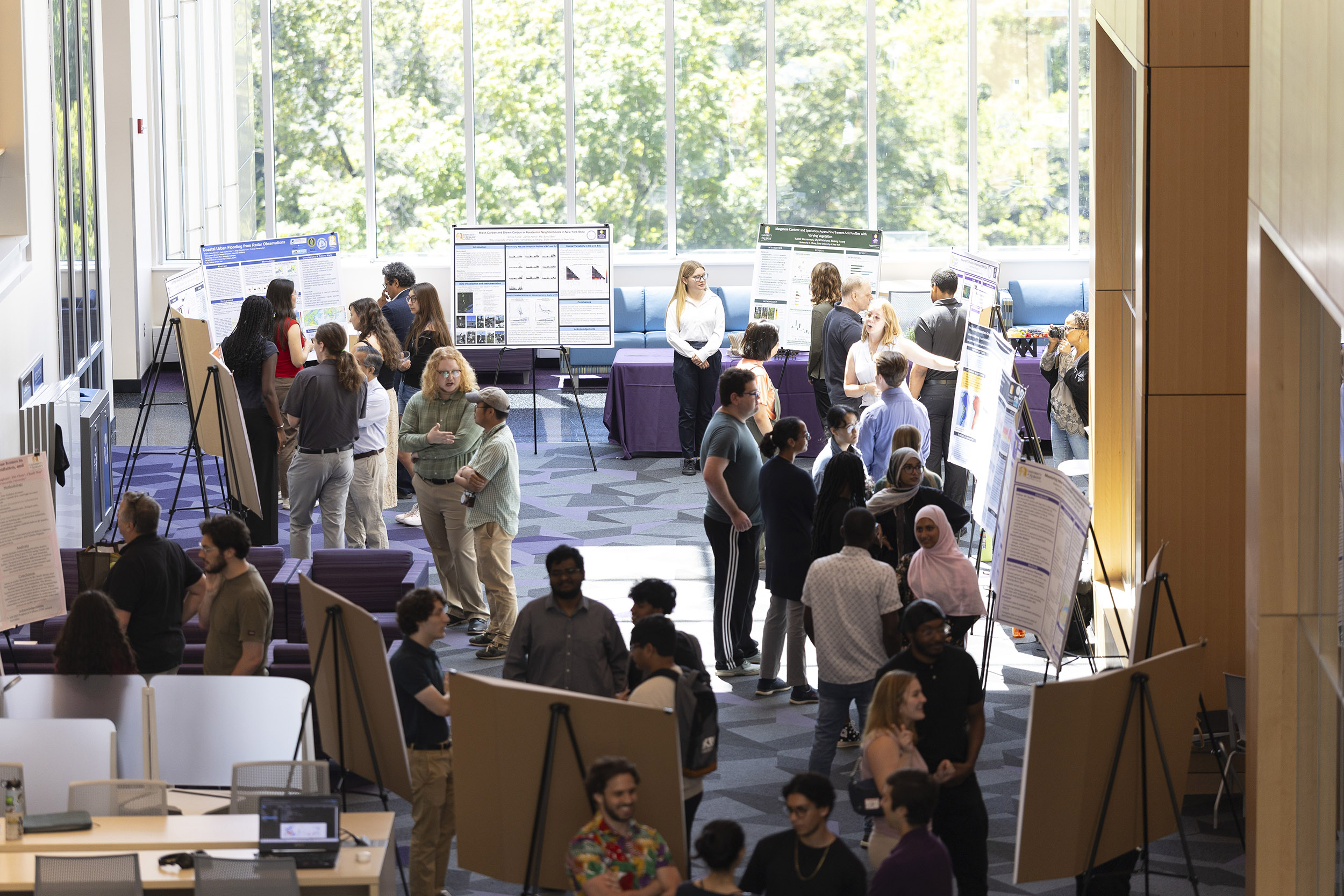
The summer concluded with a vibrant poster presentation at UAlbany, where Pierre and peers from both the IRES and REU programs shared their findings. Projects ranged from wildfire smoke modeling to sustainable engineering innovations.
“These programs give students the tools and experiences they need — not only to succeed in STEM, but also to tackle the real-world environmental challenges their generation will face,” Bari said.
For Pierre, this summer was just the beginning. “This is just the start,” she said. “I want to keep working on projects that can make life better for people in my community, and communities like it around the world.”